
50 Fascinating Facts About Africa: Cradle of Humanity
Embark on a journey through fascinating facts about Africa, the world’s second-largest continent. From its rich cultural heritage to its diverse landscapes and wildlife, Africa is a land of contrasts and wonders. Let’s explore the unique features that make this continent truly remarkable.
Africa Facts At-a-Glance
Location: Straddling the equator, bordered by the Mediterranean Sea, Red Sea, Indian Ocean, and Atlantic Ocean
Population: Approximately 1.4 billion (2023 estimate)
Area: 30.37 million square kilometers (11.7 million square miles)
Languages: Over 2,000 languages spoken
Religion: Diverse, including Christianity, Islam, and traditional African religions
Climate: Varies from tropical to subarctic on its highest peaks
Sources: UN Data, African Union, World Bank (Sub-Saharan Africa)
Geography and Natural Wonders
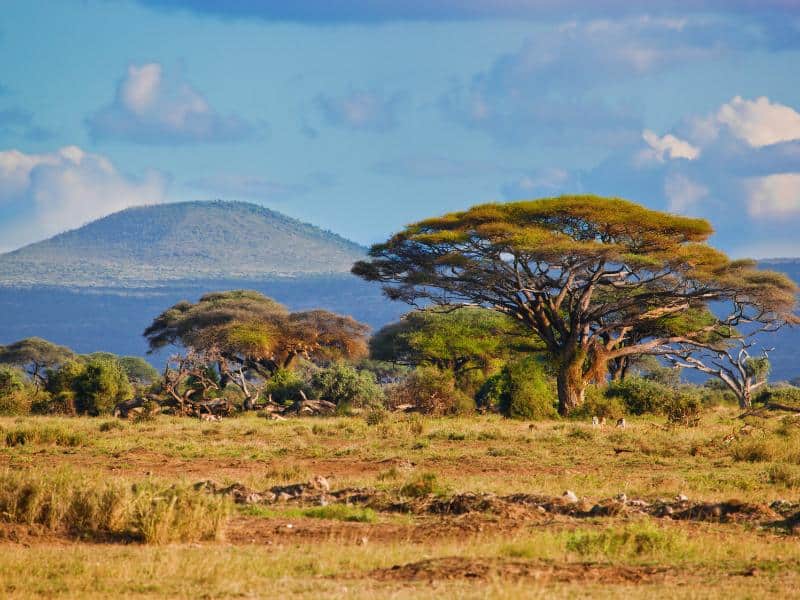
Africa’s diverse landscape encompasses everything from vast deserts to lush rainforests, offering a wealth of natural wonders.
- The Sahara Desert, covering about 3.6 million square miles (9.2 million square kilometers), is the world’s largest hot desert and spans 11 countries. Despite its harsh conditions, it’s home to over 2.5 million people.
- Mount Kilimanjaro in Tanzania stands at 19,341 feet (5,895 meters) and is Africa’s highest peak. Unlike most tall mountains, it’s not part of a mountain range but stands as the world’s tallest free-standing mountain.
- The Nile River, stretching 6,650 kilometers (4,132 miles), is the world’s longest river. Its basin covers about 10% of Africa’s landmass and provides water to 11 countries.
- Victoria Falls, locally known as “Mosi-oa-Tunya” (The Smoke That Thunders), creates a curtain of falling water 1.7 kilometers wide and 108 meters high. During peak flow, over 500 million liters of water cascade down every minute.
- The Congo Basin rainforest spans six countries and absorbs about 1.5 billion tons of CO2 annually. It contains over 10,000 plant species, 1,000 bird species, and 400 mammal species, many found nowhere else on Earth.
Wildlife and Biodiversity

Africa is home to an incredible array of animal and plant species, many of which are found nowhere else on Earth.
- The African elephant, the world’s largest land animal, can weigh up to 6 tons and consume up to 300 pounds of food daily. Their complex social structures include matriarchal leadership and they can recognize the calls of up to 100 different elephants.
- The cheetah, Africa’s speed champion, can accelerate from 0 to 60 mph in just 3 seconds and maintain speeds of up to 70 mph (112 km/h) for short bursts. Their spines act like springs during running, and their bodies have specialized adaptations for oxygen intake.
- Madagascar, which separated from mainland Africa about 160 million years ago, is a biodiversity hotspot with over 90% of its wildlife found nowhere else on Earth. Besides its famous lemurs, it has 300+ species of frogs and 260+ species of reptiles that are unique to the island.
- The giraffe, Africa’s tallest animal, has a heart that weighs up to 24 pounds and can pump blood up its long neck against gravity thanks to specialized valves and elastic arteries. Their tongues can extend up to 21 inches to reach high branches.
- The Great Migration across Tanzania’s Serengeti and Kenya’s Maasai Mara involves over 2 million wildebeest, zebras, and gazelles traveling nearly 1,000 kilometers annually in search of water and fresh grazing. This circular migration pattern between the two countries is visible from space.
Explore the Great Migration Countries:
History and Ancient Civilizations

Africa has a rich history dating back millions of years, with some of the world’s oldest civilizations originating on this continent.
- Homo sapiens originated in Africa approximately 300,000 years ago, as evidenced by fossil discoveries in Morocco’s Jebel Irhoud. DNA studies suggest all humans alive today descended from a population that lived in Africa about 60,000-70,000 years ago. [Learn more: 38 Fascinating Facts About DNA: Life’s Blueprint]
- Ancient Egypt’s civilization began around 3100 BCE and lasted for over 30 centuries. The Great Pyramid of Giza, built around 2560 BCE, remained the tallest human-made structure in the world for nearly 4,000 years until the completion of Lincoln Cathedral in England.
- The Kingdom of Kush ruled from what is now Sudan for over 1,000 years and even conquered Egypt, establishing the 25th Dynasty of Pharaohs. Their pyramid-building tradition resulted in more pyramids in Sudan than in Egypt, though they’re smaller in size.
- Timbuktu, founded around 1100 CE, became a legendary center of Islamic scholarship with universities that predated many European institutions. Its libraries held over 700,000 manuscripts on subjects ranging from astronomy to medicine and philosophy.
- The ancient city of Great Zimbabwe, built between the 11th and 15th centuries, featured walls up to 36 feet tall constructed without mortar. As the capital of the Kingdom of Zimbabwe, it was part of a trading network that extended to China and the Middle East.
Explore More African Countries In Depth:
- 35 Interesting Facts About Zimbabwe You Might Not Know
- 35 Interesting Facts About Egypt: Ancient & Modern
- 10 Interesting Facts About Sudan: Africa’s Hidden Gem
- 32 Interesting Facts About Morocco: The Gateway to Africa
- 35 Fun Facts About Algeria: North Africa’s Gem
- 10 Interesting Facts About Gabon: Africa’s Green Heart
- 35 Interesting Facts About Uganda: Explore the Pearl of Africa
Cultural Diversity

Africa’s cultural landscape is incredibly diverse, with thousands of ethnic groups and languages across the continent.
- Africa is home to over 3,000 distinct ethnic groups and more than 2,000 languages, representing nearly a third of the world’s languages. Nigeria alone has over 520 languages, making it one of the most linguistically diverse countries globally.
- The San people of southern Africa have genetic markers that identify them as one of the oldest populations of modern humans, with their distinct lineage dating back over 100,000 years. Their languages feature unique clicking sounds produced by pulling air between the tongue and the roof of the mouth.
- The Dogon people of Mali have had detailed knowledge of the Sirius star system for centuries, including awareness of Sirius B, a white dwarf star invisible to the naked eye. Their traditional masks and wooden sculptures are considered masterpieces of African art. [Learn more: 10 Interesting Facts About Stars: Cosmic Wonders]
- Africa’s oral tradition of storytelling, maintained by griots or professional historians, has preserved cultural knowledge and historical records for centuries. A single griot might memorize and recite stories that would fill over 100 books.
- The Ethiopian Orthodox Church maintains a different calendar with 13 months and celebrates Christmas on January 7th. It claims to possess the Ark of the Covenant in a chapel in Aksum, guarded by a single monk who never leaves the grounds.
Modern Africa
Today’s Africa is a continent of rapid change, economic growth, and increasing global influence. These compelling facts about Africa challenge outdated perceptions and reveal a dynamic region shaping the 21st century.
- Africa has the youngest population in the world, with a median age of 19.7 years compared to the global median of 31. By 2050, one in four global citizens will be African, dramatically changing the world’s demographic makeup.
- Lagos, Nigeria’s economic hub, adds about 77 people per hour to its population and is projected to become the world’s largest city by 2100 with potentially over 88 million residents. It already produces 25% of Nigeria’s GDP.
Suggested Read: 30 Fascinating Facts About Nigeria: West African Giant
- The African Continental Free Trade Area (AfCFTA), launched in 2021, created a market of 1.3 billion people with a combined GDP of $3.4 trillion. When fully implemented, it’s expected to lift 30 million Africans out of extreme poverty.
- Rwanda achieved one of the most dramatic economic transformations, growing from a country devastated by genocide in 1994 to one with an average annual GDP growth of 7.5% between 2000 and 2019. It’s now a leader in digital infrastructure and environmental initiatives.
- Africa’s mobile money revolution has allowed millions to access financial services for the first time. As of 2022, Sub-Saharan Africa accounts for more than 70% of the $1 trillion transacted globally through mobile money platforms.
Natural Resources

Africa is rich in natural resources, from precious metals to oil and rare earth elements.
- The Democratic Republic of Congo supplies about 70% of the world’s cobalt, essential for rechargeable batteries in electric vehicles and electronics. A single smartphone contains cobalt worth approximately 5-10 cents from Congolese mines.
- South Africa’s Bushveld Complex contains about 80% of known global platinum reserves and 90% of the world’s platinum group metals. These metals are crucial for catalytic converters, electronics, and emerging hydrogen fuel cell technologies.
- Africa holds about 30% of the world’s mineral reserves, including 40% of gold, 60% of cobalt, and 90% of platinum group metals. Despite this mineral wealth, the continent accounts for only about 5% of global GDP. [Learn more: 10 Interesting Facts About Gold: Precious Metal Secrets]
- Botswana transformed from one of the world’s poorest countries to an upper-middle-income economy largely through diamond mining and strong governance, contrasting with countries like Sierra Leone where diamond wealth has historically been more challenging to translate into development.
- Morocco’s phosphate reserves, estimated at over 50 billion tons, represent about 75% of global reserves. As a key component in fertilizer, these deposits play a crucial role in global food security.
Technological Advancements
Africa is embracing technology and innovation, leapfrogging traditional development stages in many areas.
- M-Pesa, launched in Kenya in 2007, revolutionized financial services in Africa by allowing money transfers via mobile phones. By 2023, it served over 51 million customers across seven countries, processing transactions worth over 50% of Kenya’s GDP annually.
- Rwanda’s drone delivery system, launched in 2016, can deliver blood and medical supplies to remote hospitals within 30 minutes. The drones can fly in all weather conditions and have reduced delivery times from 4 hours to an average of 30 minutes.
- The Square Kilometre Array (SKA) being built across South Africa and Australia will be the world’s largest radio telescope, capable of detecting radio signals from the earliest moments after the Big Bang. South Africa has already built the 64-dish MeerKAT array as a precursor.
- Africa’s tech startup ecosystem grew six times faster than the global average between 2015 and 2022. Countries like Nigeria, Kenya, Egypt, and South Africa have emerged as major tech hubs, with startups raising billions in venture capital funding.
- Solar energy adoption is accelerating across Africa, with costs dropping by over 80% in the last decade. Off-grid solar solutions now provide electricity to over 125 million Africans previously without power, transforming rural communities.
Discover the Remarkable Continents of Our Planet
Across our world’s seven continents, you’ll find extraordinary ecological diversity, rich cultural heritage, and remarkable human achievements that have shaped our global story throughout millennia.
- 60 Essential Facts About Europe: A Continental Journey
- 75 Amazing Facts About Asia: Land of Diversity
- 55 Interesting Facts About North America: A Diverse Continent
- 50 Fascinating Facts About South America: Land of Wonders
- 35 Fun Facts About Australia: Discover The Land Down Under
- 50 Amazing Facts About Antarctica: Icy Wonders
Unique Phenomena

Fascinating facts about Africa reveal a continent home to several unique natural and cultural phenomena found nowhere else on Earth, from geological wonders to extraordinary ecosystems.
- The Danakil Depression in Ethiopia sits 410 feet below sea level and can reach temperatures of 125°F (52°C). Its psychedelic-colored hot springs, created by mineral deposits and extremophile bacteria, are one of the most alien-looking landscapes on Earth.
- Lake Natron in Tanzania is so alkaline (pH 10.5) that it can calcify animals that die in its waters, turning them to stone-like figures. Despite this extreme environment, it’s the primary breeding ground for millions of lesser flamingos.
- The Richat Structure (Eye of the Sahara) in Mauritania is a 30-mile-wide geological formation visible from space that resembles a giant eye. Once thought to be an impact crater, scientists now believe it formed through natural erosion of layered sedimentary rock.
- The African baobab tree, often called the “Tree of Life,” can live over 2,000 years and store up to 32,000 gallons of water in its massive trunk. Some baobabs are so large that people have converted them into bars, storage areas, and even a prison.
- The annual sardine run along South Africa’s east coast is one of the largest marine migrations on Earth. Billions of sardines form shoals up to 7 kilometers long, attracting thousands of predators in a feeding frenzy visible from the air.
Sports and Athletics
Africa has produced many world-class athletes and unique sporting traditions.
- Kenyan runners dominate long-distance events globally, with Kenya’s Kelvin Kiptum setting the current marathon world record of 2:00:35 at the 2023 Chicago Marathon. East African runners’ success is attributed to a combination of genetics, high-altitude training, running-centered culture, and dietary factors.
- The ancient Egyptian sport of tahtib, a form of stick fighting dating back 5,000 years, is still practiced today. Originally a form of martial art, it evolved into a performance sport combining combat skills with dance and music.
- African nations have won the FIFA World Cup five times through their diaspora stars. The continent itself hosts the Africa Cup of Nations, first held in 1957, which now features 24 teams and has launched the careers of global superstars.
- Senegalese wrestling (Laamb) combines wrestling with boxing and mystical rituals, with top competitors earning over $100,000 per match and achieving celebrity status. Matches often draw crowds of over 60,000 spectators.
- The Donga stick fighting ritual of Ethiopia’s Suri tribe serves as both sport and courtship ceremony. Young men fight with two-meter-long poles, risking serious injury to prove their valor and win the attention of potential brides.
Culinary Traditions

African cuisine is diverse and flavorful, with each region boasting its own unique dishes and ingredients.
- Africa gave the world coffee, with Ethiopia being the original home of Coffea arabica, the most popular coffee species worldwide. Ethiopian coffee ceremonies are elaborate social rituals that can last for hours, involving roasting, grinding, and brewing the beans.
- West African cuisine introduced the world to several superfoods, including moringa, hibiscus, and fonio, an ancient grain that requires minimal water, restores soil fertility, and contains three times the protein of brown rice. These foods are now gaining global popularity.
- South Africa’s rooibos tea contains no caffeine and more antioxidants than green tea. Harvested only in the Cederberg region, it’s now exported to over 60 countries for its health benefits and unique flavor profile.
- North African cuisine has influenced global gastronomy through dishes like couscous and preserved lemons. Morocco’s complex spice blends like ras el hanout can contain up to 30 different ingredients carefully balanced for complementary flavors.
- Fermented foods play an essential role in African cuisine, from Ethiopia’s injera (a sourdough flatbread) to Ghana’s kenkey (fermented corn dough). These traditional fermentation techniques enhance nutritional value and food preservation in hot climates without refrigeration.
Explore Africa’s Natural Treasures:
- 25 Facts About The Sahara Desert: Earth’s Largest Hot Desert
- 20 Fun Facts About The Nile River: Life’s Liquid Legacy
- 25 Interesting Facts About Lake Victoria: African Wonder
- 25 Interesting Facts About The Valley of the Kings
- 40 Fascinating Facts About Victoria Falls in Africa
- 59 Interesting Facts About Mount Kilimanjaro
- 10 Interesting Facts About Wetlands: Nature’s Hidden Treasures


