
50 Amazing Facts About Antarctica: Icy Wonders
Discover interesting facts about Antarctica, Earth’s southernmost continent. This frozen wilderness is a land of extremes, home to unique wildlife and crucial scientific research. From its vast ice sheets to its hidden lakes, Antarctica holds many secrets waiting to be unveiled. Let’s explore this icy realm and uncover its mysteries.
Antarctica Facts At-a-Glance
Location: Southern Hemisphere, south of 60°S latitude
Population: No permanent residents (1,000-5,000 researchers seasonally)
Area: 14 million square kilometers (5.4 million square miles)
Languages: Various (research stations use native languages)
Religion: No official religion
Climate: Coldest, driest, windiest continent on Earth
Sources: National Geographic, British Antarctic Survey
Geography and Climate
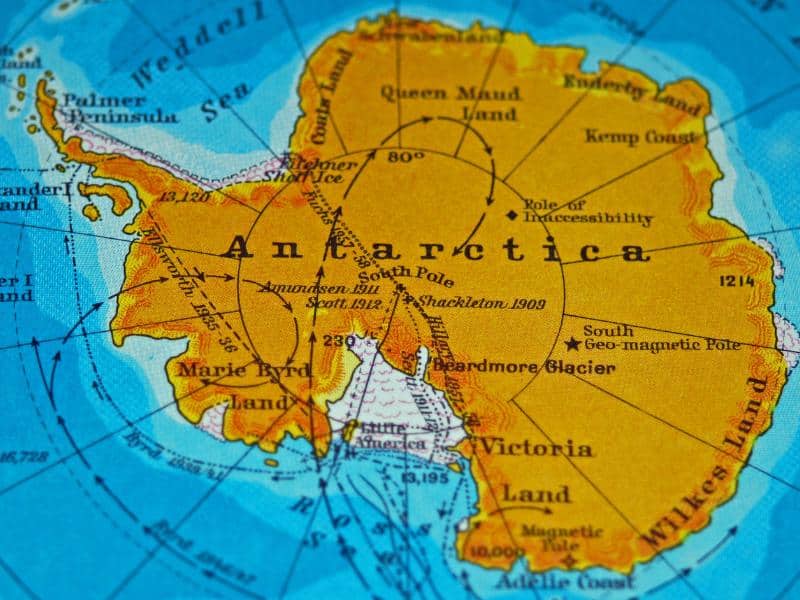
Antarctica’s unique geography and extreme climate make it one of the most fascinating places on Earth. Let’s explore some intriguing facts about this icy continent. [Learn more: 49 Fascinating Facts About The Weather]
- Antarctica is the fifth-largest continent, covering an area of 14 million square kilometers, nearly twice the size of Australia.
- About 98% of Antarctica is covered by ice, with an average thickness of 1.9 kilometers (1.2 miles), reaching depths of over 4.8 kilometers (3 miles) in some areas.
- The Antarctic Ice Sheet contains about 90% of the world’s ice and 70% of the world’s freshwater, enough to raise global sea levels by 60 meters (200 feet) if it completely melted.
- The lowest temperature ever recorded on Earth was -89.2°C (-128.6°F) at Russia’s Vostok Station in Antarctica in 1983, cold enough to instantly freeze human skin.
- Antarctica is the driest continent, with some areas receiving no precipitation for millions of years, classifying parts of it as the world’s largest desert.
- The strongest winds on Earth have been recorded in Antarctica, reaching speeds of up to 320 km/h (199 mph), powerful enough to knock a person off their feet.
- The McMurdo Dry Valleys of Antarctica are the driest places on Earth, with no ice or snow cover and no rainfall for potentially millions of years.
- Antarctica is home to at least 15 types of auroras that create spectacular light shows in its skies, appearing more vibrant during the dark polar winter.
- During summer, Antarctica experiences 24 hours of daylight, while winter brings 24 hours of darkness, creating some of the most dramatic seasonal changes on Earth.
- Antarctica has two seasons: summer and winter, each lasting about six months, with the sun never setting during summer and never rising during winter.
Recommended Read:
Wildlife and Ecosystems

Despite its harsh conditions, Antarctica is home to a variety of unique and resilient species. Here are some fascinating facts about Antarctic wildlife and ecosystems.
- Emperor penguins are the only vertebrates that breed during the Antarctic winter, enduring temperatures as low as -40°C (-40°F) while incubating their eggs.
- The Antarctic fur seal population has recovered from near extinction to over 4 million individuals, one of the greatest conservation successes in the region.
- The Antarctic blue whale is the largest animal on Earth, reaching lengths of up to 30 meters (98 feet) and weighing as much as 200 tons.
- The Antarctic Peninsula is home to the world’s southernmost flowering plants, which have adapted to survive in one of the harshest climates on the planet.
- There are no native land mammals in Antarctica; all mammals are marine species that depend on the Southern Ocean for food.
- The Weddell seal can dive to depths of over 600 meters (2,000 feet) and stay underwater for up to 80 minutes, thanks to special oxygen-storing adaptations.
- Antarctica’s coastal waters support vast amounts of krill, a crucial food source for many species and one of the most abundant animal species on Earth.
- The Antarctic petrel can fly up to 8,000 kilometers (5,000 miles) in a single foraging trip, one of the longest known feeding journeys of any bird species.
- Antarctic fish have developed antifreeze proteins in their blood that prevent ice crystals from forming, allowing them to survive in sub-zero waters.
- Acutuncus, a genus of tardigrades (commonly referred to as water bears) found in Antarctica can survive complete dehydration, freezing, and even exposure to the vacuum of space, making them one of Earth’s most resilient creatures.
History and Exploration

The history of Antarctic exploration is filled with tales of bravery, scientific discovery, and human endurance. Let’s delve into some key historical facts about this remote continent.
- The first confirmed sighting of Antarctica was in 1820 by a Russian expedition led by Fabian Gottlieb von Bellingshausen and Mikhail Lazarev.
- Norwegian explorer Roald Amundsen was the first person to reach the South Pole in 1911, beating British explorer Robert Falcon Scott by 34 days.
- The Antarctic Treaty, signed in 1959 by 12 countries, dedicates the continent to peaceful scientific research and prohibits military activities, creating the first arms-free zone established by international treaty.
- The first woman to set foot on Antarctica was Caroline Mikkelsen in 1935, though she was initially only recognized for landing on an Antarctic island rather than the mainland.
- The first child born in Antarctica was Emilio Marcos Palma, an Argentine, in 1978 at the Esperanza Base on the Antarctic Peninsula.
- The oldest known human activity in Antarctica dates back to 1899 at Cape Adare, where the first documented landing and overnight stay occurred.
- The first successful overland crossing of Antarctica was completed in 1958 by Sir Vivian Fuchs and Sir Edmund Hillary during the Commonwealth Trans-Antarctic Expedition.
- The ozone hole over Antarctica was discovered in 1985 by British scientists, leading to the Montreal Protocol, one of the most successful international environmental agreements.
- Ernest Shackleton’s ship Endurance was crushed by ice in 1915 during the Imperial Trans-Antarctic Expedition, but was finally discovered in remarkably good condition in March 2022, after 107 years underwater.
- The South Pole has been continuously occupied since 1956 when the Amundsen-Scott South Pole Station was established, making it one of the most remote permanent human settlements.
Scientific Research and Discoveries

Antarctica serves as a unique natural laboratory for scientific research. Here are some intriguing facts about the scientific endeavors and discoveries made on this icy continent.
- There are over 70 research stations in Antarctica operated by 29 countries, with approximately 1,200 researchers staying during winter and up to 5,000 during summer.
- The Antarctic ice cores provide a record of Earth’s climate going back 800,000 years, containing trapped air bubbles that reveal ancient atmospheric conditions.
- Lake Vostok, discovered beneath 4 kilometers (2.5 miles) of ice, is one of the world’s largest subglacial lakes and may contain unique life forms that evolved in isolation for millions of years.
- The IceCube Neutrino Observatory in Antarctica detects neutrinos from outer space, helping scientists study some of the most violent astrophysical sources in the universe.
- Scientists have discovered over 400 subglacial lakes beneath Antarctica’s ice sheet, creating a vast hidden hydrological network that influences ice flow dynamics.
- The Antarctic Circumpolar Current is the largest ocean current in the world, moving 100 times more water than all the world’s rivers combined.
- Meteorites are easier to find in Antarctica due to the dark ice background and ice movement, with over 10,000 specimens collected representing about 70% of all meteorites ever found.
- In 2022, researchers discovered a massive river system flowing beneath the Antarctic ice sheet, spanning nearly 460 kilometers (286 miles) and providing crucial insights into ice melt processes.
- A gigantic colony of 60 million icefish nests was discovered in the Weddell Sea in 2022, covering an area larger than San Francisco and representing the largest known fish breeding ground on Earth.
- Scientists drilling through Antarctic ice in 2021 unexpectedly discovered sponges and other marine organisms living on a boulder underneath the ice shelf, challenging assumptions about life in extreme environments.
Unique Features and Conservation

Antarctica is home to many extraordinary features and faces unique conservation challenges. From blood-red waterfalls to climate change impacts, here are some of the most fascinating aspects of this polar region.
- Blood Falls, a red waterfall in Antarctica, gets its color from iron-rich saltwater that oxidizes when exposed to air, not from algae as once thought.
- Mount Erebus is the southernmost active volcano in the world, featuring a persistent lava lake that has been active for at least 50 years.
- The McMurdo Dry Valleys of Antarctica haven’t seen rain in millions of years, making them the closest terrestrial environment to Mars found on Earth.
- The Antarctic Peninsula is one of the fastest-warming regions on Earth, with average temperatures rising by 3°C (5.4°F) since 1950, three times the global average.
- The Lambert Glacier in Antarctica is the world’s largest glacier, over 400 kilometers (250 miles) long and up to 64 kilometers (40 miles) wide, moving at speeds of up to 1,200 meters per year. [Learn more: Interesting facts about glaciers]
- Antarctica’s Gamburtsev Mountains are a range completely buried under ice, with peaks reaching heights similar to the European Alps despite never having been seen by human eyes.
- Tourism in Antarctica has increased significantly, with over 50,000 visitors annually, raising concerns about environmental impacts.
- The Protocol on Environmental Protection to the Antarctic Treaty bans mining in Antarctica, protecting the continent from commercial exploitation.
- Antarctica’s ice loss has tripled since 2012, contributing to global sea-level rise at an accelerating rate that concerns climate scientists worldwide.
- Despite its remoteness, microplastics have been found in Antarctic waters, sea ice, and even in freshly fallen snow, highlighting the global reach of plastic pollution.
Discover the Remarkable Continents of Our Planet
Across our world’s seven continents, you’ll find extraordinary ecological diversity, rich cultural heritage, and remarkable human achievements that have shaped our global story throughout millennia.
- 50 Fascinating Facts About Africa: Cradle of Humanity
- 75 Amazing Facts About Asia: Land of Diversity
- 55 Interesting Facts About North America: A Diverse Continent
- 50 Fascinating Facts About South America: Land of Wonders
- 35 Fun Facts About Australia: Discover The Land Down Under
- 60 Essential Facts About Europe: A Continental Journey


