
43 Juicy Facts About Apples: Orchard Origins
Apples are among the most widely grown fruits on Earth, with a story that stretches from wild mountain forests in Central Asia to orchards on nearly every continent. These facts about apples cover their history, botany, favorite varieties, everyday science, and the legends that have made them a cultural icon.
Apples Facts At-a-Glance
Scientific Name: Malus domestica
Plant Family: Rosaceae (rose family)
Place of Origin: Tian Shan mountains of Central Asia
Wild Ancestor: Malus sieversii
Fruit Type: Pome
Known Varieties: More than 7,500
Top Producing Country: China
How Varieties Are Propagated: Grafting
Origins and History
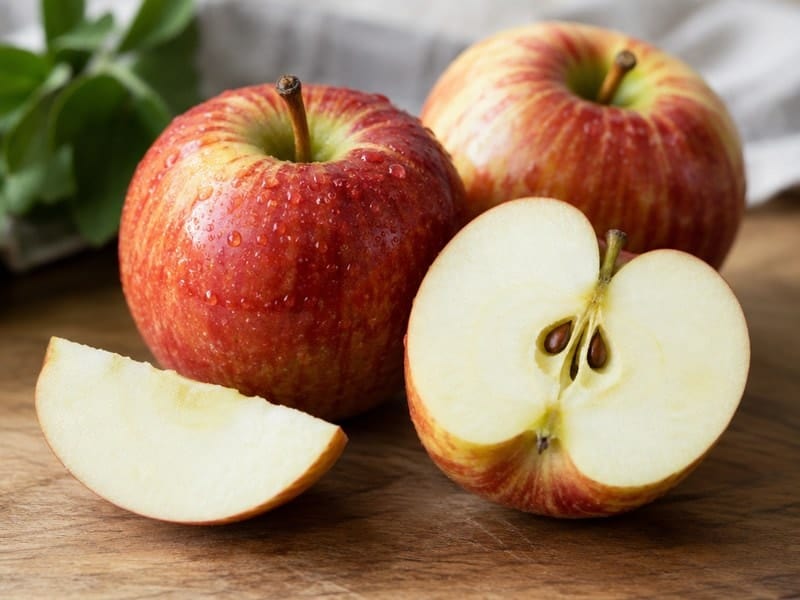
- The domesticated apple traces its roots to the Tian Shan mountains of Central Asia, in the region around modern Kazakhstan. Wild apple forests still grow there today.
- The main wild ancestor of today’s apples is Malus sieversii, a species whose fruit can vary widely in size, color, and flavor from tree to tree. [Learn more: 36 Juicy Facts About Oranges: Citrus Secrets]
- Kazakhstan’s largest city, Almaty, has a name derived from the Kazakh word for apple, a nod to the wild apple trees that once covered the surrounding hills.
- As apples traveled west along Silk Road trade routes, they crossed with other wild species, especially the European crabapple. That mixing helped shape the apples grown in Europe.
- Ancient Greeks and Romans knew how to graft apple trees, and the Romans helped spread apple growing across much of their empire.
- Apart from a few native crabapples, apples are not native to North America. European colonists brought apple seeds and cuttings with them in the 1600s.
- Johnny Appleseed was a real person named John Chapman, born in 1774. He planted apple nurseries across Pennsylvania, Ohio, and Indiana, and many of his seed-grown apples were better suited for cider than for eating fresh.
Suggested Read:
Botany and Science
- Apples belong to the rose family, which makes them relatives of pears, cherries, plums, peaches, and almonds. [Learn more: 39 Sweet Facts About Cherries: Orchard Stories]
- An apple is a type of fruit called a pome. The fleshy part we eat develops largely from tissue surrounding the flower’s ovary, while the core holds the seeds.
- Apple seeds do not grow true to type. A seed from a Honeycrisp will grow into a tree with fruit unlike its parent, because every seed is a new genetic mix.
- To keep a variety consistent, growers graft cuttings from a known tree onto rootstock. Every tree of a named variety is essentially a clone of the original.
- Rootstocks also control tree size. Dwarfing rootstocks produce small trees that are easier to pick and often bear fruit sooner.
- Most apple varieties need pollen from a different, compatible variety to set fruit, which is why orchards often mix varieties or plant crabapples among the rows.
- Bees are the main pollinators of apple blossoms, and many orchards bring in honeybee hives during bloom.
- Apple seeds contain amygdalin, a compound that can release cyanide when the seeds are crushed or chewed. Accidentally swallowing a few whole seeds is not considered dangerous.
- Apples contain plenty of air between their cells, which makes them float in water. That buoyancy is what makes the Halloween game of bobbing for apples possible.
- Apples give off ethylene, a natural gas that speeds ripening. Storing apples next to bananas or avocados can make that other fruit ripen faster.
Famous Varieties

Thousands of apple varieties exist, but a handful have especially memorable backstories.
- More than 7,500 named apple varieties are known worldwide, though only a small fraction are grown commercially.
- The McIntosh apple traces back to a seedling John McIntosh found on his Ontario farm in 1811. Apple’s Macintosh computer was named after the variety, with a slightly different spelling. [Learn more: 78 Interesting Facts About Ontario]
- Granny Smith apples began with Maria Ann Smith, who found a chance seedling growing on her property near Sydney, Australia, in 1868.
- Red Delicious started as a chance seedling on Jesse Hiatt’s farm in Iowa. A nursery later named it Delicious, and it became one of the most widely grown apples in American history.
- The Fuji apple was developed in Japan by crossing Ralls Janet and Red Delicious, and it was released in 1962.
- Honeycrisp was developed by the University of Minnesota and released in 1991. It is now Minnesota’s official state fruit. [Learn more: 90 Marvelous Facts About Minnesota]
- Cosmic Crisp, a cross of Enterprise and Honeycrisp, was bred at Washington State University and reached stores in 2019.
- Gala and Braeburn both come from New Zealand, a country that has produced several internationally popular apples.
- Pink Lady, also known as Cripps Pink, was developed in Western Australia.
Recommended Read: 35 Interesting Facts About New Zealand: Epic Wonders
Growing, Storing, and Eating
- China is the world’s largest apple producer by a wide margin.
- Within the United States, Washington State grows more apples than any other state.
- Apples are picked in late summer and fall, yet they appear in stores year-round thanks to controlled atmosphere storage. Cold rooms with low oxygen slow the fruit’s ripening for months.
- A cut apple turns brown because an enzyme called polyphenol oxidase reacts with oxygen. A splash of lemon juice slows the process.
- Apples produce their own natural waxy coating. Because washing removes some of it, packers often apply a thin food-grade wax to keep the fruit from drying out.
- Apples are mostly water, roughly 85 percent by weight, which helps explain their crisp, juicy bite.
- Apples are rich in pectin, a fiber that helps jams and jellies set. Much of an apple’s fiber is found in or just under the skin.
- In the United States, apple cider usually means unfiltered, unfermented apple juice. In many other countries, cider refers to an alcoholic drink made from fermented apples.
Recommended Read:
Myths, Legends, and Culture
- The Book of Genesis never says the forbidden fruit was an apple. The association likely grew partly from a Latin wordplay, since malum can mean both apple and evil.
- In Greek mythology, a golden apple inscribed for the fairest goddess sparked a rivalry that, according to legend, led to the Trojan War.
- The legend of William Tell tells of a Swiss archer forced to shoot an apple off his son’s head with a crossbow.
- In the Brothers Grimm fairy tale, Snow White falls into a deathlike sleep after biting a poisoned apple.
- Isaac Newton said later in life that watching an apple fall helped prompt his thinking about gravity. The popular image of it bonking him on the head is a later embellishment.
- The tree associated with Newton’s story still stands at Woolsthorpe Manor, his childhood home in England.
- The saying “an apple a day keeps the doctor away” grew out of a 19th-century Welsh proverb about eating an apple before bed.
- New York City’s nickname, the Big Apple, was popularized by sportswriter John J. Fitz Gerald in the 1920s and revived by a city tourism campaign in the 1970s.
- The apple blossom is the official state flower of both Michigan and Arkansas. [Learn more: 90 Fascinating Facts About Michigan]
Recommended Read:


