
42 Fascinating Facts About Barcelona: Catalan Capital
Barcelona blends Roman ruins, medieval lanes, and dreamlike modernist buildings along the Mediterranean coast. As the capital of Catalonia, it has a distinct language, proud traditions, and a history that stretches back more than 2,000 years. These facts explore its geography, past, architecture, culture, and sporting fame.
Barcelona Facts At-a-Glance
Location: Northeastern Spain, on the Mediterranean coast
Role: Capital of Catalonia and Spain’s second-largest city
Founded: As the Roman colony of Barcino, late 1st century BC
Languages: Catalan and Spanish (both official)
Climate: Mediterranean
Famous For: Gaudí architecture, the Gothic Quarter, FC Barcelona
Major Event Hosted: 1992 Summer Olympics
Geography and Setting
- Barcelona is the capital of Catalonia, an autonomous community in northeastern Spain, and sits on the shore of the Mediterranean Sea.
- It is Spain’s second-largest city, ranking behind only Madrid. [Learn more: 30 Interesting Facts About Madrid: Spanish Capital]
- The city occupies a coastal plain framed by the Collserola hills inland and two rivers, the Llobregat to the south and the Besòs to the north.
- Tibidabo, the highest peak in the Collserola range at 512 meters (1,680 ft), offers sweeping views over the city. Its hilltop amusement park opened in 1901, making it one of the oldest still operating anywhere.
- Montjuïc, a hill rising beside the port, is home to gardens, museums, a castle, and several venues from the 1992 Olympics.
- Barcelona has a Mediterranean climate, with mild winters and warm, dry summers that help draw visitors to its beaches year after year.
Recommended Read: 20 Magical Facts About The Mediterranean Sea: Azure Wonder
From Roman Town to Modern City
- The Romans founded the colony of Barcino in the late 1st century BC, and sections of its ancient walls can still be seen in the Gothic Quarter.
- According to legend, the city was founded by the Carthaginian general Hamilcar Barca, whose family name is sometimes linked to Barcelona’s. Historians treat this story as myth rather than fact.
- In 1137, the betrothal of Count Ramon Berenguer IV of Barcelona and Petronilla of Aragon united their lands, laying the foundation for the Crown of Aragon, a powerful Mediterranean realm.
- On September 11, 1714, Barcelona fell to Bourbon forces at the end of a long siege during the War of the Spanish Succession. Catalonia now marks that date each year as La Diada, its National Day.
- In the 1850s, the city began tearing down its cramped medieval walls, opening space for dramatic expansion.
- Engineer Ildefons Cerdà designed the Eixample district, a vast grid of city blocks with distinctive cut-off corners that give each intersection a spacious, octagonal feel.
- Barcelona hosted the 1888 Universal Exposition, and the brick Arc de Triomf was built as the main entrance to the fairgrounds.
- The 1929 International Exposition transformed Montjuïc, leaving behind landmarks such as the Magic Fountain and the Poble Espanyol, an open-air village of Spanish architectural styles.
- During the Spanish Civil War, Barcelona was a Republican stronghold, and it fell to Franco’s forces in January 1939.
- Hosting the 1992 Summer Olympics reshaped the city, as old industrial land along the waterfront was turned into beaches, promenades, and new neighborhoods.
Gaudí and Modernist Marvels
Catalan modernisme, a local take on Art Nouveau, gave Barcelona some of its most famous buildings.
- Construction of the Sagrada Família began in 1882, and Antoni Gaudí took over the project the following year. More than a century later, the church is still being completed.
- Pope Benedict XVI consecrated the Sagrada Família as a basilica in 2010, allowing it to host regular worship services despite the ongoing construction.
- Gaudí died in 1926 after being struck by a tram, and he is buried in the crypt of the Sagrada Família.
- Park Güell began as a planned housing estate commissioned by industrialist Eusebi Güell. The development never took off, so the site became a public park famous for its colorful mosaic salamander.
- Two of Gaudí’s most admired homes, Casa Batlló and Casa Milà, stand on the elegant avenue Passeig de Gràcia. Casa Milà is nicknamed La Pedrera, meaning “the stone quarry,” for its rough, rippling facade.
- Several of Gaudí’s works are listed together as a UNESCO World Heritage Site, first inscribed in 1984 and later expanded.
- Architect Lluís Domènech i Montaner designed both the Palau de la Música Catalana concert hall and the Hospital de Sant Pau, which were jointly added to UNESCO’s World Heritage List in 1997.
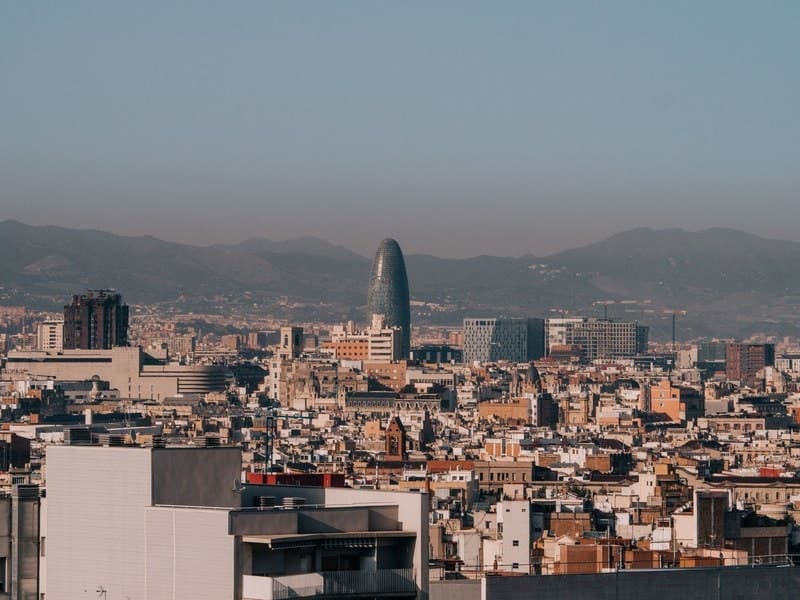
- The bullet-shaped Torre Glòries, originally known as Torre Agbar, was designed by French architect Jean Nouvel and has become a modern symbol of the skyline.
Old Quarters and Landmarks

- The Gothic Quarter, or Barri Gòtic, is the city’s historic core, a maze of narrow streets built over the old Roman town.
- Barcelona Cathedral is dedicated to the Holy Cross and Saint Eulalia, a young martyr who is one of the city’s patron saints.
- The Basilica of Santa Maria del Mar, built in the 14th century, is celebrated as a masterpiece of the Catalan Gothic style.
- La Rambla, the city’s best-known boulevard, runs from Plaça de Catalunya down toward the old port.
- The Columbus Monument stands at the seaward end of La Rambla and was built for the 1888 Universal Exposition.
- La Boqueria, a bustling food market just off La Rambla, is packed with stalls selling fresh produce, seafood, cured meats, and sweets.
Language, Art, and Traditions
- Catalan and Spanish are both official languages in Barcelona, and street signs, schools, and media widely use Catalan.
- Castells, the Catalan tradition of building towering human pyramids, were recognized by UNESCO as Intangible Cultural Heritage in 2010 and appear at many Barcelona festivals.
- La Mercè, the city’s biggest annual festival, takes place in September and honors the Mare de Déu de la Mercè, Barcelona’s other patron saint.
- On Sant Jordi’s Day, April 23, Catalans traditionally exchange books and roses, filling the streets with pop-up stalls.
- Pablo Picasso spent formative years in Barcelona, and the Museu Picasso, which opened in 1963, holds an important collection of his early work.
- Artist Joan Miró was born in Barcelona in 1893, and the Fundació Joan Miró on Montjuïc showcases his bold, playful art.
- Pa amb tomàquet, bread rubbed with ripe tomato and drizzled with olive oil, is a simple Catalan staple served alongside countless meals.
Recommended Read: 35 Fun Facts About the Spanish Language: Latin Legacy
Sports and City Life
- FC Barcelona was founded in 1899 by a group led by Swiss-born Joan Gamper. Its motto, “Més que un club,” means “More than a club.”
- The club’s Camp Nou stadium opened in 1957 and has long ranked as the largest football stadium in Europe.
- FC Barcelona is owned by its members rather than by a private investor, giving fans a vote in electing the club’s president.
- The city has a second major football club, RCD Espanyol, setting up a long-running local rivalry.
- Barcelona has experimented with “superblocks,” groups of city blocks where car traffic is limited so streets can serve as shared public space for walking, play, and greenery.
Recommended Read:


