
20 Fascinating Facts About Bolivia: Landlocked Legacy
Discover compelling facts about Bolivia, South America’s landlocked nation where ancient civilizations meet dramatic landscapes, from the world’s highest capital city to vast salt flats that mirror the sky.
Bolivia Facts At-a-Glance
Location: Central South America, bordered by Brazil, Paraguay, Argentina, Chile, and Peru
Population: Approximately 12.4 million (2024)
Area: 1,098,581 km² (424,164 sq mi)
Capital Cities: Sucre (constitutional), La Paz (administrative)
Languages: Spanish, Quechua, Aymara, and 34 other indigenous languages (all official)
Religion: Roman Catholic (70%), Protestant (20%), Indigenous beliefs
Climate: Varies from tropical (Amazon lowlands) to polar (high Andes)
Source: World Health Organization
Geography
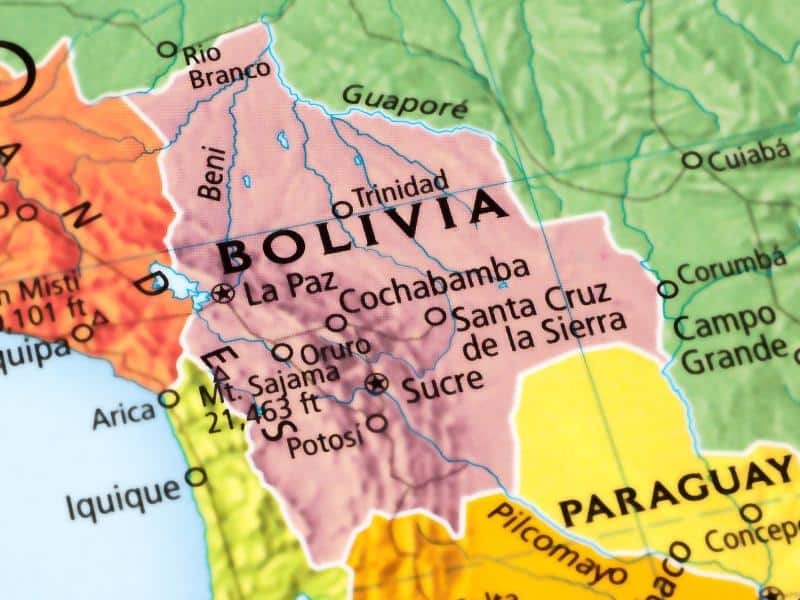
- Bolivia is one of only two landlocked countries in South America (along with Paraguay), having lost its Pacific coastline to Chile during the War of the Pacific (1879-1884). The country still maintains a navy and celebrates “Día del Mar” (Day of the Sea) annually to commemorate its lost maritime access.
- La Paz serves as Bolivia’s administrative capital and is the world’s highest capital city, sitting at an elevation of 3,500-4,150 meters (11,500-13,600 feet) above sea level. The thin air contains about 40% less oxygen than at sea level, causing many visitors to experience altitude sickness.
- The Salar de Uyuni is the world’s largest salt flat, covering over 10,000 square kilometers (4,000 square miles). During the rainy season, a thin layer of water transforms it into the world’s largest mirror, creating breathtaking reflections of the sky that attract photographers from around the globe.
- Bolivia has two capital cities: Sucre is the constitutional capital and seat of the judiciary, while La Paz serves as the administrative capital housing the executive and legislative branches. This unusual arrangement stems from political compromises made during the country’s early republican period.
- Bolivia experiences dramatic climate variations due to its diverse topography, ranging from tropical rainforests in the Amazon basin to arctic conditions in the high Andes. The country encompasses parts of the Amazon rainforest, high-altitude plateaus, and everything in between.
- Lake Titicaca, shared with Peru, is the world’s highest navigable lake at 3,812 meters (12,507 feet) above sea level. The lake is home to the Uros people, who live on floating islands made entirely of totora reeds, maintaining a lifestyle that has remained largely unchanged for centuries.
- The country experiences some of the world’s most extreme weather phenomena, including the “Surazos” – cold fronts from Antarctica that can drop temperatures by 20-30°C (36-54°F) within hours, bringing snow even to tropical regions of the country.
- The Yungas Road, nicknamed “Death Road,” was once considered the world’s most dangerous road, with an estimated 200-300 deaths annually. The narrow, winding mountain path with sheer drops of up to 600 meters (2,000 feet) is now primarily used by adventure tourists for mountain biking.
Facts About Bolivia History

- Potosí was once one of the world’s largest and wealthiest cities during the Spanish colonial period, thanks to the silver extracted from Cerro Rico (Rich Hill). The phrase “worth a Potosí” became synonymous with immense wealth, and the mountain provided silver that funded the Spanish Empire for centuries.
- The country is named after Simón Bolívar, the Venezuelan military leader who helped liberate much of South America from Spanish colonial rule in the early 19th century. Bolivia gained independence in 1825, making it one of the last South American countries to achieve freedom from Spain.
- The ancient city of Tiwanaku (Tiahuanaco) near Lake Titicaca was the center of a powerful pre-Columbian civilization that flourished from 300 to 1000 CE. The site features massive stone structures, including the famous Gate of the Sun, and represents one of South America’s most important archaeological sites.
- Evo Morales, who served as Bolivia’s president from 2006 to 2019, was the country’s first indigenous president and South America’s first indigenous head of state in over 500 years. A former coca farmer and union leader, he implemented significant social and economic reforms during his tenure, including nationalizing key industries and expanding indigenous rights.
Suggested Read: 50 Interesting Facts About Spain
Culture and People of Bolivia

- The Bolivian flag features three horizontal stripes (red, yellow, and green) representing the valor of soldiers, mineral wealth, and fertile land respectively. The state flag includes the national coat of arms featuring a condor, Mount Potosí, and symbols of Bolivia’s natural resources.
- Indigenous peoples make up approximately 62% of Bolivia’s population, making it the country with the highest percentage of indigenous people in South America. The largest groups are the Quechua (30%) and Aymara (25%), with over 30 indigenous languages officially recognized.
- The traditional bowler hats worn by indigenous Aymara women, called “bombín,” were actually introduced by British railway workers in the 1920s. When the hats proved too small for the workers, they were given to local women, who adopted them as a symbol of status and femininity.
- Bolivia has no McDonald’s restaurants, making it one of the few countries worldwide without the global fast-food chain. McDonald’s closed its Bolivian operations in 2002 due to low sales, as locals preferred traditional foods over American fast food.
- The traditional sport of “tinku” combines ritual fighting with festival celebration, originating from indigenous communities in northern Potosí. Participants engage in ceremonial combat to honor Pachamama (Mother Earth) and ensure good harvests, with the spilled blood believed to fertilize the land.
Economy and Natural Resources

- Bolivia contains approximately 50-70% of the world’s lithium reserves, primarily located beneath the Salar de Uyuni. This “white gold” is crucial for electric vehicle batteries and renewable energy storage, potentially making Bolivia a key player in the global transition to clean energy.
- Bolivia’s economy relies heavily on natural gas exports, making it South America’s second-largest natural gas producer after Venezuela. The country also exports significant quantities of zinc, tin, silver, and gold, continuing its long history as a major mineral producer.
- Bolivia is home to over 40% of all animal and plant life on Earth, despite covering only 0.2% of the planet’s surface. The country contains parts of the Amazon rainforest, hosting jaguars, pink river dolphins, over 1,400 bird species, and countless endemic plants and insects.
Explore More South American Countries
Continue your journey through South America by discovering the unique characteristics and cultural treasures of Bolivia’s neighboring nations.


