
25 Interesting Facts About Cairo: Egypt’s Capital
Facts about Cairo highlight the capital of Egypt as one of the largest cities in Africa and the Arab world, shaped by over 5,000 years of history. From its Islamic heritage and major museums to the nearby pyramids and the Nile River, Cairo remains a central hub of culture and urban life.
Cairo (capital of Egypt) Facts At-a-Glance
Location: Northeastern Egypt, southern tip of the Nile Delta
Population: ~10 million (city proper); ~21 million (greater metro area)
Founded: 969 CE by Fatimid general Jawhar al-Siqilli
Official Name: Al-Qahira (“The Victorious”)
Status: Capital and largest city of Egypt
Climate: Hot desert; less than 25 mm rainfall per year
UNESCO Heritage: Islamic Cairo designated World Heritage Site in 1979
Facts About Cairo Geography and Climate
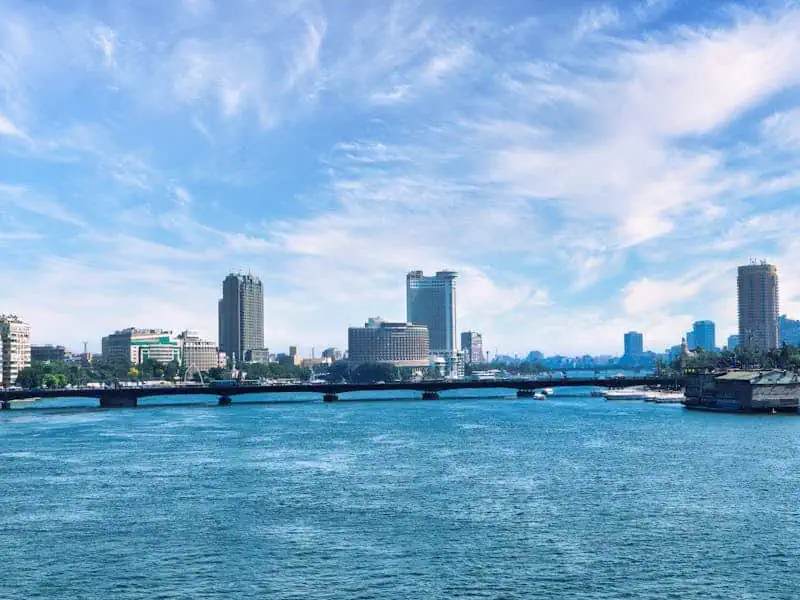
Cairo’s geography is defined by its dramatic position along the Nile and its proximity to the Sahara Desert, producing a climate of extremes and a landscape unlike any other capital city on Earth.
- Cairo is the capital and largest city of Egypt, with a population of approximately 10 million people within the city proper and over 21 million in the greater metropolitan area, making it widely regarded as the largest city in Africa and the Arab world.
- The city sits at the southern tip of the Nile Delta, where the river transitions from its single channel into the branching delta system that fans out toward the Mediterranean Sea.
- The Nile River, which flows through Cairo, is approximately 6,650 kilometers long, often cited as the longest river in the world, and it has sustained Egyptian civilization for over 5,000 years by providing water, fertile soil, and transportation.
- Cairo experiences a hot desert climate with virtually no rainfall, averaging less than 25 millimeters of rain per year. Summers are extremely hot, with temperatures regularly exceeding 40 degrees Celsius, while winters are mild and pleasant.
- The Great Pyramid of Giza and the Sphinx are located on the Giza Plateau, technically within the greater Cairo metropolitan area, making Cairo one of the few modern capitals situated directly adjacent to one of the Seven Wonders of the Ancient World.
Facts About Cairo History
Cairo’s layered history spans Roman fortresses, Islamic caliphates, and modern political revolutions, each era leaving an indelible mark on the city’s identity.
- Cairo was officially founded in 969 CE by the Fatimid general Jawhar al-Siqilli, who established it as the new capital of the Fatimid Caliphate, naming it Al-Qahira, meaning “The Victorious” or “The Conqueror.”
- Before the founding of modern Cairo, the area was home to several earlier settlements, including the ancient city of Heliopolis, the Roman fortress town of Babylon in Egypt, and the Arab settlement of Fustat, founded in 641 CE by the Muslim general Amr ibn al-As.
- The Citadel of Saladin, built between 1176 and 1183 CE by the famous Muslim military leader Saladin, served as the seat of Egyptian government for nearly 700 years and remains one of Cairo’s most iconic landmarks, housing several mosques including the stunning Muhammad Ali Mosque completed in 1848.
- Cairo played a central role in the Arab Spring when, in January and February 2011, millions of protesters gathered in Tahrir Square demanding the end of President Hosni Mubarak’s 30-year rule. The sustained demonstrations led to Mubarak’s resignation on February 11, 2011, in one of the most significant political events in modern Egyptian history.
Facts About Cairo Culture and Religion

Cairo is a city where Islamic, Coptic Christian, and secular traditions coexist, producing one of the richest and most diverse cultural landscapes in the world.
- The city is frequently referred to as “The City of a Thousand Minarets” due to its extraordinary concentration of Islamic mosques, many of which date back centuries and feature distinctive architectural styles from various Islamic dynasties.
- Cairo is home to Al-Azhar University, founded in 970 CE, which is widely considered among the oldest continuously operating universities in the world and remains one of the most prestigious centers of Islamic learning globally.
- The Coptic Christian community in Cairo is one of the oldest Christian communities in the world. The Coptic Orthodox Church traditionally traces its founding to the Apostle Mark, who is said to have brought Christianity to Egypt around 42 CE, and Cairo’s Coptic quarter contains churches dating back to the 4th and 5th centuries.
- Nobel Prize-winning author Naguib Mahfouz was born in Cairo in 1911 and set much of his celebrated fiction, including the Cairo Trilogy, in the city’s historic neighborhoods. He became the first Arabic-language writer to win the Nobel Prize in Literature in 1988.
Facts About Cairo Architecture and Historic Sites

Cairo’s built environment is a remarkable archive of human history, preserving medieval Islamic masterpieces alongside ancient burial grounds still inhabited today.
- Cairo’s historic district, known as Islamic Cairo, was designated a UNESCO World Heritage Site in 1979 and contains one of the world’s largest concentrations of medieval Islamic architecture, including mosques, madrasas, mausoleums, and caravanserais.
- Khan el-Khalili is Cairo’s famous historic bazaar, established in 1382 CE during the Mamluk period. It remains one of the oldest and largest markets in the Middle East, attracting millions of tourists and locals who shop for spices, jewelry, textiles, and handicrafts.
- The City of the Dead, known as the Qarafa necropolis, is a vast historic cemetery in Cairo that has been continuously used for burials since the 7th century. Due to Cairo’s severe housing shortage, hundreds of thousands of living residents have made their homes among the tombs and mausoleums.
Facts About Cairo Museums and Cultural Institutions
Cairo is home to some of the world’s most important repositories of ancient history, drawing scholars and visitors from every corner of the globe.
- The Egyptian Museum in Cairo, opened in 1902, houses one of the world’s largest collections of ancient Egyptian antiquities, with over 120,000 items on display, including the treasures of Tutankhamun’s tomb discovered in 1922.
- The Grand Egyptian Museum, located near the Giza pyramids, is one of the largest archaeological museums in the world. After years of construction, it began partial operations and is designed to house over 100,000 ancient artifacts, including the complete collection of Tutankhamun’s treasures displayed together for the first time.
Facts About Cairo Modern Infrastructure and Development

Despite its ancient roots, Cairo has developed bold modern infrastructure and continues to expand with ambitious urban planning projects designed to accommodate its rapidly growing population.
- Cairo Tower, completed in 1961 and standing 187 meters tall, was built with American aid money given to Egyptian President Nasser, who reportedly used the funds to construct the tower as a symbolic gesture of defiance rather than for the intended purpose.
- The Cairo Metro, opened in 1987, was the first metro system built in Africa and the Arab world. It currently operates three lines covering approximately 78 kilometers and serves around 3.5 million passengers daily, making it one of the busiest metro systems in the world.
- Cairo’s Zamalek district, located on Gezira Island in the middle of the Nile, is one of the city’s most affluent neighborhoods and is home to numerous foreign embassies, upscale restaurants, art galleries, and the Cairo Opera House, which opened in 1988.
- Egypt’s government has been constructing a new administrative capital city approximately 45 kilometers east of Cairo since 2015. The New Administrative Capital is designed to eventually house 6.5 million people and relieve pressure on the overcrowded historic city.
Facts About Cairo Urban Challenges and Politics
As one of the world’s most densely populated cities, Cairo faces profound challenges in housing, air quality, and governance that shape the daily lives of its tens of millions of residents.
- Cairo’s population density in some central districts reaches over 100,000 people per square kilometer, making parts of the city among the most densely populated urban areas on Earth, creating significant challenges for infrastructure, housing, and public services.
- Cairo suffers from significant air pollution, largely due to vehicle emissions, industrial activity, and the annual burning of rice straw in the Nile Delta. The city frequently ranks among the most polluted cities in the world, with particulate matter levels far exceeding WHO guidelines.
- Cairo hosted the Arab League headquarters from the organization’s founding in 1945, and while the headquarters was temporarily moved to Tunis from 1979 to 1990 following Egypt’s peace treaty with Israel, it returned to Cairo and has remained there since.


