
39 Sweet Facts About Cherries: Orchard Stories
Cherries are small fruits with a big story. These glossy stone fruits link the rose family to Roman history, Japanese springtime traditions, and American orchards. They also play a part in famous cocktails, desserts, and legends. Here are fun facts about cherries, covering their biology, varieties, growing, food uses, and cultural history.
Cherries Facts At-a-Glance
Plant Family: Rosaceae (rose family)
Genus: Prunus
Fruit Type: Drupe (stone fruit)
Main Species: Sweet cherry (Prunus avium) and tart cherry (Prunus cerasus)
Native Range: Europe and western Asia (wild sweet cherry)
Famous Varieties: Bing, Rainier, Montmorency, Stella
Notable US States: Washington (sweet cherries), Michigan (tart cherries)
Cherry Botany Basics
- Cherries belong to the genus Prunus in the rose family. That makes them close relatives of plums, peaches, apricots, and almonds.
- Botanically, a cherry is a drupe, which is a fleshy fruit with a single hard stone around the seed. Peaches, plums, and olives are also drupes.
- The two main cultivated cherries are the sweet cherry, Prunus avium, and the tart or sour cherry, Prunus cerasus. Most cherries eaten fresh are sweet cherries.
- The species name avium means “of birds,” which is a good fit. Birds are eager cherry eaters and can strip a tree quickly if growers do not protect it.
- The tart cherry is widely understood to have arisen as a natural hybrid between the sweet cherry and the ground cherry, Prunus fruticosa.
- The wild sweet cherry is native to Europe and western Asia. Its descendants are now grown in temperate regions around the world.
- North America has its own native cherries, including black cherry (Prunus serotina) and chokecherry (Prunus virginiana). Their small, often astringent fruits are popular with wildlife.
Growing and Harvesting
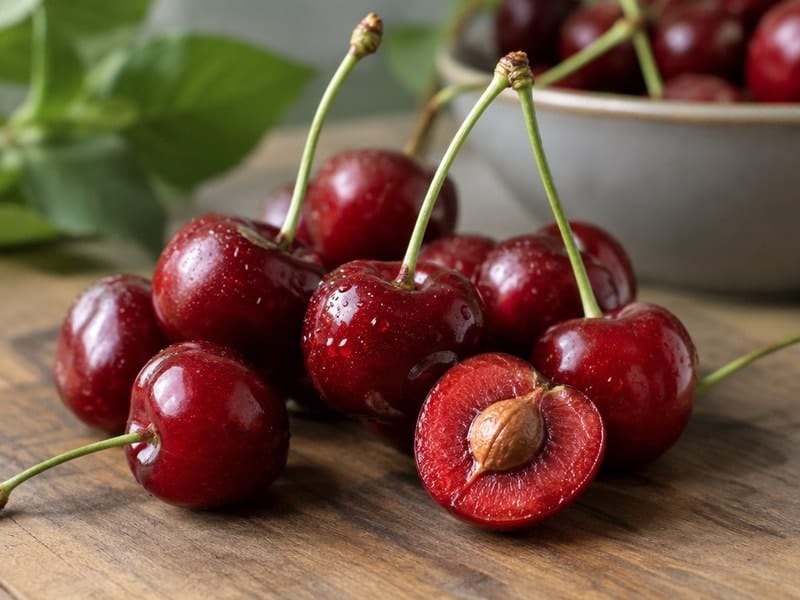
- Cherry trees need a period of winter cold, often measured in “chill hours,” before they will bloom and fruit well. Because of this, they are poorly suited to warm tropical climates.
- Many sweet cherry varieties cannot pollinate themselves and need a compatible variety planted nearby. Bees carry pollen between the trees.
- Stella, developed in Canada at the Summerland research station in British Columbia, became well known as a self-fertile sweet cherry. Growers could plant it without a separate pollinator tree.
- Unlike bananas or pears, cherries do not keep ripening after they are picked. They have to be harvested at full ripeness for the best flavor.
- Rain shortly before harvest can make ripe cherries crack. The fruit absorbs water and swells until the skin splits.
- Commercial cherry trees are usually propagated by grafting a chosen variety onto a separate rootstock. Some rootstocks help keep trees smaller and easier to pick.
- Tart cherries are often harvested with mechanical shakers that vibrate the fruit off the tree. Sweet cherries sold fresh are typically picked by hand to avoid bruising.
Famous Cherry Varieties
- The Bing cherry was developed in Oregon in 1875 by orchardist Seth Lewelling. It is named after Ah Bing, his Chinese orchard foreman.
- The Rainier cherry was developed at Washington State University in 1952 by crossing Bing and Van cherries. It is known for its yellow skin with a red-pink blush.
- Montmorency is the leading tart cherry variety grown in the United States. Its bright red fruit is a favorite for pies.
- Tart cherries are too sour for most people to enjoy fresh. That is why most of them end up frozen, dried, canned, juiced, or baked.
Recommended Read: 78 Fun Facts About Oregon: Beaver State
Cherries in Food and Drink

- Maraschino cherries take their name from maraschino liqueur. The original versions were Marasca cherries preserved in this liqueur, which came from the Dalmatian coast of present-day Croatia.
- Most modern American maraschino cherries are made with a brining process developed at Oregon State University by Ernest Wiegand in the 1920s. The cherries are then sweetened and often dyed bright red.
- Kirschwasser, often called kirsch, is a clear brandy distilled from cherries. It is a key flavor in Germany’s Black Forest cake.
- Black Forest cake, or Schwarzwälder Kirschtorte, layers chocolate cake with whipped cream and cherries. The cake is often finished with chocolate shavings.
- Cherries get their deep red and purple shades from anthocyanins, the same family of pigments that colors blueberries and red cabbage.
- Tart cherries are one of the few fruits known to contain melatonin, a compound involved in regulating sleep.
Pits, Leaves, and Wood
- Cherry pits contain amygdalin, a compound that can release cyanide if the seed inside is crushed or chewed. An accidentally swallowed whole pit usually passes through without harm.
- The wilted leaves of black cherry trees can be dangerous to grazing livestock, because damaged leaves release cyanide-producing compounds.
- American black cherry wood is prized for furniture and cabinetry. It is known for a warm reddish tone that deepens with age and exposure to light.
Cherry Blossoms
- In Japan, cherry blossoms are called sakura, and spring gatherings to view them are known as hanami. People often picnic beneath the blooming trees.
- Many ornamental cherry trees are grown for their flowers and produce little or no edible fruit. Yoshino cherry is one of the most widely planted.
- Japan’s weather agency tracks the “cherry blossom front,” the wave of blooming that moves across the country as spring warms each region.
- Records of cherry blossom festivities in Kyoto stretch back more than a thousand years. Scientists have used them to study long-term climate change.
- In 1912, Tokyo gave the city of Washington, DC, about 3,000 cherry trees as a gift of friendship. First Lady Helen Taft and Viscountess Chinda planted the first ones.
- Washington’s National Cherry Blossom Festival celebrates the 1912 gift each spring, when the trees around the Tidal Basin bloom.
Recommended Read:
History, Words, and Legends
- The English word “cherry” traces back through French and Latin to the Greek word kerasos. Medieval English speakers heard the French form cherise as a plural and dropped the “s” to create “cherry.”
- According to the Roman writer Pliny the Elder, the general Lucullus brought cherry trees to Rome from the Black Sea region. The Romans then helped spread cherry growing across their empire.
- Legend: The story of young George Washington chopping down a cherry tree and confessing, “I cannot tell a lie,” was invented by biographer Mason Locke Weems. It has no basis in historical evidence.
- Traverse City, Michigan, calls itself the Cherry Capital of the World and hosts the National Cherry Festival. Michigan is the leading US producer of tart cherries. [Learn more: 82 Fun Facts About Michigan: Great Lakes]
- Washington State leads the United States in sweet cherry production, with large orchards east of the Cascade Mountains. [Learn more: 94 Interesting Facts About Washington State]
- Anton Chekhov’s final play, The Cherry Orchard, first staged in 1904, uses a family’s beloved orchard as a symbol of a vanishing way of life in Russia.
Recommended Read:


