
38 Fascinating Facts About Chess: Royal Strategy
Chess has traveled from ancient India to nearly every corner of the globe, picking up new rules, new pieces, and new legends along the way. These facts about chess cover its origins, its odd rules, the math behind it, the machines that mastered it, and the champions who made history over the board.
Chess Facts At-a-Glance
Origin: India, around the 6th century CE (as chaturanga)
Board: 64 squares in an 8×8 grid
Pieces: 32 total, 16 per player
Objective: Checkmate the opponent’s king
Governing Body: FIDE, founded in Paris in 1924
First Official World Champion: Wilhelm Steinitz (1886)
International Chess Day: July 20
Origins and Early History
- Chess grew out of chaturanga, a game played in India around the 6th century CE. Its pieces represented the divisions of an ancient army: infantry, cavalry, elephants, and chariots.
- The game spread to Persia, where it became known as shatranj. The word checkmate comes from the Persian phrase shah mat, which roughly means the king is helpless or defeated.
- Chess reached Europe around the 10th century, carried largely through Muslim Spain and Italy. From there it spread across the continent and became a favorite pastime of medieval nobility.
- The queen started out as one of the weakest pieces on the board. In shatranj, her ancestor was a counselor or vizier who could move only one square diagonally, and the powerful modern queen appeared in Europe in the late 15th century.
- The bishop began life as an elephant. In shatranj it jumped exactly two squares diagonally, and its Spanish name, alfil, still comes from the Arabic word for elephant.
- The rook’s name comes from the Persian word rukh, meaning chariot. That’s why the piece has nothing to do with the bird, even though it shares the same English word.
- The Lewis chessmen, a famous set of 12th-century pieces carved mostly from walrus ivory, were discovered on the Isle of Lewis in Scotland in 1831. Their wide-eyed, worried-looking faces have made them some of the most recognizable chess pieces in the world.
Recommended Read: 30 Fascinating Facts About India: Culture, History & Diversity
The Board and the Pieces
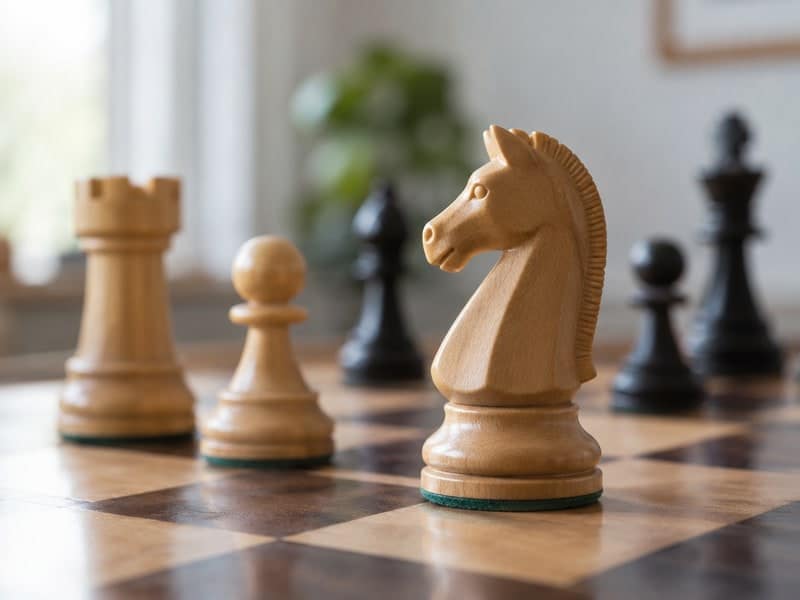
- Each player starts with 16 pieces: eight pawns, two rooks, two knights, two bishops, one queen, and one king. White always moves first.
- The board must be set up so that each player has a light square in the right-hand corner. The queen also starts on a square that matches her own color, so the white queen begins on a light square.
- The classic piece design used in tournaments is called the Staunton pattern. It was introduced in 1849 and named after Howard Staunton, the leading English player of the time.
- The knight is the only piece that can jump over other pieces. It moves in an L shape, two squares in one direction and then one square to the side.
- Castling is the only move in which a player moves two pieces at once. The king slides two squares toward a rook, and the rook hops over to land on the king’s other side.
- When a pawn reaches the far side of the board, it must be promoted to a queen, rook, bishop, or knight. Players almost always pick a queen, but choosing another piece, known as underpromotion, can occasionally win a game or avoid a stalemate.
Quirky Rules and Quick Games
- En passant, French for in passing, lets a pawn capture an enemy pawn that has just moved two squares forward and landed beside it. The capture must be made immediately, or the chance is gone.
- A game isn’t always won or lost. It can end in a draw by stalemate, when a player has no legal moves but isn’t in check, or by threefold repetition, the fifty-move rule, insufficient material, or agreement.
- The fastest possible checkmate is the Fool’s Mate, which takes only two moves by each side. White weakens the king’s defenses with poor pawn moves, and Black’s queen delivers mate.
- The Scholar’s Mate is a four-move checkmate in which the queen and bishop team up to attack the weak square next to the opponent’s king. It’s a classic trap that catches many beginners.
- White has 20 possible first moves, and Black has 20 possible replies. That means 400 different positions can exist after just one move by each player.
Math, Puzzles, and Legends

- According to a famous legend, the inventor of chess asked a ruler for one grain of wheat on the first square, two on the second, and double on each square after that. The total would be 18,446,744,073,709,551,615 grains, far more wheat than the world has ever grown.
- In 1950, mathematician Claude Shannon estimated that there are at least 10 to the 120th power possible chess games. This figure, known as the Shannon number, is far larger than the estimated number of atoms in the observable universe.
- The knight’s tour is a classic puzzle in which a knight must visit every square on the board exactly once. Mathematicians and puzzle lovers have studied it for centuries.
- The eight queens puzzle asks how to place eight queens on a board so that none can attack another. There are 92 solutions in total.
Chess and Machines
- The Mechanical Turk, built by Wolfgang von Kempelen in 1770, appeared to be a chess-playing machine and toured Europe defeating challengers. It was actually a clever hoax, with a skilled human player hidden inside the cabinet.
- Computing pioneer Alan Turing designed one of the first chess programs before any computer could run it. He tested it by working through the calculations by hand.
- In 1997, IBM’s Deep Blue defeated world champion Garry Kasparov in a six-game match by a score of 3.5 to 2.5. It was the first time a computer beat a reigning world champion in a match under standard tournament conditions, one year after Kasparov had won their first match.
- In 2017, DeepMind’s AlphaZero learned chess knowing only the rules, teaching itself by playing against itself. It then defeated Stockfish, one of the strongest traditional chess engines.
- Computers have completely solved every chess position with seven or fewer pieces on the board. These databases, called endgame tablebases, show the perfect result and best moves for each of those positions.
Champions and Competition
- The first official World Chess Championship took place in 1886, when Wilhelm Steinitz defeated Johannes Zukertort. Steinitz became the first recognized world champion.
- Emanuel Lasker held the world title for 27 years, from 1894 to 1921. That is the longest reign of any world chess champion.
- FIDE, the international chess federation, was founded in Paris on July 20, 1924. That date is now celebrated as International Chess Day.
- The first official Chess Olympiad, a team competition between nations, was held in London in 1927. The same event hosted the first Women’s World Championship, won by Vera Menchik.
- FIDE adopted the Elo rating system in 1970. Created by physicist Arpad Elo, it estimates a player’s strength from game results and is now used in many other games and sports.
- FIDE first officially awarded the title of Grandmaster in 1950. It remains the highest lifetime title a chess player can earn, apart from world champion.
Legendary Players and Games
- The Immortal Game, played in London in 1851, saw Adolf Anderssen sacrifice both rooks and his queen before checkmating Lionel Kieseritzky with his remaining minor pieces. It remains one of the most celebrated attacking games ever played.
- In 1972, American Bobby Fischer defeated Soviet champion Boris Spassky in Reykjavik, Iceland. The Cold War backdrop turned the match into a worldwide media sensation.
- Garry Kasparov became the youngest undisputed world champion in 1985, winning the title at age 22 by defeating Anatoly Karpov.
- Judit Polgar is widely considered the strongest female chess player in history. She became a Grandmaster in 1991 at age 15, breaking Bobby Fischer’s record as the youngest at the time, and later reached the top 10 of the overall world rankings.
- Magnus Carlsen of Norway became world champion in 2013. In 2014 he reached a rating of 2882, the highest in chess history.
Recommended Read:


