
39 Fun Facts About Chickens: Feathered Friends
Chickens are everywhere, from backyard coops to giant farms, yet they are far more interesting than most people realize. These birds descend from wild Asian junglefowl, share ancestry with dinosaurs, and communicate with a surprisingly rich vocabulary. Here are fun facts about their origins, bodies, eggs, behavior, and long history alongside people.
Chickens Facts At-a-Glance
Scientific Name: Gallus gallus domesticus
Wild Ancestor: Red junglefowl of Southeast Asia
Diet: Omnivore
Incubation Period: 21 days
Names: Rooster (adult male), hen (adult female), chick (young)
Typical Lifespan: Often 5 to 10 years in backyard flocks
Famous For: Eggs, crowing, and the pecking order
Origins and Evolution
The chicken’s family tree stretches from tropical forests all the way back to the age of dinosaurs.
- Domestic chickens descend mainly from the red junglefowl, a wild bird native to the forests of Southeast Asia. Wild red junglefowl still live there today and look a lot like small, sleek farmyard chickens.
- Red junglefowl aren’t the only wild ancestor. The gene that gives many chickens yellow skin and legs came from the grey junglefowl, a related species from South Asia. [Learn more: 75 Amazing Facts About Asia: Land of Diversity]
- Like all birds, chickens are descendants of theropod dinosaurs. When scientists analyzed protein fragments recovered from a Tyrannosaurus rex fossil, the closest matches among living animals were birds, including chickens.
- The old riddle about which came first has a scientific answer: the egg. Reptiles and dinosaurs were laying eggs long before the first chicken ever existed.
- Chickens are the most numerous birds on Earth. At any given time, they number in the tens of billions, far outnumbering any other bird species.
- In 2004, the chicken became the first bird to have its genome sequenced. The project gave scientists a valuable tool for studying bird biology and evolution.
Recommended Read: 8 Interesting Facts About Rainforest Wild Asia
Body and Senses
A chicken’s body is packed with clever adaptations, from its fleshy comb to its stone-filled stomach.
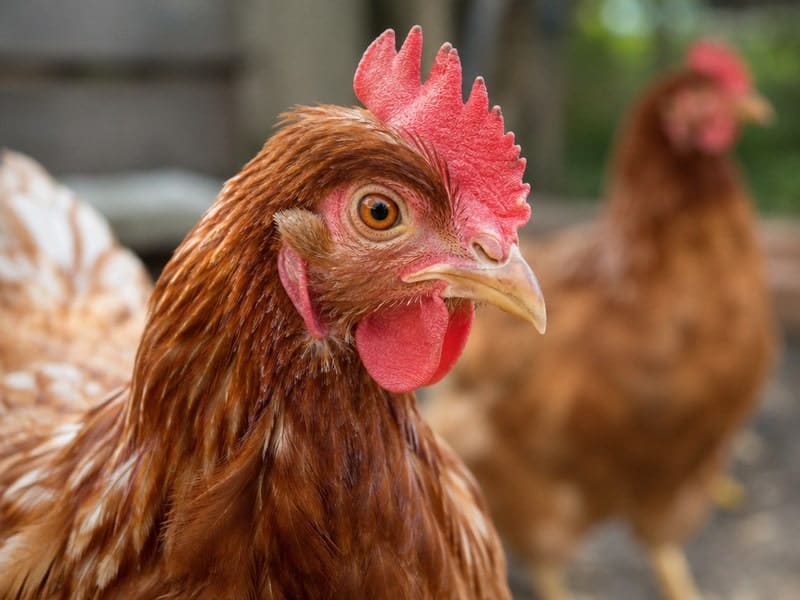
- The red comb on top of a chicken’s head and the wattles hanging below its beak help it shed body heat. Blood flowing through these fleshy parts releases warmth, which matters because chickens can’t sweat.
- Chickens have no teeth. Instead, they swallow small stones and grit that collect in a muscular stomach called the gizzard, where they help grind up food.
- Before food reaches the stomach, it passes into the crop, a pouch in the neck that stores meals temporarily. A chicken with a full crop often has a visible bulge at the base of its neck.
- Chickens have excellent color vision. Their eyes contain four types of color-sensing cones, compared with three in humans, which lets them see ultraviolet light.
- A chicken’s earlobe color often hints at its egg color. Hens with white earlobes commonly lay white eggs, while those with red earlobes often lay brown ones, though there are plenty of exceptions.
- Chickens can fly, but only in short bursts. They mostly use flight to hop onto roosts, escape danger, or flap over fences.
- Silkie chickens stand out with fur-like feathers, black skin, dark bones, and five toes on each foot instead of the usual four.
- Roosters don’t have a penis. Like most birds, chickens mate by briefly pressing their cloacas together, a move often called the cloacal kiss.
- With good care, backyard chickens often live 5 to 10 years, and some live even longer. Hens usually lay the most eggs during their first few years.
Eggs and Chicks

Eggs are the chicken’s most famous product, and their story begins long before breakfast.
- Hens don’t need a rooster to lay eggs. Without a rooster, the eggs are simply unfertilized and will never develop into chicks.
- Making a single egg takes a hen roughly 24 to 26 hours from start to finish. Much of that time is spent building the hard shell.
- Although hens are born with two ovaries, usually only the left one develops and works. The right one typically stays small and inactive.
- Shell color depends on the breed, not on the egg’s nutrition. Araucana and Ameraucana hens are known for laying blue or bluish-green eggs.
- Laying is strongly influenced by daylight. Many hens slow down or stop in the short days of winter, and they usually take a break while molting and regrowing feathers.
- Leghorns are among the most productive laying breeds, and top commercial layers can produce around 300 eggs a year. Most white eggs sold in the United States come from Leghorn-type hens.
- A fertilized chicken egg takes 21 days to hatch when kept warm by a hen or an incubator.
- To break out, a chick uses a tiny pointed tip on its beak called an egg tooth. This temporary tool falls off within a few days of hatching.
- Communication begins before hatching. A mother hen clucks to her developing chicks, and chicks can peep from inside their shells in the days before they emerge.
- A hen that wants to hatch eggs is called broody. She will sit on her nest almost constantly, leaving only briefly to eat, drink, and relieve herself.
Behavior and Communication
Chickens are social, chatty birds with surprisingly complex daily lives.
- The phrase pecking order comes from chickens. Norwegian zoologist Thorleif Schjelderup-Ebbe described the social ranking system after studying how hens establish dominance within a flock.
- Chickens use more than two dozen distinct vocalizations. Their alarm calls are especially specific, with different calls warning of predators in the air and predators on the ground.
- Roosters perform a display called tidbitting, picking up and dropping food while making excited calls. The behavior attracts hens and shows them where to find a meal.
- Roosters don’t crow only at dawn. An internal body clock helps time their morning crowing, but they also crow throughout the day.
- Chickens keep clean by taking dust baths. They wriggle in loose soil and fluff it through their feathers, which helps control mites and lice.
- Chickens are omnivores that eat seeds, plants, insects, and worms. Given the chance, they will even catch and eat small animals such as mice and lizards.
- Chickens can enter a trance-like state called tonic immobility when held still or turned on their backs. Scientists think this freezing response may help prey animals survive an attack.
Chickens in History and Culture
People and chickens have shared a long, sometimes strange history.
- Ancient Egyptians built large brick ovens to incubate chicken eggs artificially. This allowed them to hatch many chicks at once without broody hens. [Learn more: 35 Interesting Facts About Egypt]
- Ancient Romans kept sacred chickens and watched how they ate to judge omens before battles. According to a story told by ancient writers, the commander Publius Claudius Pulcher threw his sacred chickens overboard when they refused to eat before the Battle of Drepana in 249 BC, and his fleet was then defeated.
- The rooster is a national symbol of France. The connection comes partly from Latin, where the word gallus meant both rooster and an inhabitant of Gaul.
- The Rooster is one of the 12 animals of the Chinese zodiac. It is the only bird in the cycle. [Learn more: 50 Fascinating Facts About China: Ancient Civilization]
- In 1945, a rooster in Fruita, Colorado, survived having most of its head cut off and lived for 18 months. Known as Mike the Headless Chicken, he toured as a sideshow attraction, and Fruita later began holding a festival in his honor.
- Chicken eggs play an important role in medicine. Many flu vaccines are produced by growing the virus inside fertilized chicken eggs.
- An intense fear of chickens has its own name: alektorophobia. The term comes from the Greek word for rooster.
Recommended Read:


