
38 Fascinating Facts About DNA: Life’s Blueprint
DNA is the molecule that stores the instructions for building and running living things, from bacteria to blue whales. These facts about DNA cover its elegant structure, the scientists who uncovered it, what it reveals about humans, and the technologies it has inspired. [Learn more: 38 Fascinating Facts About Molecules: Chemistry Basics]
DNA Facts At-a-Glance
Full Name: Deoxyribonucleic acid
Structure: Double helix of two antiparallel strands
Bases: Adenine (A), thymine (T), guanine (G), cytosine (C)
First Isolated: 1869, by Friedrich Miescher
Double Helix Model: 1953, by James Watson and Francis Crick
Human Genome Size: About 3 billion base pairs
Human Chromosomes: 46 (23 pairs)
DNA Basics
At its core, DNA is a surprisingly simple chemical code that produces endless variety.
- DNA stands for deoxyribonucleic acid. It carries the genetic instructions that all known cellular life uses to grow, function, and reproduce, and many viruses use it too.
- The DNA code is written with just four chemical bases: adenine, thymine, guanine, and cytosine. Scientists usually shorten them to A, T, G, and C.
- The bases follow strict pairing rules. Adenine pairs with thymine through two hydrogen bonds, while guanine pairs with cytosine through three.
- DNA’s famous shape is a double helix, which looks like a twisted ladder. The two strands run in opposite directions, an arrangement scientists call antiparallel.
- Each building block of DNA, called a nucleotide, has three parts: a sugar, a phosphate group, and one of the four bases. The sugars and phosphates form the sides of the ladder, and the paired bases form the rungs.
- The sugar in DNA is deoxyribose. Its name reflects that it has one fewer oxygen atom than ribose, the sugar found in RNA.
- In plants, animals, and fungi, most DNA is packed inside the cell nucleus. Mitochondria also carry their own small set of DNA, and so do the chloroplasts in plant cells.
The Discovery of DNA
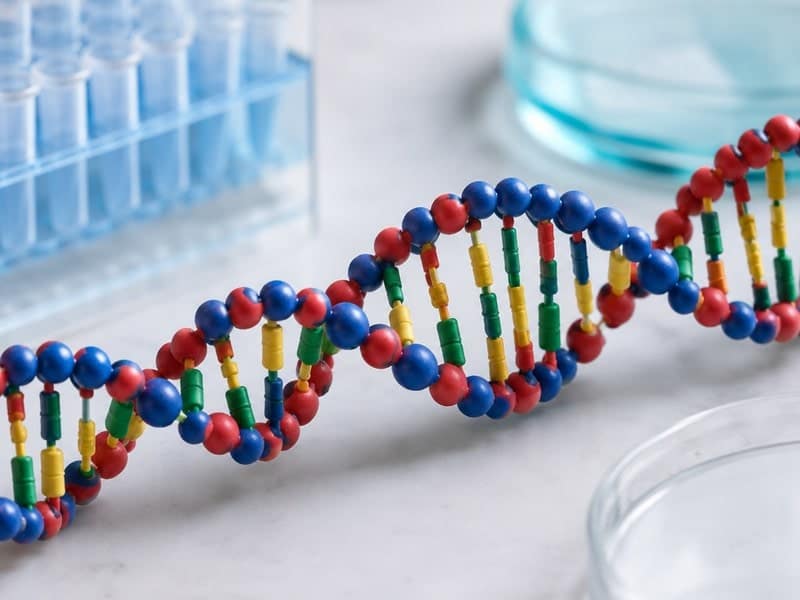
Unraveling DNA took nearly a century of work by chemists, biologists, and physicists.
- Swiss chemist Friedrich Miescher first isolated DNA in 1869. He extracted it from white blood cells found in pus on discarded surgical bandages and called the substance nuclein.
- In 1944, Oswald Avery, Colin MacLeod, and Maclyn McCarty showed that DNA was the substance that could transfer inherited traits between bacteria. Many scientists at the time still assumed proteins carried genetic information.
- In 1952, Alfred Hershey and Martha Chase used viruses that infect bacteria to provide strong further evidence that DNA, not protein, is the genetic material.
- Biochemist Erwin Chargaff found that in DNA, the amount of adenine matches the amount of thymine, and guanine matches cytosine. These observations, known as Chargaff’s rules, became a key clue to DNA’s structure.
- James Watson and Francis Crick published their double helix model in the journal Nature in 1953. Their work relied heavily on X-ray diffraction data from Rosalind Franklin, including the famous image known as Photo 51.
- Watson, Crick, and Maurice Wilkins shared the 1962 Nobel Prize in Physiology or Medicine for their DNA work. Rosalind Franklin had died in 1958, and the Nobel Prize is not awarded posthumously.
- In 1958, Matthew Meselson and Franklin Stahl showed that DNA copies itself semiconservatively. Each new double helix keeps one original strand and gains one freshly built strand.
DNA and the Human Genome
The complete set of human DNA, called the genome, is both enormous and remarkably shared among people.
- The human genome contains about 3 billion base pairs. Most body cells carry two copies, one inherited from each parent.
- Humans typically have 46 chromosomes arranged in 23 pairs. One of those pairs determines biological sex, with XX and XY being the most common combinations.
- Humans have roughly 20,000 protein-coding genes. Only around 1 to 2 percent of the genome directly codes for proteins.
- If the DNA from a single human cell were unwound and stretched out end to end, it would measure about 2 meters (6 feet). It fits inside a nucleus far too small to see without a microscope.
- The Human Genome Project began in 1990 and was declared complete in 2003. A truly gapless, end-to-end human genome sequence was not published until 2022.
- Any two people share about 99.9 percent of their DNA. The small remaining difference accounts for much of the genetic variation among individuals.
- Mitochondrial DNA is passed down almost entirely through the mother. In humans, it is a small circular molecule of 16,569 base pairs.
- The Y chromosome is passed from father to son largely unchanged. Because of this, scientists use it alongside mitochondrial DNA to trace ancestry over many generations.
How DNA Works

DNA does not build anything by itself; instead, cells read and copy it with impressive precision.
- Cells read genes in three-letter units called codons. There are 64 possible codons, which together specify 20 standard amino acids plus signals that tell the cell where to stop.
- Information typically flows from DNA to RNA to protein. Francis Crick called this idea the central dogma of molecular biology.
- Enzymes called DNA polymerases copy DNA before a cell divides. They proofread their own work, and additional repair systems fix many of the mistakes that slip through.
- To fit inside cells, DNA wraps around spool-like proteins called histones. Each DNA-and-histone unit is called a nucleosome, and these units pack together into a material known as chromatin.
- Telomeres are protective caps of repeated DNA sequences at the ends of chromosomes. In most body cells, they get shorter each time the cell divides.
Surprising DNA Facts
DNA holds plenty of surprises, from bloated plant genomes to ancient viral leftovers.
- Most bacteria store their main DNA in a single circular chromosome instead of a nucleus. Many also carry small extra DNA rings called plasmids, which can be shared between cells.
- Genome size does not reflect how complex an organism is. The Japanese plant Paris japonica has a genome about 50 times larger than a human’s.
- Roughly 8 percent of the human genome comes from ancient retroviruses. These viruses inserted their genetic material into the DNA of our ancestors’ sex cells, and it was passed down through generations.
- DNA can survive for an astonishingly long time under the right conditions. In 2021, scientists reported recovering DNA from mammoth remains more than a million years old.
- Many people living outside Africa carry about 1 to 2 percent Neanderthal DNA, a trace of interbreeding long ago. Svante Pääbo won the 2022 Nobel Prize in Physiology or Medicine for his work on ancient human genomes.
- Not every virus uses DNA. Some viruses, such as influenza viruses, store their genetic information in RNA instead.
DNA Science and Technology
Learning to read, copy, and edit DNA has transformed medicine, forensics, and research.
- Frederick Sanger developed a widely used DNA sequencing method in 1977. He is one of the few people to win two Nobel Prizes, receiving the Nobel Prize in Chemistry in 1958 and again in 1980.
- Kary Mullis invented the polymerase chain reaction, or PCR, in 1983. The technique can turn a tiny DNA sample into millions of copies, and it earned him the 1993 Nobel Prize in Chemistry.
- British geneticist Alec Jeffreys developed DNA fingerprinting at the University of Leicester in 1984. The method soon became a powerful tool for solving crimes and settling questions of family relationships.
- CRISPR-Cas9 lets scientists edit DNA at precise locations. Jennifer Doudna and Emmanuelle Charpentier shared the 2020 Nobel Prize in Chemistry for developing it as a gene-editing tool.
- Dolly the sheep, born in 1996, was the first mammal cloned from an adult cell. Her birth showed that DNA from a specialized adult cell could still direct the development of an entire animal.
Recommended Read: 50 Mind-Blowing Facts About Nature for Students


