
38 Blazing Facts About Fire: Flames Explained
Fire has warmed, fed, and frightened people for longer than our species has existed. It is a chemical reaction, a force of nature, a tool that shaped human evolution, and a symbol in cultures worldwide. These facts cover the science of flames, the history of taming fire, famous blazes, wildfires, and the myths people have told about it.
Fire Facts At-a-Glance
What It Is: A rapid chemical reaction called combustion
Needs: Heat, fuel, and oxygen (the fire triangle)
Main Products: Heat, light, carbon dioxide, water vapor, and smoke
Oldest Wildfire Evidence: Fossil charcoal from about 420 million years ago
Early Human Use: Evidence from about 1 million years ago
Flame Colors: Yellow-orange from glowing soot, blue from more complete burning
Classical Element: One of the four elements in ancient Greek thought
The Science of Flames
- Fire is the visible result of combustion, a fast chemical reaction in which a fuel combines with oxygen and releases energy as heat and light.
- Firefighters describe fire with a simple model called the fire triangle: heat, fuel, and oxygen. Take away any one of the three and the fire goes out.
- A fuller model, the fire tetrahedron, adds a fourth side for the chemical chain reaction that keeps a fire going. Some extinguishing agents work by interrupting that chain reaction.
- The yellow-orange glow of a candle flame comes mostly from tiny particles of soot that get so hot they shine. This glow from heat is called incandescence.
- A blue flame, like the one on a gas stove burner, usually means the fuel is burning more completely, with less soot. Blue flames are typically hotter than the lazy yellow flames of a candle.
- On Earth, hot gases rise and pull in fresh air, which stretches flames into their familiar teardrop shape. In the microgravity of space, flames have no up or down, so they form dim, rounded balls.
- Different chemical elements color flames in distinct ways, so copper gives a green or blue-green flame, sodium a bright yellow-orange, and strontium a deep red. Fireworks makers use these same chemicals to paint the sky.
Fire on Planet Earth
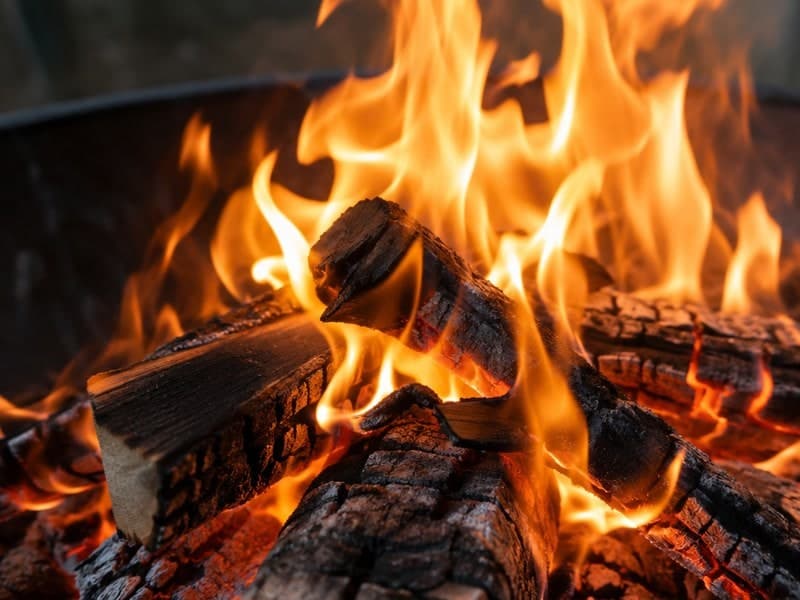
- Fire depends on free oxygen in the air, which plants and other organisms produced over billions of years. As far as scientists know, Earth is the only planet where fire happens naturally. [Learn more: 43 Fascinating Facts About Plants: Green Wonders]
- The oldest known evidence of wildfire is fossil charcoal from about 420 million years ago. That timing fits with the spread of early land plants, which supplied the first fuel.
- Lightning is the main natural cause of wildfires. Volcanic activity can also start fires, but people cause many of the wildfires that burn today. [Learn more: 25 Vivid Facts About Volcanoes: Earth’s Fiery Giants]
- Some plants depend on fire to reproduce. Lodgepole pines, for example, can grow cones sealed shut with resin that open and release seeds after the heat of a fire.
- Very intense wildfires can create their own thunderstorm clouds, known as pyrocumulonimbus clouds. These fire-made storms can produce lightning and spark new fires.
- In 1988, a series of huge fires burned roughly a third of Yellowstone National Park. The event changed how many people viewed fire as a natural part of forest ecosystems.
- Fire managers sometimes set deliberate, carefully controlled fires called prescribed burns. These fires clear built-up dry fuel and can reduce the risk of larger, more destructive wildfires.
- Indigenous peoples in Australia and North America have used planned burning for thousands of years to manage land, encourage new plant growth, and support hunting.
Recommended Read:
How Humans Tamed Fire
- Burned bone and plant ash in Wonderwerk Cave in South Africa suggest that human ancestors were using fire about 1 million years ago. Learning to control fire was one of the most important steps in human history.
- Fire gave early humans warmth, light, protection from predators, and a way to cook food. Cooking makes many foods easier to chew and digest.
- Anthropologist Richard Wrangham has proposed that cooking helped shape human evolution, possibly supporting the growth of larger brains. This idea, often called the cooking hypothesis, is still debated.
- Before matches, people started fires with friction tools like the hand drill and bow drill, or by striking sparks with stones such as flint and iron pyrite.
- Fire made it possible to harden clay into pottery and later to smelt metals like copper and iron. Much of technological history depends on controlling high heat.
- English chemist John Walker invented the friction match in 1826. Striking his match along a rough surface created enough heat to ignite chemicals on its tip.
- Safety matches, developed in Sweden, keep part of the ignition chemistry on the box instead of on the match. That is why they usually light only when struck against the red phosphorus strip on the box.
Fighting Fire

- Ancient Rome had an organized firefighting force called the Vigiles, created under Emperor Augustus. They also patrolled the city at night as watchmen.
- Benjamin Franklin helped found the Union Fire Company in Philadelphia in 1736. It was a volunteer brigade whose members pledged to help protect one another’s property.
- Most deaths in house fires are caused by breathing smoke and toxic gases, such as carbon monoxide, rather than by burns. This is a major reason smoke alarms save so many lives.
- Water should never be thrown on a burning pan of grease or oil. The water turns to steam instantly and can spray flaming oil across a kitchen.
- Flashover is a dangerous moment in a room fire when the heat becomes so intense that nearly everything in the room ignites at once.
Famous Fires in History
- The Great Fire of Rome broke out in AD 64 during Nero’s reign. The popular story that Nero fiddled while Rome burned is a legend.
- The Great Fire of London began in September 1666 in a bakery on Pudding Lane. It destroyed thousands of homes and the old St. Paul’s Cathedral, which Christopher Wren later rebuilt.
- The Great Chicago Fire of 1871 destroyed much of the city. Legend blames Mrs. O’Leary’s cow for kicking over a lantern, but that tale has never been proven.
- The Triangle Shirtwaist Factory fire in New York City in 1911 killed 146 garment workers, many trapped behind locked doors. The tragedy led to major workplace safety reforms.
- An underground coal mine fire has been burning beneath Centralia, Pennsylvania, since 1962. Most of the town’s residents eventually left, and Centralia became famous as a near ghost town.
- On April 15, 2019, fire tore through the roof of Notre-Dame Cathedral in Paris and toppled its spire. The cathedral reopened in December 2024 after a massive restoration.
Recommended Read:
Fire in Myth, Culture, and Ideas
- In Greek mythology, the Titan Prometheus stole fire from the gods and gave it to humanity. As punishment, Zeus chained him to a rock, where an eagle ate his liver every day.
- Ancient Greek thinkers, including Empedocles, counted fire among the four classical elements, along with earth, air, and water.
- In ancient Rome, priestesses called the Vestal Virgins tended the sacred fire of Vesta, goddess of the hearth. The flame was meant to burn continuously as a symbol of the city’s well-being.
- The Olympic flame is lit at Olympia, Greece, using the sun’s rays focused by a curved mirror. The torch relay that carries it to the host city began with the 1936 Berlin Games.
- Scientists once believed burning materials released a substance called phlogiston. In the late 1700s, French chemist Antoine Lavoisier showed that combustion actually involves combining with oxygen.
Recommended Read:


