
20 Gripping Facts About Greenland: Arctic Wonder
Discover interesting facts about Greenland, the world’s largest island and a land of icy wonders. This massive Arctic territory boasts breathtaking landscapes, unique culture, and surprising history.
From its ancient indigenous roots to its modern-day challenges, Greenland offers a wealth of intriguing information. Let’s explore this frozen frontier and uncover what makes it truly special.
Greenland Facts At-a-Glance
Location: North America (autonomous territory of Denmark)
Population: 56,865 (2023 estimate)
Area: 2,166,086 km² (836,330 sq mi)
Capital: Nuuk
Languages: Greenlandic (Kalaallisut), Danish
Religion: Predominantly Lutheran Christianity
Climate: Arctic to subarctic
Sources: World Bank Data, CIA World Factbook
Geography and Natural Wonders
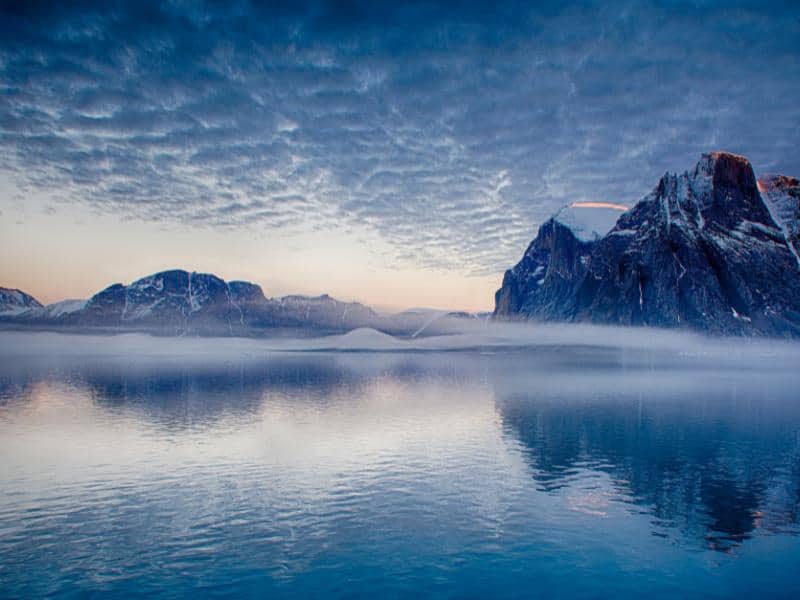
Greenland’s vast landscape is dominated by ice and rugged coastlines, creating a unique and awe-inspiring environment. [Learn more: 20 Fun Facts About The Tundra: Frozen Biome]
1. World’s Largest Non-Continental Island
Greenland is the world’s largest island that isn’t a continent, with an area of approximately 2.17 million square kilometers (836,000 square miles). Despite its massive size, it has a population of only about 56,800 people, making it the least densely populated territory on Earth with just 0.026 people per square kilometer.
2. Home to the Second-Largest Ice Sheet on Earth
The Greenland Ice Sheet covers about 80% of the island’s surface and is the second-largest ice body in the world after Antarctica, containing roughly 10% of the world’s fresh water. If this ice sheet were to melt completely, global sea levels would rise by approximately 7.4 meters (24 feet).
Suggested Read: 50 Amazing Facts About Antarctica: Icy Wonders
3. Contains the World’s Largest National Park
Greenland is home to the world’s largest national park, Northeast Greenland National Park, covering an area of 972,000 square kilometers (375,000 square miles). This vast protected wilderness area represents nearly 45% of Greenland’s total land area and is home to polar bears, musk oxen, Arctic foxes, and numerous bird species.
Discover Interesting Facts About Famous National Parks:
4. Features the Planet’s Largest Fjord System
Greenland has some of the world’s most spectacular fjords, including Scoresby Sund, the largest fjord system on the planet with a length of 350 kilometers (217 miles). Some of these majestic inlets extend over 100 kilometers inland, carved by ancient glaciers that created steep cliff walls rising more than 2,000 meters from the water.
5. Preserves Some of Earth’s Oldest Rocks
Greenland’s ancient geological history is remarkable, with some of the oldest rocks on Earth dating back 3.8 billion years found in the Isua Greenstone Belt. These ancient formations provide scientists with rare insights into Earth’s early development and the origins of life.
6. Experiences Extreme Temperature Variations
Greenland experiences some of the most extreme temperature changes on the planet, with records ranging from -69.6°C (-93.3°F) in the interior ice sheet to 25.9°C (78.6°F) in southern regions. These dramatic temperature variations create unique microclimates supporting surprising biodiversity in some areas.
7. Boasts One of the World’s Smallest Capital Cities

Nuuk, Greenland’s capital and largest city, is one of the smallest capital cities in the world with a population of about 18,800 people. Despite its small size, Nuuk features a blend of traditional Inuit and modern Scandinavian influences, with colorful houses dotting the hillsides against a dramatic backdrop of mountains and fjords.
History and Culture
Greenland’s story encompasses thousands of years of human adaptation and cultural development in one of Earth’s most challenging environments.
8. First Settled by Ancient Paleo-Inuit Peoples
The first humans to inhabit Greenland were the Paleo-Inuit peoples (Saqqaq and Dorset cultures), who arrived around 2500 BCE and survived in the harsh Arctic environment for millennia.
The Thule people, ancestors of modern Inuit Greenlanders, arrived much later around 1200 CE, bringing with them advanced hunting technologies and cultural practices specifically adapted to Arctic living.
9. Named as a Medieval Marketing Strategy
Despite its misleading name, Greenland is mostly covered in ice year-round. The name was given by Erik the Red, who was exiled from Iceland for manslaughter around 982 CE and deliberately named the island “Greenland” as a marketing strategy to attract settlers to the relatively fertile southwestern coast.
10. Operates Under Self-Government Within the Danish Realm

Greenland has been politically connected to Denmark since 1721 when Danish-Norwegian colonization began, but achieved home rule in 1979 and expanded self-government (Self-Government Act) in 2009.
Today, Greenland manages nearly all of its own affairs including education, health, and natural resources, with Denmark retaining control over foreign policy, defense, and providing an annual subsidy of about 3.9 billion Danish kroner.
Suggested Read:
11. Maintains Traditional Inuit Hunting Practices
Inuit traditional hunting practices remain central to Greenlandic culture, with seal, whale, reindeer, and fish hunting not only providing food but serving as important cultural touchstones. These sustainable hunting practices are protected by international agreements recognizing their cultural significance.
12. Moving Toward Potential Full Independence
Greenland’s ongoing political movement toward potential full independence from Denmark represents one of the most significant contemporary indigenous sovereignty efforts. This gradual process could eventually result in the world’s first Inuit nation-state.
Environmental and Economic Realities

Greenland stands at the intersection of global climate change, resource exploitation, and traditional ways of life.
13. Losing Billions of Tons of Ice Annually
Climate change is dramatically affecting Greenland with the ice sheet losing an average of 286 billion tons of ice per year between 2002 and 2020. This rapid melting is not only contributing to global sea level rise but is also exposing minerals and changing traditional ways of life for local communities.
14. Sits Atop Vast Untapped Mineral Resources
Greenland possesses vast mineral resources including rare earth elements, uranium, zinc, lead, iron ore, and potentially oil and gas deposits. The increasing accessibility of these resources due to melting ice has sparked international interest and debates about economic development versus environmental protection.
Unique Features and Phenomena

From natural wonders to distinctive cultural practices, these fascinating facts about Greenland reveal peculiarities not found elsewhere in the world.
15. Experiences Both Midnight Sun and Polar Night
Greenland experiences the midnight sun phenomenon where the sun remains visible for 24 hours during summer months above the Arctic Circle, with the northernmost point experiencing continuous daylight for nearly four months.
Conversely, during winter, parts of Greenland experience polar night with Qaanaaq (Thule) having no direct sunlight for over three months from November to February.
16. Uses One of the World’s Most Complex Languages
Greenlandic (Kalaallisut), the official language of Greenland, belongs to the Inuit branch of Eskimo-Aleut languages and is known for its polysynthetic structure where single words can express what requires entire sentences in other languages.
The word “Nalunaarasuartaateeqqissaaeeqqissaatitalik” (meaning “one who is provided with something that can be used as a radio station again and again”) demonstrates this linguistic characteristic.
17. Functions Without Inter-City Road Networks
Greenland has no roads connecting its towns and settlements, with all inter-town transportation conducted by air, boat, helicopter, dog sled, or snowmobile depending on the season and location.
The capital city of Nuuk has only about 60 kilometers of roads, and most communities are completely isolated from one another by land, creating a unique transportation ecosystem entirely different from most modern societies.
18. Contains One of the World’s Most Productive Glaciers

The Ilulissat Icefjord, a UNESCO World Heritage site since 2004, contains one of the fastest and most active glaciers in the world, Sermeq Kujalleq (Jakobshavn Glacier).
This remarkable glacier calves around 35 billion tonnes of ice annually, producing approximately 10% of all Greenland’s icebergs that drift into Disko Bay and sometimes the North Atlantic, creating a spectacular natural phenomenon visible from both land and sea.
19. Patrolled by Elite Military Dog Sledding Teams
The Sirius Patrol, a Danish elite military unit, conducts dog sled patrols across Northeast Greenland National Park covering thousands of kilometers in extreme conditions. These patrols represent one of the world’s last examples of military dog sledding and help maintain Denmark’s sovereignty claims.
20. Emerging as a Unique Arctic Tourism Destination
Tourism in Greenland centers around unique Arctic experiences including dog sledding, northern lights viewing, iceberg cruises, and visiting the inland ice sheet.
Annual visitor numbers have grown to approximately 100,000 tourists per year, with the industry becoming increasingly important to Greenland’s economy while presenting challenges in balancing development with environmental and cultural preservation.
Explore More Arctic & Nordic Wonders:


