
37 Spooky Facts About Halloween: Ancient Origins
Halloween blends ancient harvest festivals, medieval Christian customs, and modern American fun into one memorable night. These facts trace its journey from Celtic bonfires and carved turnips to costumes, candy, and classic horror films, with a few surprising detours along the way.
Halloween Facts At-a-Glance
Date: October 31
Name Origin: Short for All Hallows’ Eve
Roots: Gaelic Samhain and Christian Allhallowtide
Related Days: All Saints’ Day (Nov 1), All Souls’ Day (Nov 2)
Colors: Orange and black
Symbols: Jack-o’-lanterns, black cats, witches, ghosts
Popular Activities: Trick-or-treating, costumes, pumpkin carving, apple bobbing
Ancient Roots and Early History
Halloween’s story stretches back many centuries and mixes pagan and Christian traditions.
- Halloween is celebrated every year on October 31, the night before the Christian feast of All Saints’ Day on November 1.
- The name is a shortened form of “All Hallows’ Eve,” with “hallow” being an old word for a saint or holy person. It was long spelled “Hallowe’en,” with the apostrophe marking letters dropped from “even,” an old word for evening.
- Many of Halloween’s customs are linked to Samhain, a Gaelic festival marking the end of the harvest and the start of winter. Samhain was observed from October 31 into November 1.
- During Samhain, people in Ireland and Scotland lit large bonfires. It was believed that the boundary between the human world and the supernatural grew thin, allowing spirits and fairies to roam more freely.
- In the 8th century, Pope Gregory III dedicated a chapel in St. Peter’s Basilica to all the saints on November 1. A century later, Pope Gregory IV extended the All Saints’ feast to the entire Western church.
- Halloween opens Allhallowtide, a three-day stretch of All Hallows’ Eve, All Saints’ Day, and All Souls’ Day. All Souls’ Day on November 2 is set aside for remembering the dead.
- In medieval Britain, a custom called souling saw poor people and children go door to door offering prayers for the dead. In return, they received small spiced treats called soul cakes.
- In Scotland and Ireland, children took part in guising, dressing in disguises and visiting homes. They performed songs, poems, or jokes in exchange for food or coins.
- Irish and Scottish immigrants helped bring Halloween traditions to the United States in the 19th century. The large wave of Irish arrivals during and after the Great Famine of the 1840s spread these customs widely. [Learn more: 25 Fascinating Facts About Ellis Island: History Explained]
Recommended Read: 27 Fun Facts About Ireland: Emerald Isle Wonders
Jack-o’-Lanterns and Pumpkins
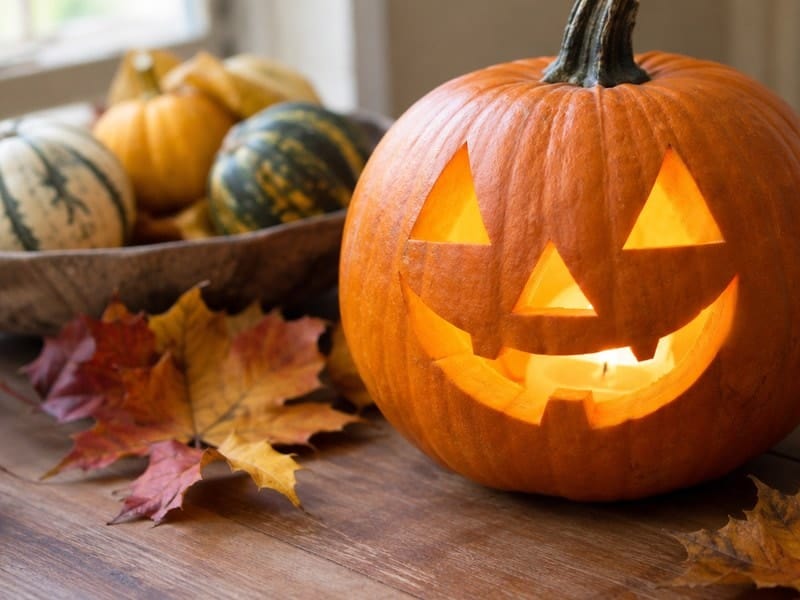
- The first jack-o’-lanterns weren’t pumpkins at all. In Ireland and Scotland, people carved faces into turnips and other root vegetables, while potatoes and beets were also used in parts of the British Isles.
- Legend: An Irish folktale tells of Stingy Jack, a man who tricked the Devil more than once. Turned away from both heaven and hell, he was doomed to wander the night carrying a glowing coal inside a hollowed-out turnip.
- Pumpkins are native to North America, and immigrants found them larger and much easier to carve than turnips. They quickly became the standard jack-o’-lantern in the United States.
- Before it named carved pumpkins, “jack-o’-lantern” was a term for will-o’-the-wisp, the eerie flickering lights sometimes seen over marshes and bogs at night.
- Botanically, a pumpkin is a fruit. It belongs to the gourd family, alongside squash, cucumbers, and melons. [Learn more: 32 Juicy Facts About Pumpkins: Harvest Highlights]
Trick-or-Treating and Treats
- The phrase “trick or treat” appeared in print in North America in the 1920s. One of the earliest known examples comes from a 1927 newspaper report in Alberta, Canada. [Learn more: 155 Captivating Facts About Canada: The Great White North]
- In the early 20th century, Halloween pranks and vandalism became a problem in many American towns. Communities responded by organizing parties, parades, and treat-giving to steer young people toward safer fun.
- Sugar rationing in the United States during World War II put a damper on trick-or-treating. The custom rebounded strongly after the war and became a fixture of suburban life.
- Candy corn dates to the 1880s and is credited to George Renninger of the Wunderlee Candy Company. Its yellow, orange, and white stripes were meant to resemble kernels of corn.
- The Teal Pumpkin Project, launched by Food Allergy Research & Education in 2014, encourages families to place a teal pumpkin outside. It signals that non-food treats are available for children with food allergies.
- Halloween ranks among the biggest candy-selling occasions of the year in the United States, rivaling holidays like Easter.
Games, Symbols, and Superstitions

- Bobbing for apples began as a fortune-telling game in Britain and Ireland. Young people believed that whoever grabbed an apple first might be the next to marry. [Learn more: 43 Juicy Facts About Apples: Orchard Origins]
- In Ireland, Halloween is linked to barmbrack, a fruit bread baked with small objects hidden inside. Finding a ring in your slice was said to predict an upcoming marriage.
- Halloween’s signature colors are orange and black. Orange suggests the autumn harvest, while black evokes darkness, night, and death.
- Black cats became tied to Halloween through European folklore that linked them with witches. In some places, including Britain and Japan, black cats are actually considered good luck.
- An intense fear of Halloween has its own name: samhainophobia, taken from the ancient festival of Samhain.
- On Halloween 2020, the sky featured a full moon that was also a blue moon, the second full moon in a single calendar month.
- In parts of the United States, the night before Halloween is known as Mischief Night, while in Detroit it was long called Devil’s Night. Both names refer to an evening of pranks.
Halloween in Pop Culture and History
- Orson Welles’s radio drama “The War of the Worlds” aired on October 30, 1938, the night before Halloween. Its realistic news-bulletin style startled some listeners, though reports of widespread panic were later exaggerated.
- Famed escape artist Harry Houdini died on Halloween, October 31, 1926.
- “Monster Mash” by Bobby “Boris” Pickett hit No. 1 on the Billboard Hot 100 in 1962. It remains a Halloween party staple decades later.
- The animated special “It’s the Great Pumpkin, Charlie Brown” premiered on CBS in 1966. Linus’s faithful wait in the pumpkin patch made it a seasonal favorite.
- John Carpenter’s horror film “Halloween” was released in 1978, with Jamie Lee Curtis in her first feature film role. Villain Michael Myers’s chilling mask was a modified Captain Kirk mask made in the likeness of William Shatner.
- New York City’s Village Halloween Parade began in 1974, started by puppeteer and mask maker Ralph Lee. It has grown into one of the largest Halloween events in the country.
Suggested Read: Fun Facts About New York City: Quick Guide
Celebrations Around the World
- Salem, Massachusetts, the site of the infamous 1692 witch trials, has become a major Halloween destination. Visitors flock there every October for tours, events, and spooky history.
- Anoka, Minnesota, calls itself the “Halloween Capital of the World.” The town began organizing a community celebration in 1920 to discourage Halloween pranks.
- Mexico’s Día de los Muertos, or Day of the Dead, takes place on November 1 and 2 and is a separate holiday from Halloween. Families honor loved ones who have died with home altars called ofrendas, decorated with marigolds, photos, and favorite foods. [Learn more: 120 Interesting Facts About Mexico]
- Ireland, where many Halloween customs began, still celebrates with traditions such as bonfires, fireworks, costumes, and barmbrack.
Recommended Read:


