
40 Interesting Facts About Japan
Japan is an island nation where ancient shrines stand near neon-lit cities and bullet trains run past snowcapped volcanoes. These facts cover its dramatic geography, long history, distinctive traditions, famous food, and the inventions and pop culture that have reached people around the world.
Japan Facts At-a-Glance
Location: East Asia, in the western Pacific Ocean
Capital: Tokyo
Area: 377,975 sq km (145,937 sq mi)
Main Islands: Honshu, Hokkaido, Kyushu, and Shikoku
Language: Japanese
Government: Constitutional monarchy with a parliamentary system
Currency: Japanese yen
Highest Point: Mount Fuji, 3,776 m (12,388 ft)
Geography and Nature
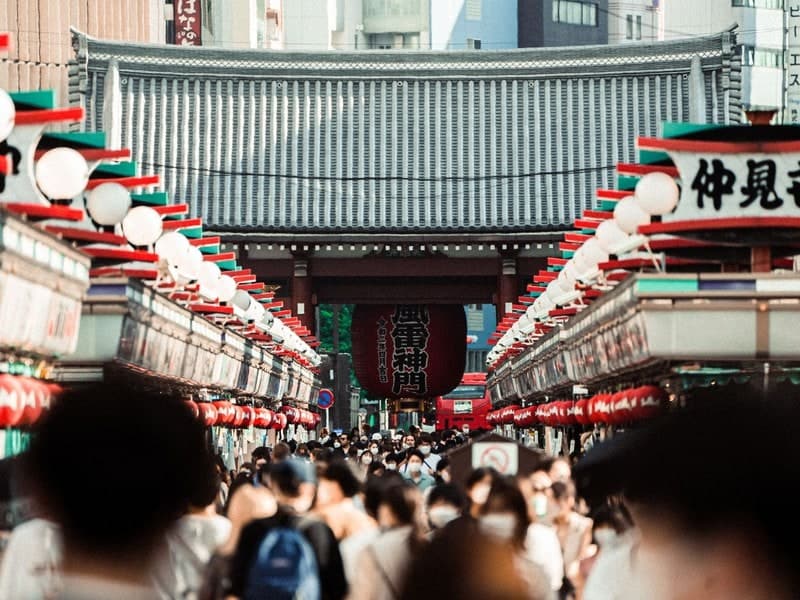
Japan’s landscape is shaped by mountains, seas, and the restless geology beneath it.
- Japan is made up of four main islands: Honshu, Hokkaido, Kyushu, and Shikoku. Honshu is the largest and is home to Tokyo, Osaka, and Kyoto.
- Beyond the four main islands, Japan includes thousands of smaller ones. A 2023 recount by the country’s mapping agency raised the official total to 14,125 islands, more than double the long-cited figure of 6,852.
- Mount Fuji, Japan’s tallest peak at 3,776 meters (12,388 feet), is an active volcano that last erupted in 1707. It was added to the UNESCO World Heritage List in 2013 as a cultural site, recognizing its role in art and religion.
- Japan sits on the Pacific Ring of Fire, where several tectonic plates meet. It has more than 100 active volcanoes and experiences frequent earthquakes.
- On March 11, 2011, a magnitude 9.0 earthquake struck off northeastern Japan and triggered a massive tsunami. The disaster also caused a nuclear accident at the Fukushima Daiichi power plant. [Learn more: 20 Amazing Facts About Tsunamis: Ocean’s Fury Unleashed]
- About two-thirds of Japan is covered by forest, making it one of the most heavily forested developed countries. Much of its population is concentrated on the relatively narrow coastal plains.
- Japanese macaques, often called snow monkeys, live farther north than any other nonhuman primate. At Jigokudani in Nagano Prefecture, some famously soak in hot springs during snowy winters.
- Japan’s climate ranges widely from north to south. Hokkaido has long, snowy winters, while the Okinawa islands in the far south are subtropical.
Recommended Read:
History and Heritage
- The Japanese name for the country, Nihon or Nippon, means “origin of the sun.” That meaning gave rise to the popular nickname “Land of the Rising Sun.”
- Japan’s imperial family is considered the oldest continuous hereditary monarchy in the world. According to legend, the first emperor, Jimmu, founded the line in 660 BCE, though that date comes from mythology rather than historical records.
- Pottery from Japan’s prehistoric Jomon culture is among the oldest known in the world. The name Jomon means “cord-marked,” describing the patterns pressed into the clay.
- Kyoto served as Japan’s imperial capital from 794 until 1868. Many of its temples, shrines, and gardens are protected together as a UNESCO World Heritage Site.
- The Tale of Genji, written by the court lady Murasaki Shikibu in the early 11th century, is often called one of the world’s first novels. It follows the life and romances of a fictional prince at the Heian court.
- The Tokugawa shogunate ruled Japan from 1603 to 1868, with military leaders holding real power while emperors remained in Kyoto. During much of this era, strict policies sharply limited contact with foreign countries.
- In 1853, US Commodore Matthew Perry arrived with warships to press Japan to open its ports. The Treaty of Kanagawa followed in 1854, ending Japan’s long period of relative isolation.
- The Meiji Restoration of 1868 returned power to the emperor and launched rapid modernization. The same year, the city of Edo was renamed Tokyo, meaning “eastern capital.”
- The United States dropped atomic bombs on Hiroshima on August 6, 1945, and Nagasaki on August 9, 1945. Japan announced its surrender on August 15, ending World War II.
Culture and Traditions

- Written Japanese combines three scripts: kanji characters borrowed from Chinese, plus two phonetic syllabaries called hiragana and katakana. A single sentence often uses all three.
- Shinto and Buddhism have coexisted in Japan for centuries, and many people take part in both traditions. Shinto shrines are often marked by torii gates, while Buddhist temples are commonly associated with funerals.
- Fushimi Inari Taisha in Kyoto is famous for its thousands of bright vermilion torii gates. They form winding tunnels up a wooded mountainside.
- The Ise Grand Shrine, Shinto’s most sacred site, is ritually rebuilt every 20 years. The most recent rebuilding took place in 2013, continuing a tradition more than a thousand years old.
- Hanami, the custom of viewing cherry blossoms, draws crowds to parks every spring. People gather for picnics beneath the trees during the blossoms’ brief bloom.
- Sumo wrestling has deep ritual roots in Shinto, seen in practices like the wrestlers throwing salt to purify the ring. The sport’s highest rank is yokozuna, meaning “grand champion.”
- Haiku is a short form of Japanese poetry built on a pattern of 5, 7, and 5 sound units. The 17th-century poet Matsuo Basho is its most celebrated master.
- Kabuki theater began in the early 1600s and is credited to a female performer named Izumo no Okuni. Today kabuki roles are traditionally played entirely by men, including the female characters.
- The Japanese tea ceremony, known as chanoyu or sado, turns preparing and serving matcha into a careful ritual. The 16th-century tea master Sen no Rikyu shaped many of its guiding ideals.
Food and Flavor
- Washoku, traditional Japanese cuisine, was added to UNESCO’s list of Intangible Cultural Heritage in 2013. It emphasizes seasonal ingredients and balanced presentation.
- Sushi traces back to an ancient method of preserving fish by fermenting it with rice. The hand-pressed nigiri style popular today developed in Edo as a quick street food.
- Momofuku Ando invented instant noodles in 1958 with a product called Chicken Ramen. He later introduced Cup Noodles in 1971.
- In 1908, Japanese chemist Kikunae Ikeda identified umami as a distinct savory taste while studying kombu seaweed broth. His work led to the creation of the seasoning MSG.
- Kobe beef is a famous type of wagyu that comes from Tajima cattle raised in Hyogo Prefecture. It is prized for its rich marbling.
Modern Japan
- Greater Tokyo is often ranked as the most populous metropolitan area in the world. It blends dense business districts with quiet residential neighborhoods and historic temples.
- Japan’s first Shinkansen bullet train line opened on October 1, 1964, linking Tokyo and Osaka. It launched just days before Tokyo hosted the first Olympic Games held in Asia.
- Tokyo Skytree, completed in 2012, stands 634 meters (2,080 feet) tall. It is the world’s tallest tower, though not the tallest building.
- Japan has one of the highest life expectancies in the world. It also has one of the oldest populations, with more than a quarter of its residents aged 65 or older.
- Japan’s legislature is the National Diet, made up of the House of Representatives and the House of Councillors. Under the 1947 constitution, the emperor is a symbol of the state with no governing powers.
- Nintendo was founded in Kyoto in 1889 as a maker of hanafuda playing cards. Decades later it became one of the world’s best-known video game companies.
- Hayao Miyazaki’s Spirited Away won the Academy Award for Best Animated Feature in 2003. It remains one of the most celebrated Japanese animated films.
- Emoji were created in Japan, and Shigetaka Kurita designed an influential early set in 1999. The word combines the Japanese terms for “picture” and “character,” not the English word emotion.
- Karaoke originated in Japan, and its name means “empty orchestra.” The term describes music played without a lead singer so anyone can take the microphone.
Recommended Read:


