
40 Fascinating Facts About Jazz: Swinging History
Jazz grew from African American communities in New Orleans and became one of the most influential art forms in the world. Built on improvisation, rhythm, and conversation between musicians, it has reinvented itself many times. These facts cover its roots, legends, styles, sounds, and lasting impact.
Jazz Facts At-a-Glance
Birthplace: New Orleans, Louisiana, United States
Emerged: Late 1800s to early 1900s
Roots: Blues, ragtime, spirituals, brass bands, and African rhythmic traditions
First Recording: 1917, by the Original Dixieland Jass Band
Major Styles: New Orleans, swing, bebop, cool, hard bop, modal, free jazz, fusion
Hallmarks: Improvisation, swing feel, syncopation, and blue notes
International Jazz Day: April 30
Roots and Origins
- Jazz took shape in New Orleans around the turn of the 20th century. African American musicians blended blues, ragtime, spirituals, work songs, and brass band music into a new sound.
- Congo Square in New Orleans was a gathering place where enslaved Africans played drums, sang, and danced on Sundays. It is often remembered as an important root of the city’s musical traditions.
- Cornetist Buddy Bolden is often named as one of the earliest jazz bandleaders. Despite his legendary reputation in New Orleans, no recordings of his playing are known to survive.
- The first jazz record was made in 1917 by the Original Dixieland Jass Band, a group of white New Orleans musicians. Notice the spelling: “jass” appeared alongside “jazz” in the music’s early years.
- The exact origin of the word “jazz” remains uncertain. Some of the earliest known printed uses appeared in West Coast sports writing in the early 1910s, before the word became tied to music.
- During the Great Migration, millions of Black Southerners moved north and west. Jazz traveled with them, building thriving scenes in Chicago, New York, and Kansas City. [Learn more: 105 Fascinating Facts About Chicago]
- F. Scott Fitzgerald helped popularize the term “Jazz Age” to describe the energetic, rebellious spirit of the 1920s in America.
Recommended Read:
Legendary Musicians
- Louis Armstrong’s Hot Five and Hot Seven recordings, made between 1925 and 1928, helped turn the solo improviser into the star of jazz. His trumpet playing and gravelly voice changed popular music.
- Armstrong helped popularize scat singing, where vocalists improvise with nonsense syllables. According to a popular legend, he started scatting on the 1926 song “Heebie Jeebies” after dropping his lyric sheet.
- Duke Ellington wrote more than 1,000 compositions during his career. His orchestra’s residency at Harlem’s Cotton Club in the late 1920s brought his music to a wide radio audience.
- Count Basie led one of the most celebrated big bands to come out of Kansas City. His band was famous for its relaxed, hard-driving swing and spare piano style. [Learn more: 90 Fascinating Facts About Kansas: The Sunflower State]
- Billie Holiday recorded “Strange Fruit” in 1939. The haunting song protested the lynching of Black Americans and became one of the most powerful protest songs of its century.
- Ella Fitzgerald earned the nickname “The First Lady of Song.” Her Songbook albums, each devoted to a great American songwriter, are treasured recordings of classic popular songs.
- Charlie Parker, nicknamed “Bird,” was a saxophonist whose lightning-fast, harmonically daring solos helped define bebop. He frequently partnered with trumpeter Dizzy Gillespie.
- Thelonious Monk’s quirky harmonies and unusual rhythms made his piano style instantly recognizable. His tune “‘Round Midnight” became one of the most recorded jazz compositions.
- Belgian-born guitarist Django Reinhardt lost the use of two fingers on his fretting hand after a 1928 fire. He developed a new technique and became a founder of Gypsy jazz with violinist Stéphane Grappelli.
Landmark Albums and Moments
- Benny Goodman’s 1938 concert at Carnegie Hall helped establish jazz as concert music, not just dance music. Goodman, known as the “King of Swing,” also led one of the first prominent racially integrated jazz groups.
- Miles Davis released Kind of Blue in 1959. Built around modal jazz, which uses scales rather than fast chord changes, it is frequently cited as the best-selling jazz album of all time.
- Dave Brubeck’s “Take Five,” from the 1959 album Time Out, is written in an unusual 5/4 time signature. The tune was composed by the quartet’s saxophonist, Paul Desmond.
- John Coltrane’s A Love Supreme, released in 1965, is a four-part spiritual suite. It remains one of the most admired recordings in jazz history.
- Getz/Gilberto, featuring “The Girl from Ipanema,” won the Grammy for Album of the Year in 1965. It brought Brazilian bossa nova to a huge international audience.
- Miles Davis’s Bitches Brew, released in 1970, mixed jazz improvisation with electric instruments and rock rhythms. It became a landmark of jazz fusion.
- Wynton Marsalis won the Pulitzer Prize for Music in 1997 for Blood on the Fields. It was the first jazz composition to receive the award.
Styles Through the Decades

- The swing era, from the 1930s to the mid-1940s, made big band jazz America’s popular music. Dance halls filled with crowds moving to orchestras led by Ellington, Basie, Goodman, and others.
- Bebop developed in the 1940s, partly through late-night jam sessions at Minton’s Playhouse in Harlem. It favored fast tempos, complex harmonies, and small groups built for listening rather than dancing.
- Cool jazz offered a calmer, softer alternative to bebop. Miles Davis’s Birth of the Cool sessions became a key starting point for the style.
- Hard bop emerged in the 1950s and drew more heavily on blues and gospel. Drummer Art Blakey’s Jazz Messengers became a famous training ground for young players.
- Free jazz broke away from fixed chord progressions and steady forms. Ornette Coleman’s albums The Shape of Jazz to Come and Free Jazz helped launch the movement.
- Latin jazz blended jazz with Afro-Cuban rhythms. Dizzy Gillespie’s collaboration with Cuban percussionist Chano Pozo on “Manteca” became a classic of the style.
How Jazz Works
- Improvisation is at the heart of jazz. Musicians often play a melody, then take turns inventing new solos over the song’s chord structure.
- Jazz rhythm relies on syncopation and a lilting “swing” feel, where notes are played with an uneven, bouncing pulse instead of strictly even beats.
- Blue notes, bent or slightly lowered pitches borrowed from the blues, give jazz much of its expressive, emotional flavor.
- Many jazz tunes use the 12-bar blues form or the 32-bar AABA song form. So many tunes borrow the chords of George Gershwin’s “I Got Rhythm” that musicians call them “rhythm changes.”
- A typical jazz rhythm section includes piano, bass, and drums. In early jazz, the tuba and banjo often handled the bass line and rhythm before the upright bass and piano became standard.
- When soloists “trade fours,” they take turns improvising four-measure phrases, often with the drummer. It works like a lively musical conversation.
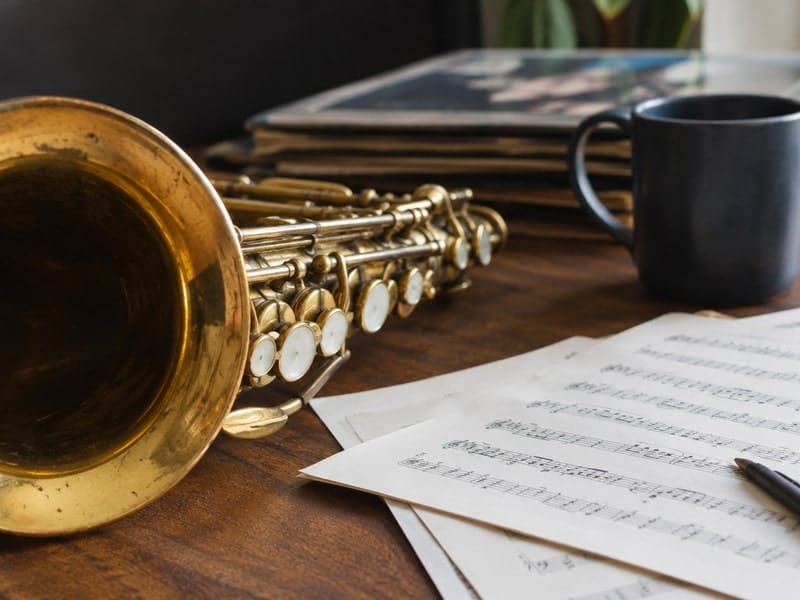
- The saxophone, now a symbol of jazz, was invented by Belgian instrument maker Adolphe Sax in the 1840s, long before jazz existed.
Culture and Legacy
- Blue Note Records was founded in 1939 by Alfred Lion. The label became known for classic recordings and its bold, distinctive album cover designs.
- The Newport Jazz Festival in Rhode Island began in 1954 and became a model for jazz festivals around the world. Switzerland’s Montreux Jazz Festival followed in 1967.
- Starting in 1956, the US State Department sent musicians such as Dizzy Gillespie, Louis Armstrong, Dave Brubeck, and Duke Ellington on international tours. These musicians became known as “Jazz Ambassadors.”
- UNESCO established International Jazz Day in 2011, and it was first celebrated on April 30, 2012. The day honors jazz as a force for dialogue and unity.
- April is Jazz Appreciation Month in the United States, an initiative started by the Smithsonian’s National Museum of American History in 2001.
Recommended Read:


