
39 Dazzling Facts About Light: Radiant Science
Light lets us see the world, powers nearly all life on Earth, and carries messages from the edge of the universe. These facts about light cover what it is, how fast it travels, why we see colors, how living things use it, what it reveals about the cosmos, and how people have turned it into powerful technology.
Light Facts At-a-Glance
What It Is: Electromagnetic radiation, with visible light as the part human eyes can detect
Speed in a Vacuum: 299,792,458 m/s (about 186,282 miles per second)
Visible Wavelengths: Roughly 380 to 750 nanometers
Basic Unit: Photon
Sunlight to Earth: About 8 minutes 20 seconds
One Light-Year: About 9.46 trillion km (5.88 trillion mi)
Key Pioneers: Isaac Newton, Thomas Young, James Clerk Maxwell, Albert Einstein
What Light Really Is
Scientists argued for centuries about the nature of light before arriving at a surprising answer.
- Light is a form of electromagnetic radiation, part of a vast spectrum that runs from radio waves to gamma rays. The visible portion is a narrow band of wavelengths, roughly 380 to 750 nanometers.
- Light travels in tiny packets of energy called photons. A photon has no rest mass, yet it still carries energy and momentum.
- Light behaves like a wave in some experiments and like a stream of particles in others. Physicists call this dual nature wave-particle duality.
- In the early 1800s, Thomas Young shone light through two narrow slits and saw a pattern of bright and dark bands. This interference pattern was strong evidence that light acts like a wave.
- In the 1860s, James Clerk Maxwell developed equations describing electricity and magnetism. They predicted electromagnetic waves traveling at the measured speed of light, revealing that light itself is an electromagnetic wave.
- In 1905, Albert Einstein explained the photoelectric effect, in which light knocks electrons out of metal, by treating light as particles. This work earned him the 1921 Nobel Prize in Physics.
The Speed of Light
- Light travels through a vacuum at exactly 299,792,458 meters per second. The number is exact because, since 1983, the meter has been defined as the distance light travels in 1/299,792,458 of a second.
- In 1676, Danish astronomer Ole Rømer noticed that eclipses of Jupiter’s moon Io arrived earlier or later depending on Earth’s distance from Jupiter. He concluded that light takes time to travel, so its speed is finite.
- Einstein’s special theory of relativity, published in 1905, holds that the speed of light in a vacuum is the same for every observer. It also sets a cosmic speed limit, since nothing with mass can reach it.
- Light slows down when it passes through materials. It moves at about 75% of its vacuum speed in water and about two-thirds of that speed in ordinary glass.
- Sunlight takes about 8 minutes 20 seconds to reach Earth, while moonlight makes the trip in a little over one second. If the Sun suddenly vanished, we wouldn’t notice for more than eight minutes.
- A light-year measures distance, not time: it is how far light travels in one year, about 9.46 trillion kilometers (5.88 trillion miles). Because light takes time to arrive, looking at distant stars means seeing them as they were in the past.
- Particles can travel faster than light does inside a material like water, though never faster than light in a vacuum. When they do, they produce an eerie blue glow called Cherenkov radiation, famously seen in the water around nuclear reactor cores.
Color and the Spectrum
Every color we see comes from light of different wavelengths reaching our eyes.
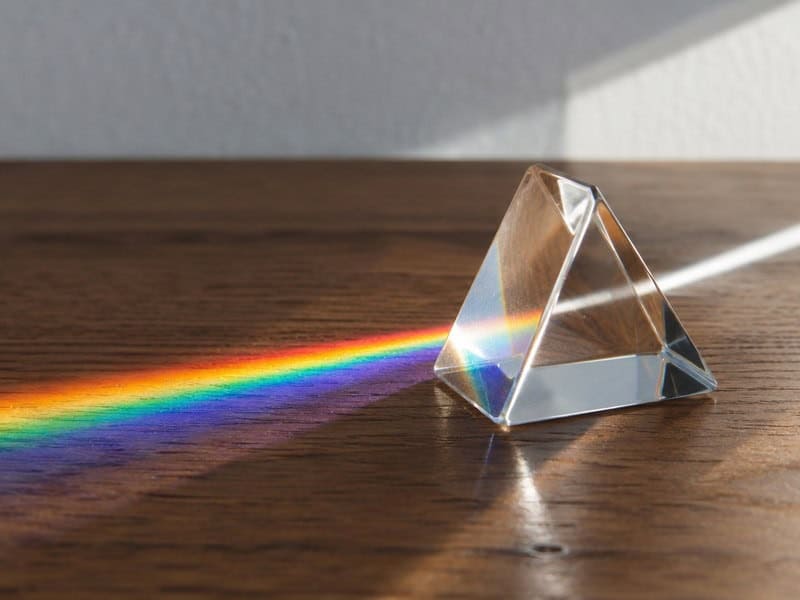
- In the 1660s, Isaac Newton used prisms to split sunlight into a band of colors and then recombine them into white light. His experiments showed that white light is a mixture of all the visible colors.
- Rainbows form when sunlight is refracted, reflected, and spread into colors inside raindrops. In a double rainbow, the fainter outer bow has its colors in reverse order.
- The sky looks blue because air molecules scatter short wavelengths far more strongly than long ones, a process called Rayleigh scattering. The effect grows with the fourth power of the shortening wavelength, so blue light gets scattered across the whole sky.
- Sunrises and sunsets glow red and orange because sunlight passes through much more atmosphere when the Sun is low. Most of the blue light is scattered away before it reaches us, leaving the warmer colors.
- In 1800, William Herschel placed thermometers beyond the red end of a spectrum and found invisible heating rays, now called infrared. Just a year later, in 1801, Johann Ritter discovered ultraviolet light beyond the violet end.
- Shorter wavelengths carry more energy, so violet light is more energetic than red light. That is why invisible ultraviolet light can damage skin and cause sunburn.
- An object’s color depends on which wavelengths it reflects and which it absorbs. A green leaf looks green because it reflects green light while soaking up much of the rest.
- Phone, computer, and TV screens create every color by mixing just three colors of light: red, green, and blue. Combining all three at full strength produces white.
Light and Living Things

- The human retina has two main kinds of light-sensing cells. Rods handle dim light, while three types of cones let us see color in brighter conditions.
- Many insects and birds can see ultraviolet light that humans cannot. Bees, for example, spot ultraviolet patterns on flowers that guide them toward nectar. [Learn more: 10 Interesting Facts About Flowers: Nature’s Masterpieces]
- Plants use light to power photosynthesis, turning water and carbon dioxide into sugar and releasing oxygen. Chlorophyll absorbs mostly red and blue light, which is why plants look green.
- Fireflies, many deep-sea fish, and some fungi make their own light through bioluminescence. The glow comes from a chemical reaction usually involving a molecule called luciferin and an enzyme called luciferase.
- Sunlight helps the human body produce vitamin D. Ultraviolet B rays striking the skin trigger the process.
- Light, especially blue light, signals the brain to reduce production of the sleep hormone melatonin. This helps keep the body’s daily circadian rhythm in sync with day and night.
Light Across the Cosmos
- Einstein’s general relativity predicted that gravity bends the path of light. During a 1919 solar eclipse, an expedition led by Arthur Eddington measured starlight curving around the Sun, confirming the theory.
- Black holes have gravity so intense that not even light can escape once it crosses the boundary called the event horizon. That is why they appear black.
- The oldest light we can detect is the cosmic microwave background, released about 380,000 years after the Big Bang. It once glowed hot, but the universe’s expansion has stretched it into faint microwaves.
- Light from distant galaxies is stretched toward longer, redder wavelengths, an effect called redshift. In 1929, Edwin Hubble showed that farther galaxies have larger redshifts, evidence that the universe is expanding.
- Auroras light up polar skies when charged particles from the Sun collide with gases high in the atmosphere. Oxygen glows green and red, while nitrogen adds blue and purple hues.
Recommended Read: 10 Interesting Facts About Gravity: Force of Nature
Harnessing Light
People have turned light into tools for communication, energy, science, and safety.
- Theodore Maiman built the first working laser in 1960 using a ruby crystal. The word laser stands for light amplification by stimulated emission of radiation.
- Apollo astronauts left special mirrors called retroreflectors on the Moon. Scientists bounce laser pulses off them and time the round trip to measure the Earth-Moon distance with remarkable precision.
- Fiber-optic cables carry information as pulses of light through thin strands of glass. Total internal reflection keeps the light bouncing inside the fiber, and these cables form the backbone of the internet.
- The 2014 Nobel Prize in Physics went to Isamu Akasaki, Hiroshi Amano, and Shuji Nakamura for inventing efficient blue LEDs. Their work made bright, energy-saving white LED lighting possible.
- Solar panels turn sunlight directly into electricity using the photovoltaic effect. Light striking special materials such as silicon frees electrons and creates an electric current.
- In the 1820s, French physicist Augustin-Jean Fresnel designed a lens built from concentric rings of glass. Fresnel lenses made lighthouse beams far brighter and visible from much greater distances.
- Light waves can vibrate in different directions, and sunlight reflecting off water or roads tends to vibrate horizontally. Polarized sunglasses block that horizontal light, cutting glare.
Recommended Read:


