
35 Fascinating Facts About Llamas: Andean Icons
Llamas are gentle, curious, and surprisingly useful animals that have worked alongside people in the Andes for thousands of years. These facts about llamas cover their camel relatives, their high-altitude adaptations, their quirky social habits, and why farmers and scientists value them today.
Llamas Facts At-a-Glance
Scientific Name: Lama glama
Family: Camelidae (camels and their relatives)
Native Region: Andes Mountains of South America
Domesticated: From the wild guanaco, 4,000–5,000 years ago
Adult Weight: 280–450 lb (130–200 kg)
Lifespan: 15–25 years
Diet: Herbivore (grasses and other plants)
Baby Name: Cria
Origins and Family Tree
- The llama’s scientific name is Lama glama, and it belongs to the camelid family. Its relatives include camels, alpacas, guanacos, and vicuñas.
- Llamas were domesticated from the wild guanaco in the Andes Mountains of South America. That process began 4,000–5,000 years ago.
- The camelid family first evolved in North America before spreading to South America and Asia. Camelids later died out in North America at the end of the last ice age.
- There are no truly wild llamas. All llamas are domestic animals, while their close relatives, the guanaco and the vicuña, still live in the wild.
- Llamas and alpacas look alike, but llamas are much larger and have long, curved ears often described as banana-shaped. Llamas were bred mainly as pack animals, while alpacas were bred for their fine fiber.
- Llamas and alpacas can interbreed. Their hybrid offspring are called huarizos.
Built for the Mountains
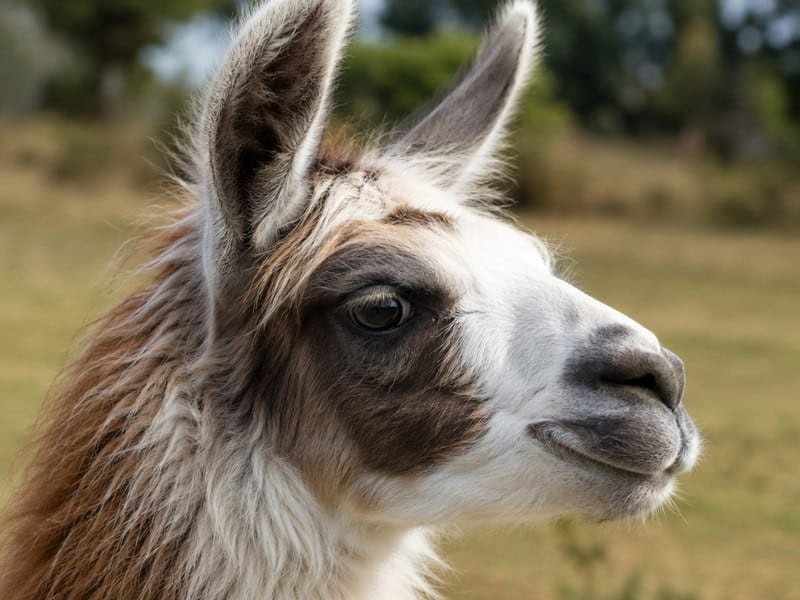
- Adult llamas typically weigh 280–450 pounds (130–200 kilograms). Many stand 5.5 to 6 feet tall at the top of the head.
- Instead of hard hooves, llamas walk on two-toed feet with soft, leathery pads and toenails on top. These padded feet grip rocky ground and are gentle on trails and pastures.
- Llamas have oval red blood cells, a trait shared by other camelids. Their hemoglobin also binds oxygen very efficiently, helping them thrive in thin mountain air.
- Llamas have no upper front teeth. They bite grass against a tough dental pad, and males grow sharp fighting teeth that owners often trim.
- A llama’s stomach has three compartments, and like cows, llamas chew their cud. This system helps them get plenty of nutrition from tough, sparse plants.
- Llamas have a double coat made of a soft undercoat and coarser guard hairs. Their fiber contains no lanolin, the greasy wax found in sheep’s wool.
Behavior and Communication
- Llamas are herd animals that feel safest with companions. A llama kept completely alone can become stressed and anxious.
- Humming is one of the main ways llamas communicate. Mothers and their babies often hum to each other, and llamas may also hum when curious, tired, or uneasy.
- When a llama spots a possible predator, it may give a loud, shrill alarm call. The sound warns the rest of the herd to pay attention.
- Llamas mostly spit at each other to settle disputes over food or rank in the herd. They rarely spit at people unless they have been mishandled, and the spit is mainly partly digested stomach contents.
- A llama herd uses a few shared dung piles rather than leaving droppings everywhere. This tidy habit makes pastures much easier to clean.
- When resting, llamas often lie in a position called kushing, with their legs tucked neatly beneath their bodies. A pack llama may also kush and refuse to move if its load is too heavy.
- Male llamas raised with too much human handling can develop a dangerous condition known as berserk male syndrome. These llamas may treat people as rivals and become aggressive as adults.
Babies and Life Cycle

- A llama pregnancy lasts about 11.5 months. That long gestation means a mother usually has one baby per year at most.
- A baby llama is called a cria, and mothers almost always give birth to just one. Twins are rare.
- Newborn crias are quick to get going. Many stand up and begin nursing within about an hour of birth.
- Female llamas are induced ovulators, meaning mating triggers the release of an egg. This allows llamas to breed at any time of year.
- During mating, male llamas make a distinctive gurgling sound called orgling.
- Llamas usually live 15–25 years, giving owners a long-term companion.
Working Llamas
- Llamas are strong, sure-footed pack animals. A healthy adult can carry about 25–30 percent of its body weight, which makes llamas popular for hiking and trekking.
- Many farmers use llamas as guard animals for sheep and goats. Llamas are naturally alert and will confront or chase off predators such as coyotes and dogs.
- Calm, gentle llamas sometimes work as therapy animals. They visit places like hospitals, schools, and care homes to comfort and cheer people.
- Andean people have long used llama fiber to make yarn, rope, rugs, and textiles. The coarser guard hairs are especially useful for sturdy items like ropes.
- In the high Andes, where trees are scarce, dried llama dung has served as fuel for cooking and heating.
History, Culture, and Science
- Llamas were vital to the Inca Empire. They carried goods across mountainous roads and provided meat, fiber, and animals for religious offerings. [Learn more: 25 Fascinating Facts About Machu Picchu: Lost Inca Wonder]
- Along with alpacas, llamas were the only large domesticated animals in the Americas before European contact.
- The word llama came into English through Spanish, which borrowed it from Quechua, an Indigenous language of the Andes.
- The English word jerky comes from the Quechua word ch’arki, meaning dried meat. Andean peoples preserved meat, including llama meat, by drying it.
- Llamas and other camelids produce unusual, extra-small antibodies made only of heavy chains. Scientists use fragments of these, called nanobodies, in medical research, including studies on COVID-19.
Recommended Read:


