
30 Fascinating Facts About Malta: History & Culture
There are many fascinating facts about Malta packed into just 316 square kilometers, making this small Mediterranean archipelago one of history’s richest destinations. From ancient temples older than Stonehenge to one of the European Union’s smallest capitals, Malta has shaped Mediterranean civilization, endured intense 20th-century warfare, and preserved a unique language and culture that still captivates visitors today.
Malta Facts At-a-Glance
Location: Central Mediterranean Sea, ~93 km south of Sicily
Total Land Area: 316 sq km (one of the world’s smallest countries)
Population: ~520,000 (among the most densely populated countries on Earth)
Capital City: Valletta (widely cited as smallest EU capital by area, 0.8 sq km)
Independence: September 21, 1964 (from Britain); Republic since December 13, 1974
EU Membership: May 1, 2004
Official Languages: Maltese and English
UNESCO World Heritage Sites: 7 sites, including Megalithic Temples and Valletta
Facts About Malta Geography and Natural Features
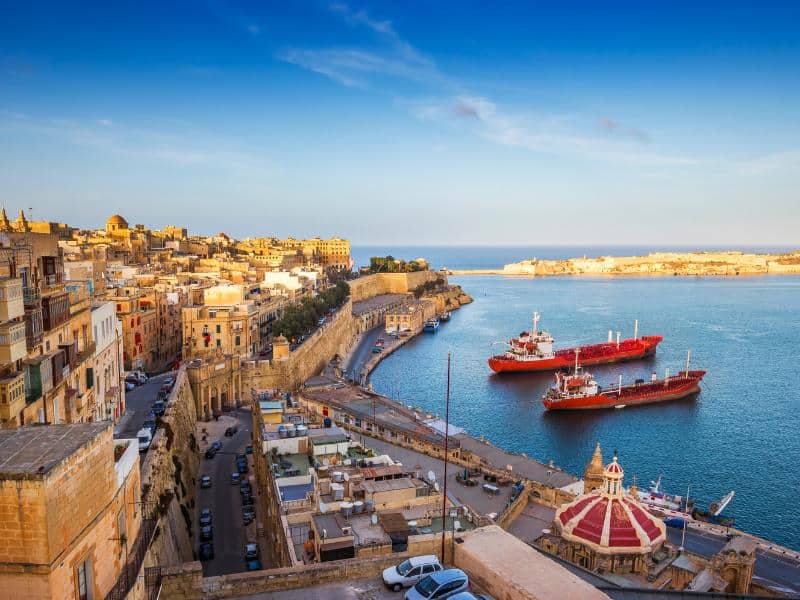
Malta’s geography is as dramatic as it is compact — a sun-drenched archipelago sitting at the crossroads of Europe and Africa in the Mediterranean Sea. Its small size belies an extraordinary variety of landscapes, from sea caves to limestone cliffs.
- Malta is an archipelago nation in the central Mediterranean Sea, located approximately 93 kilometers south of Sicily, Italy, and 288 kilometers north of the African coast of Libya.
- The Maltese archipelago consists of three inhabited islands — Malta, Gozo, and Comino — along with several small uninhabited islets, with a total land area of just 316 square kilometers, making it one of the smallest countries in the world.
- Despite its tiny size, Malta is one of the most densely populated countries on Earth, with approximately 1,500 people per square kilometer and a total population of around 520,000 as of recent estimates.
- Malta has no rivers, lakes, or significant freshwater sources, making it among the most water-scarce countries in the world; the country relies heavily on seawater desalination plants and groundwater extraction to meet its freshwater needs.
- The Blue Grotto, a series of sea caves on the southern coast of Malta, is one of the island’s most famous natural attractions, known for its vivid phosphorescent waters that glow in shades of blue, purple, and green due to underwater algae and light refraction.
- Malta enjoys a classic Mediterranean climate with hot, dry summers and mild, wet winters, averaging over 300 days of sunshine per year, making it among the sunniest countries in Europe.
- Malta was once home to the Azure Window, a natural limestone arch on Gozo that was one of the Mediterranean’s most photographed natural landmarks until it collapsed into the sea during a storm on March 8, 2017.
Suggested Read:
Facts About Malta Ancient History and Prehistoric Sites

Malta’s prehistoric legacy is staggering — its megalithic temples are among the oldest freestanding structures on the planet, and its underground burial sites reveal a sophisticated civilization that flourished thousands of years before recorded history.
- Malta has been continuously inhabited for approximately 7,000 years, with evidence of human settlement dating back to around 5900 BCE when Neolithic farmers arrived, likely from Sicily.
- The Megalithic Temples of Malta, including Ġgantija on Gozo, are among the oldest freestanding stone structures in the world, predating both Stonehenge and the Egyptian pyramids by roughly a thousand years or more, with construction beginning around 3600 BCE.
- The Ġgantija temples on Gozo are so named because Maltese folklore attributed their construction to a race of giants, as the word “ġgantija” derives from the Maltese word for giant.
- Malta has seven UNESCO World Heritage Sites, an extraordinary number for such a small nation, including the Megalithic Temples, the Hal Saflieni Hypogeum, and the historic city of Valletta.
- The Hal Saflieni Hypogeum is a subterranean prehistoric burial site carved entirely by hand from solid rock around 3300 BCE, spanning three levels and containing the remains of approximately 7,000 individuals.
Facts About Malta Medieval and Early Modern History
Malta’s medieval and early modern chapters were shaped by powerful rulers — Arab settlers, crusading knights, and eventually Napoleon himself — each leaving a lasting imprint on the islands’ language, architecture, and identity.
- The Maltese language is the only Semitic language written in the Latin alphabet and is the national language of Malta, having evolved primarily from Siculo-Arabic spoken by Arab settlers who occupied the islands between 870 and 1091 CE.
- The Knights of St. John, also known as the Knights Hospitaller or the Order of Malta, ruled Malta from 1530 to 1798, transforming the islands into a major Mediterranean naval power and leaving behind an enduring architectural and cultural legacy.
- Valletta, the capital city of Malta, is widely cited as the smallest capital city in the European Union by area, covering just 0.8 square kilometers, yet it contains an extraordinary concentration of baroque architecture and cultural monuments.
- Valletta was founded in 1566 by Jean Parisot de Valette, Grand Master of the Knights of St. John, following the Great Siege of Malta in 1565, in which a small Maltese and Knight force repelled a massive Ottoman invasion.
- Napoleon Bonaparte captured Malta from the Knights of St. John in 1798 during his Egyptian campaign, but French rule lasted only two years before the Maltese, aided by the British Royal Navy, expelled the French garrison in 1800.
Suggested Read:
Facts About Malta During British Rule and World War II
Malta’s strategic position in the Mediterranean made it indispensable to the British Empire and a prime target during World War II, when its people endured a siege that became one of the defining stories of civilian courage in modern history.
- Malta became a British Crown Colony in 1814 under the Treaty of Paris and remained under British rule for 150 years, during which time it became a strategically vital naval base in the Mediterranean.
- During World War II, Malta endured one of the most intense aerial bombardments in history, with over 3,000 air raids between 1940 and 1942, dropping reportedly more bombs on Malta than on London during the entire Blitz.
- In recognition of the extraordinary bravery and resilience of the Maltese people during World War II, King George VI awarded the entire island of Malta the George Cross on April 15, 1942 — one of the most exceptional instances of a collective civilian population receiving this honor.
Facts About Modern Malta and Independence

Malta’s post-colonial journey has been swift and successful — from independence in 1964 to EU membership in 2004, the small island nation has carved out a prosperous and diplomatically neutral place on the world stage.
- Malta gained independence from Britain on September 21, 1964, became a republic on December 13, 1974, and joined the European Union on May 1, 2004, as part of the largest single enlargement in EU history.
- Malta adopted the euro as its official currency on January 1, 2008, replacing the Maltese lira, which had been in use since 1972.
- Despite having no standing army in the traditional sense, Malta maintains the Armed Forces of Malta, which includes a maritime squadron, an air wing, and a land force; the country is constitutionally neutral and does not participate in military alliances, though it is a member of NATO’s Partnership for Peace program.
Facts About Malta Language and Culture
Malta’s culture is a vivid blend of Arab, Norman, Spanish, Italian, and British influences, producing a language unlike any other in Europe and a calendar packed with vibrant religious and community celebrations.
- Malta is officially bilingual, with both Maltese and English recognized as official languages; English has been widely spoken since British colonial rule and is used extensively in business, law, and education. [Learn more: 35 Fun Facts About the English Language]
- Malta has a remarkably high proportion of the population identifying as Roman Catholic, at approximately 90 percent; the country has over 360 churches, meaning there is roughly one church for every 1,000 inhabitants.
- The Maltese festa, a traditional village feast day celebrating the patron saint of each town, is a deeply embedded cultural tradition featuring elaborate church decorations, fireworks, brass band marches, and street celebrations, with over 60 festas held annually across the islands.
- The Maltese Cross, an eight-pointed cross that was the symbol of the Knights of St. John, remains one of the most recognized symbols associated with Malta and is still used in the country’s national imagery, decorations, and cultural identity.
Facts About Malta Economy and Modern Industries

Malta has transformed itself into a dynamic, service-driven economy that punches well above its weight, attracting global tourism, international finance, and major film productions to its shores.
- The Maltese economy is heavily service-oriented, with tourism, financial services, online gaming, and pharmaceuticals being among the most significant sectors; tourism alone contributes roughly 15 to 20 percent of GDP, with over 2 million visitors annually in pre-pandemic years.
- Malta served as a major filming location for numerous international productions, including portions of the television series Game of Thrones, the film Gladiator, and Troy, largely due to its ancient architecture, Mediterranean scenery, and favorable filming conditions.
Facts About Malta Wildlife and Natural Heritage

Malta’s natural heritage extends beyond its landscapes to include a piece of literary history, with one of the island’s most prized native creatures inspiring one of the most celebrated crime novels ever written.
- The Maltese Falcon, a breed of peregrine falcon native to Malta, was historically so prized that the Knights of St. John paid an annual tribute of one such falcon to the King of Sicily as rent for the islands — an arrangement said to have inspired Dashiell Hammett’s famous 1930 novel of the same name.
Explore the Vibrant Nations of Europe:
- 50 Interesting Facts About France: History & Culture
- 50 Interesting Facts About Italy: La Dolce Vita
- 25 Fun Facts About San Marino: The World’s Oldest Republic
- 35 Remarkable Facts About Switzerland: Alpine Nation
- 50 Remarkable Facts About Austria: Imperial Legacy
- 35 Fun Facts About Germany You Probably Didn’t Know
- 25 Fun Facts About Liechtenstein: The Alpine Microstate


