
38 Facts About Molecules: Chemistry Basics
Molecules are the tiny building blocks behind nearly everything you touch, breathe, smell, and eat. These facts about molecules cover what they are, how their bonds and shapes work, how small they really are, the molecules that make life possible, and the scientists who uncovered their secrets.
Molecules Facts At-a-Glance
Definition: Two or more atoms held together by chemical bonds
Main Bond Type: Covalent bonds, where atoms share electrons
Simplest Neutral Molecule: Hydrogen (H2)
Typical Size: Less than a billionth of a meter for small molecules like water
Counting Unit: The mole, equal to 6.022 × 10^23 particles
Key Milestone: Avogadro’s hypothesis (1811)
Famous Examples: Water, DNA, carbon dioxide, buckminsterfullerene (C60)
What Molecules Are
- A molecule is a group of two or more atoms joined by chemical bonds. For molecular substances, it is the smallest unit that still keeps that substance’s chemical identity.
- Some molecules contain only one element, such as oxygen gas (O2). Others combine different elements, like water (H2O), which makes them compounds as well as molecules.
- Seven elements naturally pair up into two-atom molecules: hydrogen, nitrogen, oxygen, fluorine, chlorine, bromine, and iodine.
- The hydrogen molecule (H2) is the simplest neutral molecule. It contains just two protons and two electrons.
- Noble gases such as helium, neon, and argon usually exist as single atoms instead of bonding into molecules, because their electron arrangements are already very stable.
- Not every compound is made of separate molecules. Table salt (sodium chloride) is an ionic solid, a repeating lattice of sodium and chloride ions rather than individual molecular units.
- The word “molecule” traces back through French to the New Latin molecula, a diminutive of the Latin moles, meaning “mass.” In other words, it means “little mass.”
Bonds and Shapes
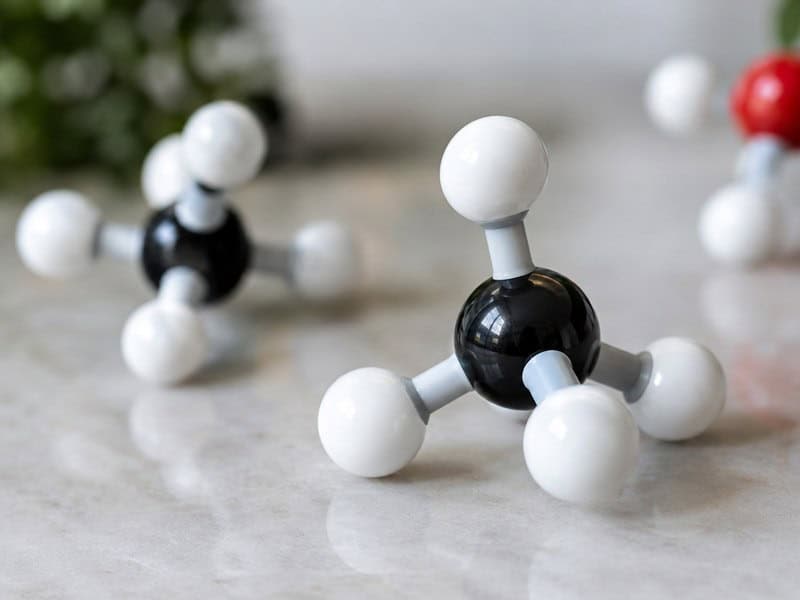
- In a covalent bond, two atoms share a pair of electrons. Double and triple bonds share two or three pairs, which pull the atoms closer together.
- A water molecule is bent rather than straight, with an angle of about 104.5 degrees between its two hydrogen atoms.
- Methane (CH4) has a tetrahedral shape, with its four hydrogen atoms spaced evenly around the central carbon at angles of about 109.5 degrees.
- Carbon dioxide (CO2) is a straight, linear molecule, with the carbon atom sitting directly between two oxygen atoms.
- Water is a polar molecule, meaning its electric charge is unevenly spread, with a slightly negative oxygen side and slightly positive hydrogen sides. This is a big reason water dissolves so many substances.
- Attractions called hydrogen bonds link neighboring water molecules. They help explain water’s surprisingly high boiling point for such a small molecule and its strong surface tension.
- Molecules with the same atoms can have different arrangements. Ethanol and dimethyl ether share the formula C2H6O, yet one is a drinking alcohol and the other is a gas at room temperature.
- Some molecules come in mirror-image forms, like left and right hands. The two forms of carvone show how much this matters: one smells like spearmint and the other like caraway.
Size and Motion
- A water molecule measures less than a billionth of a meter across, far too small to see with an ordinary light microscope.
- One mole of any substance contains 6.022 × 10^23 particles, a figure known as Avogadro’s number. Chemists use it to count molecules by weighing them.
- A mole of water weighs just 18 grams, so a small sip holds an almost unimaginable number of molecules.
- At room temperature, gas molecules in the air zip around at hundreds of meters per second, constantly colliding with one another.
- In 1827, botanist Robert Brown observed tiny particles from pollen jiggling randomly in water. Albert Einstein explained this Brownian motion in 1905 as the result of countless collisions with water molecules.
- Jean Perrin’s experiments confirmed Einstein’s explanation, giving strong evidence that molecules are real. He won the 1926 Nobel Prize in Physics for this work.
- In 2009, IBM researchers in Zurich used an atomic force microscope to capture images of a single pentacene molecule, clearly showing the bonds between its atoms.
Molecules of Life

- DNA is among the largest molecules known. If the DNA in a single human cell were stretched out end to end, it would measure about 2 meters long.
- James Watson and Francis Crick published the double-helix structure of DNA in 1953, a discovery that relied on X-ray diffraction data produced in Rosalind Franklin’s lab.
- Proteins are long chains of amino acids that fold into precise 3D shapes. The standard genetic code uses 20 amino acids to build them.
- Hemoglobin, a protein in red blood cells, carries oxygen from the lungs to tissues throughout the body.
- ATP (adenosine triphosphate) acts as the energy currency of cells, storing and delivering energy for processes like muscle contraction.
- Chlorophyll, the pigment that makes plants green, captures light energy for photosynthesis. A single magnesium atom sits at the center of each chlorophyll molecule.
- Glucose, with the formula C6H12O6, is a simple sugar that plants make through photosynthesis and that many living things use as fuel.
Recommended Read: 43 Fascinating Facts About Plants: Green Wonders
Molecules Around Us and in Space
- The air you breathe is mostly nitrogen molecules (N2), which make up about 78 percent of dry air, followed by oxygen molecules (O2) at about 21 percent.
- Ozone (O3), a three-atom form of oxygen, forms a layer high in the stratosphere that absorbs much of the Sun’s harmful ultraviolet radiation.
- Every scent you notice begins with odor molecules drifting into your nose and binding to specialized receptors.
- Buckminsterfullerene (C60), discovered in 1985, is a hollow cage of 60 carbon atoms shaped like a soccer ball. Robert Curl, Harold Kroto, and Richard Smalley shared the 1996 Nobel Prize in Chemistry for the discovery.
- Molecules are not limited to Earth. Astronomers have detected water, ammonia, and many other molecules in space, and in 2010 NASA’s Spitzer Space Telescope spotted C60 in a planetary nebula.
Discovering Molecules
- In 1811, Amedeo Avogadro proposed that equal volumes of gases at the same temperature and pressure contain equal numbers of molecules. His idea was largely overlooked for decades.
- Stanislao Cannizzaro championed Avogadro’s hypothesis at the 1860 Karlsruhe Congress, helping chemists finally agree on consistent atomic and molecular weights.
- August Kekulé proposed the ring structure of benzene in 1865. By a famous legend he later told himself, the idea came to him in a daydream of a snake biting its own tail.
- The 2016 Nobel Prize in Chemistry honored Jean-Pierre Sauvage, Fraser Stoddart, and Ben Feringa for designing molecular machines, tiny molecules built to move in controlled ways.
Recommended Read:


