
35 Interesting Facts About New Zealand: Epic Wonders
Discover fascinating facts about New Zealand, a country known for its breathtaking landscapes and unique culture. This island nation in the southwestern Pacific Ocean offers an incredible mix of natural wonders, rich Māori heritage, and innovative achievements. From its stunning mountains to its flightless birds, New Zealand continues to captivate visitors from around the world.
New Zealand Facts At-a-Glance
Location: Southwestern Pacific Ocean
Population: Approximately 5 million
Area: 268,021 square kilometers (103,483 square miles)
Capital City: Wellington
Languages: English, Māori, NZ Sign Language (all official)
Religion: Christianity (primary), with significant non-religious population
Climate: Temperate maritime climate with regional variations
Source: Stats NZ (New Zealand’s official data agency)
Geography and Natural Wonders
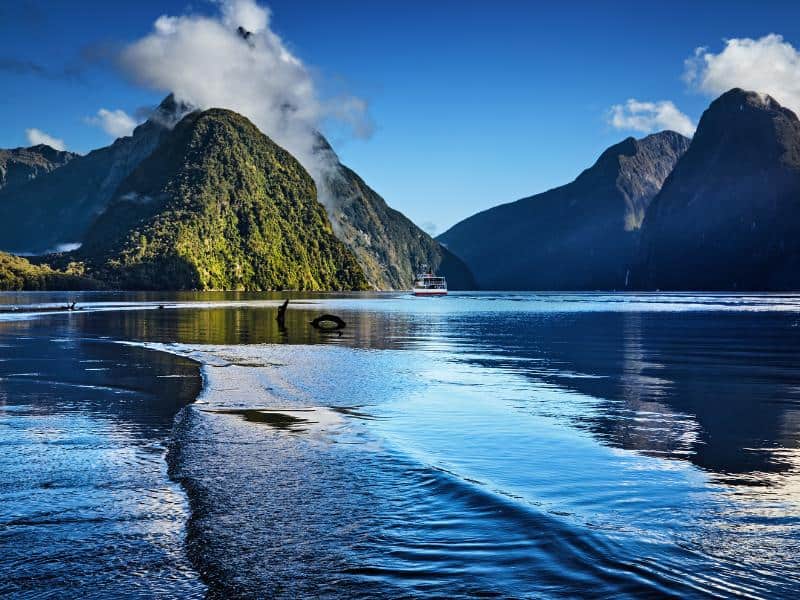
New Zealand’s landscape is incredibly diverse, featuring everything from snow-capped mountains to pristine beaches, active volcanoes, and lush rainforests. This geographical variety has made the country famous as a filming location and adventure tourism destination.
- New Zealand consists of two main islands – the North Island (Te Ika-a-Māui) and South Island (Te Waipounamu) – plus approximately 600 smaller islands scattered across the surrounding Pacific Ocean.
- The country sits on the “Ring of Fire,” a path along the Pacific Ocean characterized by active volcanoes and frequent earthquakes, making it one of the most geologically active places on Earth.
- Milford Sound, described by Rudyard Kipling as the “eighth wonder of the world,” is actually a fjord carved by glaciers during ice ages over millions of years, not a sound as its name suggests. [Learn more: 25 Fascinating Facts About Glaciers]
- New Zealand is home to the Southern Alps, a mountain range running along the South Island with 16 peaks over 3,000 meters high, including Aoraki/Mount Cook at 3,724 meters.
- Lake Taupo, located in the North Island, was formed by a supervolcanic eruption approximately 26,500 years ago – one of the world’s most violent eruptions in the last 70,000 years and still considered an active volcanic system.
- The country experiences some of the most extreme weather variations on Earth, with rainfall in Milford Sound reaching over 6 meters annually, making it one of the wettest inhabited places in the world.
- New Zealand is one of the few countries where you can see the Southern Lights (Aurora Australis), the southern hemisphere’s equivalent of the Northern Lights, particularly from the South Island during winter months.
Suggested Read:
Unique Wildlife and Conservation

Due to its geographical isolation, New Zealand developed a unique ecosystem with many endemic species found nowhere else on Earth. The country’s commitment to conservation has become a cornerstone of its national identity.
- The kiwi, New Zealand’s national symbol, is a flightless bird with nostrils at the end of its long beak, hair-like feathers, and the unusual ability to remember scents for up to three years.
- Before human arrival around 700 years ago, New Zealand had no native land mammals except for three species of bats, making birds the dominant vertebrates in the ecosystem.
- The tuatara, a reptile native to New Zealand, is often called a “living fossil” as it’s the only surviving member of an order that flourished during the age of dinosaurs 200 million years ago.
- New Zealand was once home to the moa, a massive flightless bird that could grow up to 3.6 meters tall and weigh over 250 kilograms, making it one of the tallest birds ever to exist before becoming extinct around 1400 CE.
- The country is home to the world’s only alpine parrot, the kea, known for its intelligence, curiosity, and mischievous behavior that often involves investigating tourists’ belongings and cars.
- Approximately 30% of New Zealand’s land area is protected in national parks and reserves, showcasing the country’s world-leading commitment to conservation and biodiversity protection.
Māori Culture and Heritage
The indigenous Māori people have a profound influence on New Zealand’s identity. Their rich cultural traditions, language, and customs continue to play a vital role in shaping the nation’s character.
- The Māori name for New Zealand is “Aotearoa,” which translates to “land of the long white cloud,” referring to the distinctive cloud formations early Polynesian navigators used to locate the islands.
- The Treaty of Waitangi, signed in 1840 between Māori chiefs and the British Crown, is considered New Zealand’s founding document and established the basis for Māori and European coexistence.
- The haka, a traditional Māori war dance made famous worldwide by the All Blacks rugby team, was originally performed before battle to intimidate opponents and strengthen warrior resolve.
- Māori is one of New Zealand’s three official languages, alongside English and New Zealand Sign Language, and is experiencing a remarkable revival in schools and communities nationwide.
- Traditional Māori tattoos, known as “tā moko,” are considered sacred and tell the story of the wearer’s ancestry, achievements, and social status through intricate geometric patterns.
Suggested Read: 89 Fun Facts About Auckland: The City of Sails
Progressive Achievements

New Zealand has often been at the forefront of social and political progress, establishing several significant “firsts” on the world stage and maintaining a reputation for innovation and forward thinking.
- On September 19, 1893, New Zealand became the first self-governing country in the world to grant women the right to vote in parliamentary elections, led by campaigners like Kate Sheppard who organized massive petition drives.
- New Zealand was the first country to have its three highest positions of power held simultaneously by women: Prime Minister Helen Clark, Governor-General Dame Silvia Cartwright, and Chief Justice Dame Sian Elias from 2001-2006.
- Sir Edmund Hillary, a New Zealander, and Tenzing Norgay were the first people confirmed to reach the summit of Mount Everest on May 29, 1953, earning Hillary a place on the country’s $5 note.
- New Zealand scientist Ernest Rutherford, known as the “father of nuclear physics,” was the first person to split an atom and conduct groundbreaking research on radioactivity, earning him a Nobel Prize in Chemistry.
- The country has been consistently ranked among the least corrupt nations in the world according to Transparency International’s Corruption Perceptions Index, typically placing in the top three globally.
- New Zealand became the first country to introduce the 40-hour work week in 1936 and was among the first to provide universal healthcare and social welfare systems.
Quirky and Fascinating Tidbits

Beyond its natural beauty and cultural significance, New Zealand is home to many unusual and interesting facts that showcase its unique character and global contributions.
- New Zealand currently has approximately 23.3 million sheep compared to 5.2 million people, giving a ratio of about 4.5 sheep per person – though this has dramatically decreased from a peak of 22 sheep per person in the 1980s when the country had 70 million sheep.
- The Lord of the Rings trilogy was filmed entirely in New Zealand, with over 150 locations across both islands serving as Middle-earth, transforming the country into the world’s most famous fantasy filming destination.
- New Zealand is one of the first places in the world to see each new day, with the Chatham Islands experiencing sunrise approximately 45 minutes before the mainland.
- The hill Taumatawhakatangihangakoauauotamateaturipukakapikimaungahoronukupokaiwhenuakitanatahu, at 85 letters, holds the Guinness World Record for the longest place name, though locals simply call it “Taumata Hill.”
- New Zealand has more golf courses per capita than any other country in the world, with over 400 courses serving its small population.
- The country has no snakes, and only one native venomous spider (the katipō), making it one of the safest places on Earth in terms of dangerous wildlife.
- Wellington (New Zealand’s capital city) is the windiest major city in the world, with average wind speeds of 27 km/h, and the southernmost capital city globally.
- New Zealand was the last major landmass on Earth to be settled by humans, with Māori arriving only around 700-800 years ago, making it one of the world’s youngest countries in terms of human habitation.
- The country has more species of penguins (13) than any other nation, including the rare yellow-eyed penguin found only in New Zealand waters.
- Queenstown is considered the adventure capital of the world and was the birthplace of commercial bungee jumping, invented by AJ Hackett in 1988.
- New Zealand produces enough renewable energy to power the entire country during normal rainfall years, with over 80% of electricity coming from hydroelectric, geothermal, and wind sources.
Discover the Remarkable Continents of Our Planet
Across our world’s seven continents, you’ll find extraordinary ecological diversity, rich cultural heritage, and remarkable human achievements that have shaped our global story throughout millennia.
- 35 Fun Facts About Australia: Discover The Land Down Under
- 75 Amazing Facts About Asia: Land of Diversity
- 50 Fascinating Facts About Africa: Cradle of Humanity
- 55 Interesting Facts About North America: A Diverse Continent
- 50 Fascinating Facts About South America: Land of Wonders
- 60 Essential Facts About Europe: A Continental Journey
- 50 Amazing Facts About Antarctica: Icy Wonders


