
30 Fascinating Facts About Nigeria: West African Giant
Nigeria is often called the “Giant of Africa” due to its population, diversity, and cultural influence. These facts about Nigeria cover its history, people, languages, and global impact.
Nigeria Facts At-a-Glance
Location: West Africa, bordering the Gulf of Guinea
Population: Over 220 million (most populous country in Africa)
Capital City: Abuja (since 1991)
Independence: October 1, 1960 (from British colonial rule)
Official Language: English
Area: 923,768 km² (roughly twice the size of California)
Government: Federal republic; 36 states + Federal Capital Territory
Currency: Nigerian Naira (introduced January 1, 1973)
Facts About Nigeria Geography
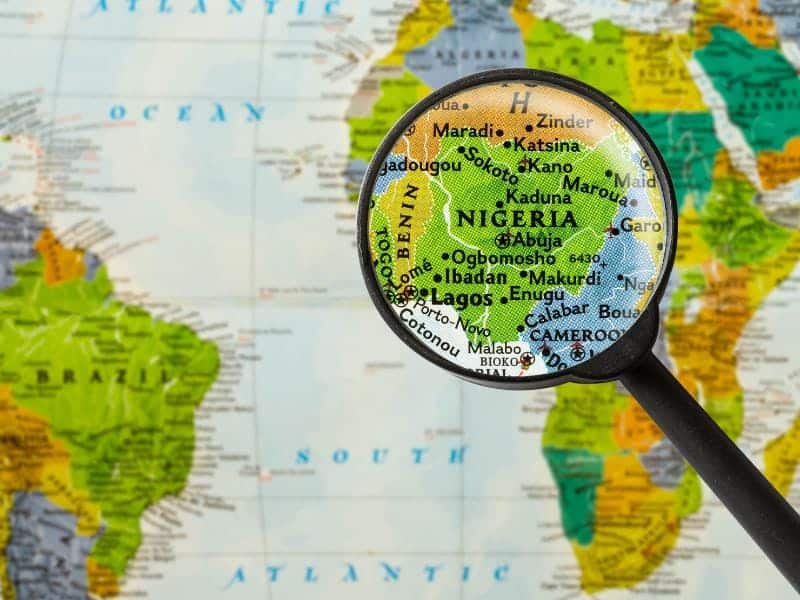
Nigeria’s landscape is one of the most varied on the African continent, stretching from arid savanna in the north to lush rainforest in the south. Its major waterways, highlands, and coastal delta make it a geographically rich and strategically important nation.
- Nigeria is located in West Africa and covers an area of approximately 923,768 square kilometers, making it roughly twice the size of California.
- The Niger River, one of Africa’s principal rivers, flows through Nigeria for approximately 1,400 kilometers before emptying into the Atlantic Ocean through a vast delta. The country’s name is derived from this river.
- Nigeria contains diverse ecosystems ranging from the Sahel savanna in the far north to tropical rainforests in the south, and includes the Jos Plateau, a highland region rising to about 1,829 meters above sea level.
- The Niger Delta region in southern Nigeria contains one of the world’s largest mangrove forests and is among the most oil-rich areas on the planet, producing the majority of Nigeria’s petroleum output.
- The Zuma Rock, a massive monolith located near Abuja, stands approximately 725 meters above the surrounding plains and is a prominent national symbol, even appearing on the 100-naira banknote.
- Yankari National Park in Bauchi State is one of Nigeria’s most important wildlife reserves, home to elephants, hippos, baboons, and various antelope species, as well as the Wikki Warm Springs, a natural warm-water pool.
Facts About Nigeria Demographics and Society

Nigeria’s population is as diverse as it is large, encompassing hundreds of ethnic groups, languages, and religious traditions that coexist — sometimes harmoniously, sometimes tensely — within a single national identity.
- With an estimated population of over 220 million people, Nigeria is the most populous country in Africa and among the ten most populous countries in the world.
- The country is home to more than 500 distinct ethnic groups, with the three largest being the Hausa-Fulani in the north, the Yoruba in the southwest, and the Igbo in the southeast.
- Nigeria has over 500 languages spoken within its borders, making it one of the most linguistically diverse countries on Earth. English serves as the official language, a legacy of British colonization.
- Nigeria has one of the youngest populations in the world, with an estimated 60% of its citizens under the age of 25, presenting both significant economic opportunities and substantial challenges for education and employment.
- Nigeria is home to among the largest Christian and Muslim populations in Africa. The country is roughly split between a predominantly Muslim north and a predominantly Christian south, with indigenous religious practices also present throughout.
Facts About Nigeria Government and Politics
Nigeria’s political structure reflects its complex history of colonial rule, military governance, and democratic transition, resulting in a federal system designed to balance the interests of its many regions and peoples.
- Abuja replaced Lagos as Nigeria’s capital city in 1991. The move was intended to create a more centrally located, neutral capital that did not favor any single ethnic group.
- Lagos is Nigeria’s largest city and one of the fastest-growing cities in the world, with a metropolitan population estimated at over 15 million people, making it one of the largest cities in Africa.
- Nigeria operates a federal system of government with 36 states and one Federal Capital Territory. The constitution adopted in 1999 established the current democratic framework after years of military rule.
Facts About Nigeria History

Nigeria’s history spans ancient kingdoms, transatlantic trade, colonial conquest, and a hard-won independence — each chapter leaving a lasting imprint on the nation’s identity and institutions.
- Nigeria gained independence from British colonial rule on October 1, 1960, a date celebrated annually as Independence Day.
- The country experienced a devastating civil war from 1967 to 1970, commonly known as the Biafran War, in which the southeastern region attempted to secede as the Republic of Biafra. The conflict resulted in an estimated one to three million deaths, many from famine.
- The Benin Kingdom, located in present-day Edo State, Nigeria, was among the oldest and most sophisticated kingdoms in West Africa, dating back to the 11th century. It was renowned for its sophisticated bronze and ivory artwork.
- The famous Benin Bronzes — thousands of brass and bronze sculptures created by the Benin Kingdom — were looted by British forces during the Punitive Expedition of 1897 and scattered across museums worldwide. Repatriation efforts have been ongoing.
- The Trans-Saharan trade routes historically connected Nigeria to North Africa and the Mediterranean world, enabling the ancient Kanem-Bornu Empire in northeastern Nigeria to flourish as a major center of Islamic scholarship and commerce from around the 9th century through the 19th century.
Facts About Nigeria Economy
Nigeria’s economy is the largest on the African continent, powered by oil exports, a vast agricultural sector, and a rapidly expanding services industry that is increasingly driven by technology and entrepreneurship.
- Nigeria is Africa’s largest economy by GDP, with a nominal GDP that has been estimated at over $440 billion as of recent years, driven largely by oil, agriculture, and a growing services sector.
- Nigeria became a major oil producer after petroleum was discovered in commercial quantities at Oloibiri in the Niger Delta in 1956 by Shell-BP. The country joined OPEC in 1971.
- Despite its oil wealth, agriculture remains a critical sector of Nigeria’s economy, employing approximately 70% of the rural workforce. Nigeria is often cited as one of the world’s largest producers of cassava, yams, and sorghum.
- Nigeria’s currency is the naira, which was introduced on January 1, 1973, replacing the pound at a rate of two naira to one pound.
Facts About Nigeria Culture and Arts

Nigeria’s cultural output — from literature and film to music and sacred heritage sites — has earned the country a prominent place on the global stage, influencing art and entertainment far beyond the African continent.
- Nollywood, Nigeria’s film industry, is widely regarded as one of the largest film industries in the world by volume of output, producing thousands of films annually and frequently cited as surpassing Hollywood in sheer number of productions.
- The Nobel Prize in Literature was awarded to Nigerian writer Wole Soyinka in 1986, making him the first African to receive that honor. He is also a playwright, poet, and political activist.
- Chinua Achebe’s novel Things Fall Apart, published in 1958, is one of the most widely read books in African literature and has been translated into more than 57 languages worldwide.
- The Nigerian music genre Afrobeats has achieved massive global popularity in the 21st century, with artists such as Burna Boy, Wizkid, and Davido gaining international recognition and performing at major venues worldwide.
- Nigeria is the birthplace of Afrobeat, a distinct genre pioneered by legendary musician and activist Fela Kuti in the 1970s, which blended traditional Yoruba music with jazz, funk, and politically charged lyrics.
- The Osun-Osogbo Sacred Grove in Osun State is a UNESCO World Heritage Site designated in 2005. It is considered one of the last sacred forests in Yorubaland and is dedicated to the Yoruba goddess of fertility, Osun.
Facts About Nigeria Sports
Sport — particularly football — is a powerful unifying force in Nigeria, and the country has consistently produced world-class athletes who compete and excel on the global stage.
- Nigeria has produced several world-class athletes, including sprinter Blessing Okagbare and multiple Olympic medalists. The country’s football (soccer) national team, the Super Eagles, won the Africa Cup of Nations three times — in 1980, 1994, and 2013.


