
41 Notable Facts About Notre-Dame Cathedral: Gothic Icon
Rising from an island in the Seine, Notre-Dame Cathedral has watched over Paris for more than 850 years. It has hosted coronations and royal weddings, survived revolution and fire, and inspired one of literature's most famous novels. These facts cover its construction, its art, its dramatic history, and its recent rebirth.
Notre-Dame Cathedral Facts At-a-Glance
Location: Île de la Cité, Paris, France
Construction Began: 1163
Generally Considered Complete: 1345
Style: French Gothic
Tower Height: 69 meters (226 ft)
Dedicated To: The Virgin Mary
UNESCO Status: Part of the Paris, Banks of the Seine World Heritage Site (1991)
Reopened After 2019 Fire: December 7, 2024
Origins and Construction
- The cathedral's full name, Notre-Dame de Paris, means "Our Lady of Paris." It is dedicated to the Virgin Mary.
- Notre-Dame stands on the Île de la Cité, an island in the Seine that was the heart of early Paris. Earlier churches occupied the site before the Gothic cathedral was built.
- In 1711, workers digging beneath the choir uncovered the Pillar of the Boatmen. This Roman monument was dedicated to Jupiter by a guild of boatmen in the first century, and it is now displayed at the Musée de Cluny.
- Construction began in 1163 under Bishop Maurice de Sully, who wanted a grand cathedral worthy of a growing capital.
- Building and modifying the cathedral took nearly two centuries. It is generally considered complete in 1345.
- Notre-Dame is the seat of the Archbishop of Paris. Under a 1905 French law, the building is owned by the French state, while the Catholic Church has use of it for worship.
Architecture and Art
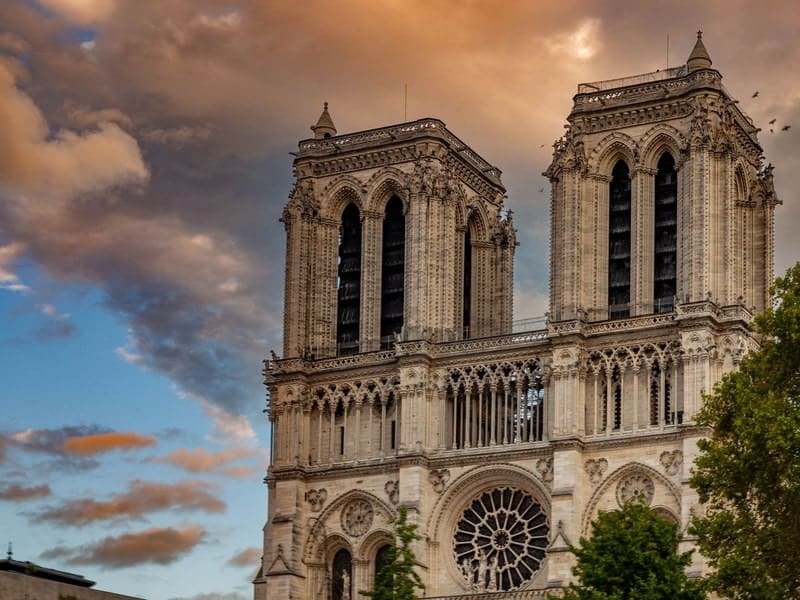
- Notre-Dame is a landmark of French Gothic architecture and was among the earliest major buildings to use flying buttresses. These external supports allowed for thinner walls and larger windows.
- The cathedral measures 128 meters (420 ft) long, and its interior vaults soar about 33 meters (108 ft) above the floor.
- The twin towers on the west facade reach 69 meters (226 ft). Spires were planned to top them, but they were never built, which gave the facade its famously flat-topped look.
- The west facade has three great portals. The central Portal of the Last Judgment is flanked by the Portal of the Virgin and the Portal of Saint Anne.
- Above the portals runs the Gallery of Kings, a row of 28 statues representing the kings of Judah from the Bible.
- Three enormous rose windows fill the cathedral with colored light. The north and south roses, both from the 13th century, are each nearly 13 meters (43 ft) across.
- Notre-Dame's gargoyles are working water spouts that carry rainwater away from the walls. The brooding chimeras on the upper gallery are purely decorative and mostly date from the 19th-century restoration.
- The most famous chimera, known as Le Stryge, rests its chin in its hands and gazes out over Paris.
- The medieval roof framework was nicknamed "the forest" because it was made from a huge number of oak beams, some dating to the 13th century.
- Architect Eugène Viollet-le-Duc added a new spire of oak and lead in the 1860s, rising 96 meters (315 ft). Statues of the apostles surrounded its base, and the figure of Saint Thomas bears Viollet-le-Duc's own face.
Bells, Music, and Treasures
- The cathedral's largest bell, Emmanuel, was cast in 1686 and hangs in the south tower. It weighs about 13 tons and survived the French Revolution, when many of the other bells were melted down.
- A new set of bells was installed in 2013 to celebrate the cathedral's 850th anniversary.
- Notre-Dame's grand organ has nearly 8,000 pipes. The renowned builder Aristide Cavaillé-Coll rebuilt and expanded it in 1868.
- The cathedral safeguards a relic venerated as the Crown of Thorns. King Louis IX acquired it in 1239, and it was carried to safety during the 2019 fire.
- In the square in front of the cathedral is Point Zéro des Routes de France, a bronze marker from which road distances to Paris are measured.
Royal Weddings, Revolution, and Famous Moments

- Mary, Queen of Scots, married the French dauphin Francis at Notre-Dame in 1558.
- In 1572, the Protestant Henry of Navarre married Marguerite de Valois in front of the cathedral. Just days later, the St. Bartholomew's Day Massacre broke out in Paris.
- During the French Revolution, the cathedral was rededicated to the Cult of Reason in 1793, and Catholic worship there was suspended.
- Revolutionaries beheaded the statues in the Gallery of Kings, mistaking the biblical kings for French monarchs. Many of the lost heads were rediscovered in 1977 during construction work elsewhere in Paris and are now at the Musée de Cluny.
- Napoleon was crowned emperor at Notre-Dame on December 2, 1804, with Pope Pius VII present. Napoleon placed the crown on his own head, a scene captured in Jacques-Louis David's huge painting in the Louvre.
- Victor Hugo's 1831 novel "Notre-Dame de Paris," known in English as "The Hunchback of Notre-Dame," made the neglected cathedral famous again. The story centers on Quasimodo, the cathedral's bell ringer.
- Renewed public interest led to a major restoration beginning in 1844 under architects Jean-Baptiste Lassus and Eugène Viollet-le-Duc.
- On August 26, 1944, Charles de Gaulle attended a Magnificat at Notre-Dame to celebrate the liberation of Paris during World War II.
Recommended Read: 35 Intriguing Facts About The Louvre In Paris
The 2019 Fire and Restoration
- On the evening of April 15, 2019, a fire broke out in the cathedral's roof. Most of the roof was destroyed, and Viollet-le-Duc's spire collapsed as crowds watched. [Learn more: 38 Blazing Facts About Fire: Flames Explained]
- Firefighters saved the two towers and the main stone structure. The stone vaults largely held, though parts of them were breached by falling debris.
- Just days before the fire, the 16 copper statues surrounding the spire had been removed for restoration, so they escaped the flames.
- The rooster weathervane that topped the spire was found battered but intact in the debris after the fire.
- Beehives kept on a roof of the cathedral survived the blaze, and their bees were found alive afterward.
- French President Emmanuel Macron pledged to rebuild the cathedral within five years. The spire was faithfully recreated to Viollet-le-Duc's design, and the new roof framework was built from French oak using traditional techniques.
- In December 2023, a new golden rooster with flame-shaped wings was placed atop the rebuilt spire as a symbol of the cathedral's rebirth.
- Notre-Dame officially reopened with a ceremony on December 7, 2024, more than five years after the fire.
Visiting Notre-Dame
- Notre-Dame is part of the Paris, Banks of the Seine World Heritage Site, which UNESCO inscribed in 1991.
- Visitors who climb the towers face 387 steps, rewarded with close views of the chimeras and sweeping views over Paris.
- In the years before the 2019 fire, the cathedral welcomed around 12 million visitors a year, making it one of the most visited monuments in Paris.
- Beneath the square in front of the cathedral, an archaeological crypt displays remains of the ancient and medieval city that once stood on the island.
Recommended Read:


