
36 Juicy Facts About Oranges: Citrus Secrets
Oranges are among the world’s best-loved fruits, peeled for snacks, squeezed for breakfast, and simmered into marmalade. Behind the bright skin is a surprising story of ancient hybrids, traveling traders, lucky mutations, and clever chemistry. These facts about oranges explore where they came from, how they grow, and why they matter.
Oranges Facts At-a-Glance
Scientific Name: Citrus × sinensis (sweet orange)
Plant Family: Rutaceae (the rue or citrus family)
Origin: Region spanning southern China, northeastern India, and Myanmar
Fruit Type: Hesperidium, a specialized berry
Ancestry: Hybrid of pomelo and mandarin
Popular Varieties: Navel, Valencia, blood, Cara Cara
Leading Producer: Brazil
Key Nutrient: Vitamin C
Origins and Names
- The sweet orange is not a wild species. It is an ancient hybrid between the pomelo and the mandarin, two of the original citrus ancestors.
- Oranges first arose in a region that includes southern China, northeastern India, and Myanmar, where citrus has been cultivated for thousands of years. [Learn more: 30 Fascinating Facts About India: Culture, History & Diversity]
- The word orange traces back to the Sanskrit naranga, which passed through Persian and Arabic before reaching Old French and then English.
- English speakers once said ‘a norange.’ Over time the n slid over to the article, and the phrase became ‘an orange.’
- The fruit gave its name to the color, not the other way around. Before the fruit became familiar in England, there was no common English word for that shade.
- In Greek, Turkish, and Romanian, the word for orange is linked to Portugal, because Portuguese traders helped spread sweet oranges around the Mediterranean.
Botany of the Orange
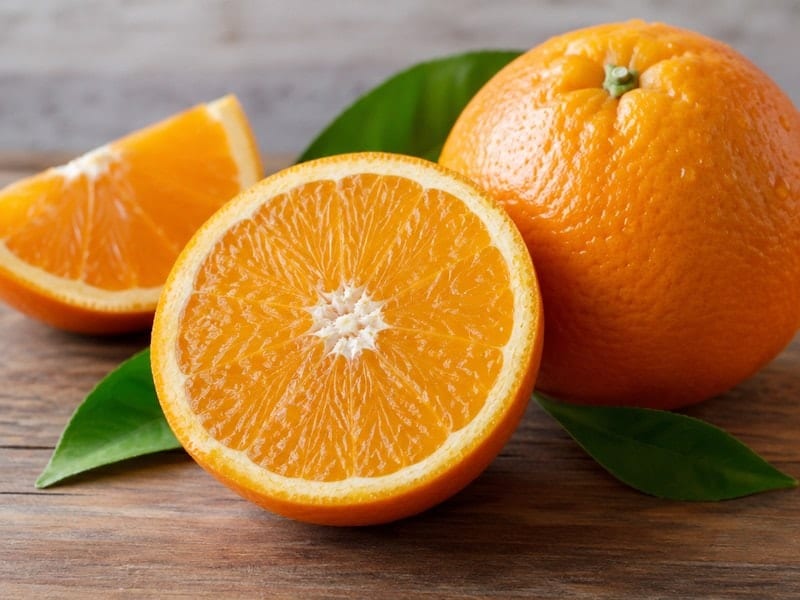
- Botanically, an orange is a hesperidium, a type of berry with a leathery rind and juicy segments inside.
- The colorful outer layer of the peel is called the flavedo, while the white, spongy layer beneath it is called the albedo, better known as the pith.
- Each wedge of an orange is a carpel, and the juice is held inside tiny sacs called juice vesicles.
- Orange trees are evergreen, and a single tree can carry fragrant white blossoms and ripening fruit at the same time.
- Oranges are non-climacteric fruits, which means they do not continue ripening after they are picked. They need to reach full sweetness on the tree.
- A whole orange floats in water because its peel is full of tiny air pockets. Once peeled, the fruit usually sinks.
Recommended Read: 43 Fascinating Facts About Plants: Green Wonders
Color and Varieties
- A ripe orange is not always orange. In tropical climates, the peel often stays green because warm nights never break down the green chlorophyll.
- Commercial growers sometimes expose green-skinned ripe oranges to ethylene gas, a natural plant hormone that helps reveal the orange color underneath.
- Valencia oranges can turn partly green again while still hanging on the tree in warm weather, even though the fruit inside remains ripe.
- Navel oranges get their name from the small, navel-like bump at the blossom end, which is actually a second, undeveloped fruit.
- Because navel oranges are seedless, every navel tree is grown by grafting cuttings onto other rootstock rather than from seeds.
- Blood oranges owe their deep red flesh to anthocyanins, the same pigments found in many berries. Cool nights help the color develop.
- Cara Cara oranges are pink-fleshed navel oranges whose rosy color comes from lycopene, the pigment that also colors tomatoes.
- Valencia oranges are one of the most widely grown juice oranges, prized for their sweet juice and late-season harvest.
History and Culture

- The navel orange began as a natural mutation in Bahia, Brazil, in the early 1800s. In 1873, Eliza Tibbets planted navel trees in Riverside, California, helping launch the state’s citrus industry.
- One of the original navel orange trees planted in Riverside is still alive and is protected as a historic landmark. [Learn more: 100 Interesting Facts About California: The Golden State]
- Christopher Columbus carried citrus seeds to the Americas on his second voyage in 1493, introducing these fruits to the New World.
- Wealthy Europeans of the 17th and 18th centuries built orangeries, glass-fronted buildings for sheltering citrus trees through cold winters. The orangerie at Versailles is a famous example.
- The Dutch royal House of Orange takes its name from the Principality of Orange in southern France, not from the fruit. The Netherlands still celebrates orange as its national color. [Learn more: 45 Fun Facts About The Netherlands: Lowland Wonders]
- During Lunar New Year, mandarin oranges are popular gifts in Chinese communities, where they symbolize good fortune and prosperity.
Flavor, Nutrition, and Science
- Oranges are an excellent source of vitamin C, and a single medium orange can supply most or all of an adult’s daily needs.
- In 1747, Scottish naval surgeon James Lind tested treatments for scurvy among sailors and found that those given oranges and lemons recovered dramatically.
- Orange peel is rich in limonene, a fragrant oil used in cleaning products, perfumes, and flavorings.
- Limonene is flammable, so squeezing a strip of orange peel near a flame can produce a brief burst of sparks. [Learn more: 38 Blazing Facts About Fire: Flames Explained]
- Orange juice tastes unpleasant right after brushing your teeth because a common toothpaste ingredient, sodium lauryl sulfate, dulls sweet taste and makes bitter flavors stand out.
Bitter Oranges and Orange Growing
- The bitter orange, often called the Seville orange, is too sour to eat raw but is the classic choice for British-style marmalade.
- Neroli oil, a prized perfume ingredient, is distilled from the blossoms of the bitter orange tree. Orange blossom water is another fragrant product of these flowers.
- Brazil is the world’s largest orange producer, and much of its crop is turned into orange juice for export.
- In the United States, Florida and California are the main orange-growing states. Florida’s state flower is the orange blossom.
- Citrus greening, also called huanglongbing, is a devastating bacterial disease spread by a tiny insect called the Asian citrus psyllid, and it has severely damaged orange groves in Florida.
Recommended Read:


