
25 Interesting Facts About Oslo: Viking Heritage
These fascinating facts about Oslo reveal a city where Viking heritage, cutting-edge design, world-class museums, and bold sustainability efforts come together between the Oslofjord and ancient forests.
Oslo Facts At-a-Glance
Location: Head of the Oslofjord, southeastern Norway
Population: ~700,000 city proper; over 1 million in greater metro area
Founded: c. 1000 AD, traditionally attributed to King Harald Hardrada
Status: Capital and most populous city of Norway
Climate: Humid continental — cold winters, mild summers
Notable Honor: Host city of the Nobel Peace Prize ceremony since 1901
Winter Olympics: Hosted the 1952 Winter Olympics
Sustainability Goal: Targeting carbon neutrality by 2030
Facts About Oslo Geography and Natural Setting
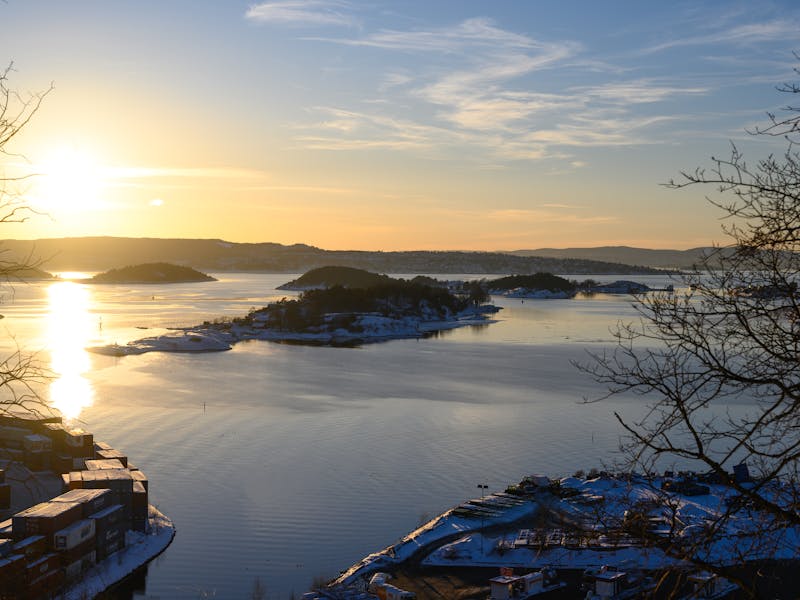
Oslo’s dramatic natural setting — where deep fjord waters meet dense boreal forest — shapes daily life in the city as much as any human-made landmark.
- Oslo is the capital and most populous city of Norway, with a population of approximately 700,000 people in the city proper and over 1 million in the greater metropolitan area, making it home to roughly one-fifth of Norway’s entire population.
- The city sits at the head of the Oslofjord, a 100-kilometer-long fjord that stretches southward into the Skagerrak strait, giving Oslo one of the most scenic natural harbors of any European capital.
- The city experiences a humid continental climate with cold winters and mild summers, receiving approximately 763 millimeters of precipitation annually, and can experience temperatures dropping below minus 20 degrees Celsius during harsh winters.
- The city is surrounded by the Oslomarka, a vast forested area covering approximately 1,700 square kilometers that provides residents with immediate access to hiking, skiing, and outdoor recreation, with over 2,600 kilometers of marked trails.
- Oslo’s drinking water comes directly from Maridalsvannet, a lake located within the city boundaries in the Oslomarka forest; the water quality is considered so high that it requires minimal treatment, and it is frequently cited as among the purest tap water in Europe.
Facts About Oslo History

Oslo’s history stretches from Viking-era settlements through centuries of Danish rule, wartime occupation, and a modern renaissance as a thriving Scandinavian capital.
- The city was founded around 1000 AD, traditionally attributed to King Harald Hardrada, though archaeological evidence suggests settlement in the area dates back even further to the Viking Age and earlier.
- Oslo was renamed Christiania in 1624 by King Christian IV of Denmark-Norway after a devastating fire destroyed the original city, and it kept that name until 1925 when it officially reverted to Oslo.
- Oslo’s Akershus Fortress is a medieval castle built around 1300 AD that is not recorded as having been successfully captured by an enemy, having withstood sieges by Swedish forces on multiple occasions, and it serves today as a museum and venue for state functions.
- Oslo was occupied by Nazi Germany from April 9, 1940, until May 8, 1945, during which time the Norwegian resistance movement operated extensively from the city and surrounding forests, and the occupation profoundly shaped modern Norwegian national identity.
- The city hosted the 1952 Winter Olympics, with the Holmenkollen area serving as the primary venue for skiing events that drew record crowds, cementing Oslo’s reputation as a world-class winter sports destination.
Facts About Oslo Culture and Arts
Oslo punches well above its weight culturally, hosting globally significant art collections, a world-famous sculpture park, and the most prestigious peace prize ceremony on Earth.
- The Nobel Peace Prize has been awarded in Oslo every year since 1901, with the ceremony held at Oslo City Hall each December 10th — the anniversary of Alfred Nobel’s death — making Oslo uniquely associated with this prestigious honor.
- Oslo is home to the Vigeland Sculpture Park, widely regarded as the world’s largest sculpture park dedicated to a single artist, featuring 212 bronze, granite, and wrought iron sculptures created by Gustav Vigeland, spread across 80 acres within Frogner Park.
- The Viking Ship Museum in Oslo houses three of the best-preserved Viking ships in the world, including the Oseberg ship dating from around 820 AD, which was discovered in a burial mound in 1904 and is widely regarded as one of the finest examples of Viking craftsmanship ever found.
- The Munch Museum, which relocated to a striking new waterfront building in 2021, houses the largest publicly held collection of works by Edvard Munch, including multiple versions of his iconic painting The Scream, of which Munch created four versions between 1893 and 1910.
- Oslo has among the highest concentrations of museums per capita in Europe, with over 50 museums within the city limits covering topics ranging from maritime history and folk culture to contemporary art and the history of the resistance.
Facts About Oslo Architecture and Urban Development

From a medieval fortress to a marble opera house you can walk on, Oslo’s built environment spans a thousand years of ambition and reinvention.
- Oslo Opera House, opened in 2008 and designed by the Norwegian architectural firm Snøhetta, features a sloping white marble roof that visitors can walk on, and it won the European Union Prize for Contemporary Architecture in 2009.
- Oslo’s Holmenkollen ski jump, located on a hill overlooking the city, has hosted ski jumping competitions since 1892 and attracts over one million visitors annually, making it one of Norway’s most visited tourist attractions.
- The city’s Barcode district, developed in the 2000s and 2010s along the waterfront, consists of a row of high-rise buildings of varying widths designed to resemble a barcode when viewed from across the fjord, representing one of Oslo’s most dramatic modern urban developments.
- Oslo’s Aker Brygge and Tjuvholmen waterfront districts, developed on former shipyard land, transformed a once-industrial harbor into a vibrant area of restaurants, galleries, and residences, exemplifying the city’s broader waterfront regeneration strategy.
- The Norwegian Parliament building, known as the Stortinget, was completed in 1866 and is located on Karl Johans gate — the main street of Oslo — which stretches from Oslo Central Station to the Royal Palace and serves as the ceremonial spine of the city.
Facts About Oslo Demographics and Society

Oslo is one of Europe’s most diverse cities, shaped by decades of immigration that have transformed its cultural fabric.
- The city is home to approximately 180 nationalities, with immigrants and Norwegian-born people with immigrant backgrounds making up around 33 percent of Oslo’s population, reflecting significant demographic changes since the 1970s.
Facts About Oslo Quality of Life and Economics
Oslo’s reputation for exceptional livability comes with a well-known trade-off: it is one of the most expensive cities on the planet.
- Oslo is consistently ranked among the most expensive cities in the world for cost of living, with prices for everyday goods, housing, and services significantly exceeding those in most other European capitals.
- Oslo consistently ranks among the top cities globally for quality of life, regularly appearing near the top of international surveys measuring factors such as safety, healthcare, education, and environmental quality.
Facts About Oslo Transportation and Sustainability
Oslo is widely regarded as a global leader in urban sustainability, combining an integrated public transport network with some of the world’s most ambitious climate commitments.
- Oslo’s public transportation system includes buses, trams, a metro system called the T-bane, ferries, and suburban trains, and the city has set a goal to become carbon neutral by 2030 — among the most ambitious climate targets set by any major city.
- The city has one of the highest rates of electric vehicle adoption in the world, with electric cars accounting for over 80 percent of new car sales in Norway in recent years, supported by generous government incentives and an extensive charging infrastructure.
Explore Fascinating Facts About Europe’s Iconic Capitals
Quick insights and highlights from some of the continent’s most famous cities.
- 125 Interesting Facts About London England
- 101 Fun Facts About Rome: Discover The Eternal City
- 120 Fascinating Facts About Athens
- 50 Fun Facts About Paris: The City of Light Unveiled
- 30 Interesting Facts About Budapest: Vibrant Culture & History
- 30 Fun Facts About Lisbon: Where Trams Meet Traditions
- 35 Fun Facts About Copenhagen: From Vikings to Michelin Stars
- 100 Interesting Facts About Vienna: The City of Dreams
- 25 Fun Facts About Helsinki: Top-Tier Quality of Life
- 30 Interesting Facts About Madrid: Spanish Capital
- 108 Interesting Facts About Amsterdam


