
25 Fascinating Facts About Papua New Guinea
There are countless surprising facts about Papua New Guinea that make this Pacific nation one of the most extraordinary places on Earth — a land of staggering biodiversity, ancient cultures, and dramatic landscapes that few countries can rival.
Nestled just north of Australia on the second-largest island in the world, Papua New Guinea is widely regarded as packing more linguistic diversity, wildlife richness, and cultural complexity into its borders than almost anywhere else on the planet, offering endless fascination for travelers, researchers, and curious minds alike.
Papua New Guinea Facts At-a-Glance
Location: Eastern half of New Guinea island, southwestern Pacific Ocean, north of Australia
Population: Approximately 10 million
Capital City: Port Moresby
Independence: September 16, 1975 (from Australian administration)
Official Languages: Tok Pisin, Hiri Motu, and English
Government Type: Constitutional monarchy with parliamentary democracy
Highest Point: Mount Wilhelm — 4,509 m (14,793 ft)
Number of Languages Spoken: Over 800 distinct languages (~12% of all world languages)
Facts About Papua New Guinea Geography
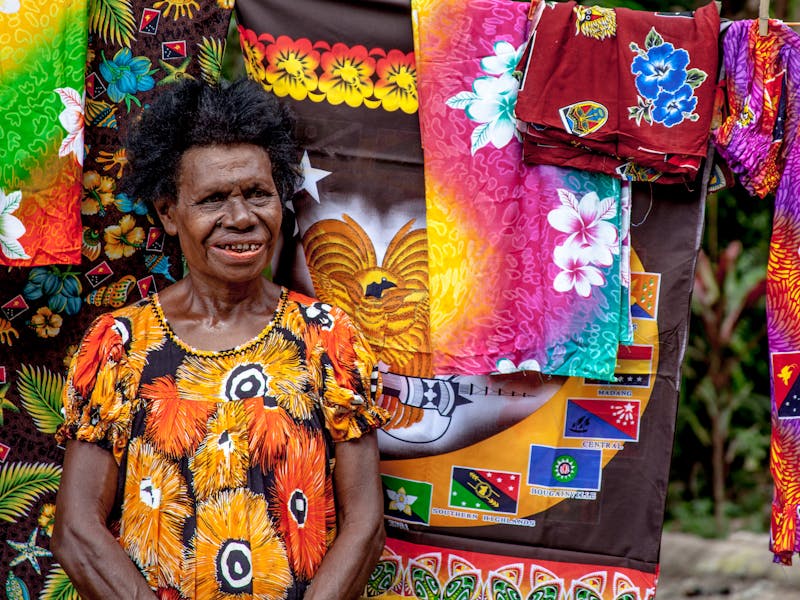
Papua New Guinea’s physical landscape is as dramatic as it is diverse, spanning rugged mountain ranges, vast river systems, and a coastline teeming with marine life.
- Papua New Guinea (PNG) occupies the eastern half of the island of New Guinea, the second-largest island in the world, and is located in the southwestern Pacific Ocean just north of Australia.
- The capital city is Port Moresby, located on the southeastern coast of the mainland, and it is the largest city in the country with an estimated population of approximately 400,000 people.
- Papua New Guinea is part of the Pacific Ring of Fire and experiences frequent volcanic activity and earthquakes; the country has at least 14 active volcanoes, including Tavurvur near Rabaul, which erupted dramatically in 1994 and buried much of the town in ash.
- The Sepik River, stretching approximately 1,126 kilometers (700 miles), is one of the longest rivers in the Asia-Pacific region and serves as a vital artery for transportation and trade for communities living along its banks.
- Mount Wilhelm, standing at 4,509 meters (14,793 feet) above sea level, is the highest peak in Papua New Guinea and is among the highest mountains in the Pacific region, attracting trekkers from around the world.
Facts About Papua New Guinea Environment and Biodiversity

Papua New Guinea is a global biodiversity hotspot, sheltering some of the planet’s rarest and most spectacular wildlife within its ancient rainforests and coral-rich seas.
- Papua New Guinea is home to the Coral Triangle, one of the most biodiverse marine ecosystems on the planet, making its coastal waters a world-renowned destination for scuba divers and marine biologists.
- The country contains some of the world’s last remaining pristine tropical rainforests, covering approximately 70% of its land area, and these forests are among the most biologically rich tropical forests on Earth.
- Papua New Guinea is one of the few places in the world where birds of paradise are found in the wild; the country is home to around 38 of the approximately 42 known species of these spectacularly plumed birds, though exact counts vary by taxonomic authority.
- Papua New Guinea is home to the tree kangaroo, a remarkable marsupial that has adapted to life in the rainforest canopy; several species are found exclusively on the island of New Guinea and are considered vulnerable or endangered due to habitat loss and hunting.
Papua New Guinea History
Papua New Guinea’s history spans tens of thousands of years of indigenous settlement, a dramatic colonial era, fierce World War II battles, and a relatively recent path to independence.
- The country gained independence from Australian administration on September 16, 1975, making it one of the more recently independent nations in the Pacific region.
- The Highlands region of Papua New Guinea was largely unknown to the outside world until 1933, when Australian gold prospectors Michael Leahy and his brothers flew over the area and discovered that approximately one million people were living in the fertile mountain valleys.
- The Kokoda Track, a 96-kilometer mountain trail through the Owen Stanley Range, was the site of a brutal World War II campaign in 1942 between Australian and Japanese forces, and today it is a significant pilgrimage route for Australians honoring their military history — much like Australia itself holds deep ties to this chapter of Pacific history.
- Cannibalism was historically practiced by certain tribes in Papua New Guinea, and the country gained international medical attention in the 1950s when scientists discovered kuru, a fatal prion disease spread through ritual consumption of human brain tissue among the Fore people of the Eastern Highlands.
- Australian-born scientist Daniel Carleton Gajdusek won the 1976 Nobel Prize in Physiology or Medicine for his research into kuru disease conducted among Papua New Guinea’s Fore people, which ultimately contributed to the understanding of prion diseases including Creutzfeldt-Jakob disease.
Facts About Papua New Guinea Language and Culture

No country on Earth rivals Papua New Guinea’s linguistic and cultural complexity — a mosaic of over a thousand distinct peoples, each carrying their own living traditions.
- Papua New Guinea is one of the most linguistically diverse countries on Earth, with over 800 distinct languages spoken — approximately 12% of all the world’s languages — within a population of roughly 10 million people.
- Tok Pisin, an English-based creole language, serves as the most widely spoken lingua franca across the country, alongside Hiri Motu and English as the three official languages.
- Papua New Guinea has an extraordinarily high level of cultural diversity, with over 1,000 distinct ethnic groups, each with its own traditions, customs, art forms, and social structures.
- The Huli Wigmen of the Southern Highlands are widely regarded as one of the most photographed indigenous groups in the world, known for their elaborate wigs made from their own hair, decorated with feathers and flowers for ceremonial purposes.
- The Asaro Mudmen, from the Eastern Highlands Province, are one of Papua New Guinea’s most iconic cultural groups, known for wearing large clay masks and covering their bodies in gray mud during traditional ceremonies, a practice rooted in a legend about frightening enemy tribes by appearing as spirits from the river.
Papua New Guinea Government and Politics
Papua New Guinea operates under a Westminster-style parliamentary system inherited from its colonial past, blending modern governance with deeply rooted indigenous traditions.
- The country has a constitutional monarchy with the British monarch as head of state, represented locally by a Governor-General, while a Prime Minister leads the elected government.
- The country’s flag features a bird of paradise on a black and red background divided diagonally, with the Southern Cross constellation on the black half, symbolizing the nation’s connection to both its indigenous heritage and the Pacific region.
Facts About Papua New Guinea Economy
Papua New Guinea’s economy is driven by abundant natural resources, though the benefits of extraction have not always reached the majority of its rural population.
- Gold and copper are the country’s most significant mineral exports, with the Ok Tedi mine and the Porgera gold mine being among the largest and most economically important mining operations in the nation.
- Papua New Guinea’s economy is heavily dependent on resource extraction, with liquefied natural gas (LNG) becoming a major export following the launch of the PNG LNG project in 2014, operated largely by ExxonMobil.
- The country’s agricultural sector employs the majority of the population, with coffee, cocoa, copra, palm oil, and vanilla being among the most important cash crops grown for export.
Papua New Guinea Social Issues
Despite its rich cultural heritage and natural wealth, Papua New Guinea faces serious social challenges that continue to draw international attention and calls for reform.
- Papua New Guinea is widely reported as having one of the highest rates of violence against women in the world, with studies suggesting that up to two-thirds of women have experienced physical or sexual violence, prompting significant international concern and ongoing reform efforts.
Discover the Remarkable Continents of Our Planet
Across our world’s seven continents, you’ll find extraordinary ecological diversity, rich cultural heritage, and remarkable human achievements that have shaped our global story throughout millennia.
- 75 Amazing Facts About Asia: Land of Diversity
- 50 Fascinating Facts About Africa: Cradle of Humanity
- 55 Interesting Facts About North America: A Diverse Continent
- 50 Fascinating Facts About South America: Land of Wonders
- 60 Essential Facts About Europe: A Continental Journey
- 50 Amazing Facts About Antarctica: Icy Wonders


