
25 Fascinating Facts About Paraguay: Guaraní Nation
These facts about Paraguay reveal a landlocked South American nation where 90% of the population speaks the indigenous Guaraní language, the world’s second-largest hydroelectric dam powers the economy, and a unique blend of indigenous and Spanish colonial heritage creates one of the continent’s most distinctive cultures.
Paraguay Facts At-a-Glance
Location: South America (landlocked), bordered by Brazil, Argentina, and Bolivia
Population: Approx. 6,844,146 (est. 2025)
Area: 406,752 km² (157,048 sq mi)
Capital City: Asunción
Languages: Spanish and Guaraní (both official)
Religion: Approximately 96% Christian (predominantly Roman Catholic)
Climate: Subtropical with no dry season, hot summers (up to 45°C/113°F), mild winters
Source: World Bank Group
Geography
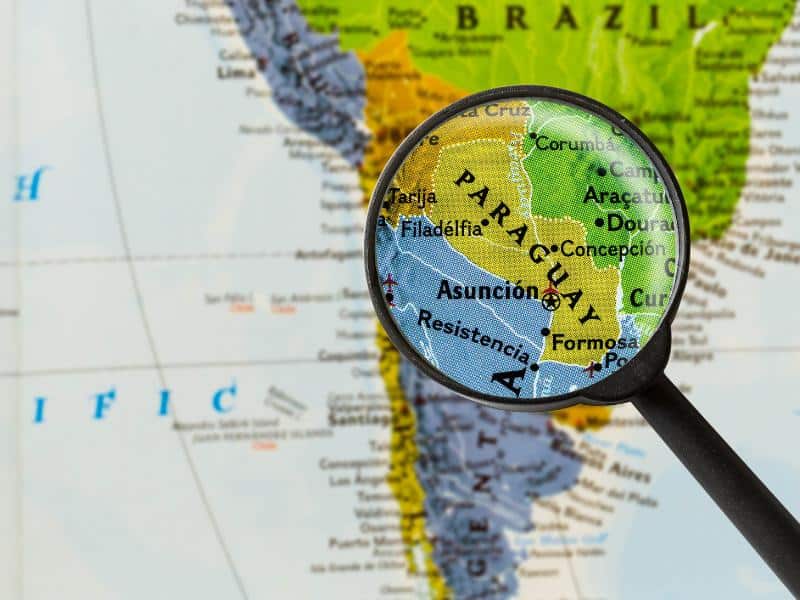
- Paraguay is one of only two landlocked countries in South America (along with Bolivia), bordered by Brazil to the north and east, Argentina to the south and west, and Bolivia to the northwest, covering an area of 406,752 square kilometers.
- The Paraguay River divides the country into two distinct regions: the eastern region (Región Oriental), which is fertile and densely populated, and the western region called the Chaco (Región Occidental), a vast, sparsely populated plain that covers about 60% of the country’s territory.
- The country experiences a subtropical climate with no dry season, receiving abundant rainfall year-round. Temperatures can reach up to 45°C (113°F) in summer, while winters are mild with temperatures rarely dropping below 0°C (32°F).
- The country has a unique water wealth, with the Guaraní Aquifer beneath its territory representing one of the world’s largest freshwater reserves, shared with Brazil, Argentina, and Uruguay, containing enough water to supply the world’s population for 200 years.
- Paraguay is home to the Pantanal wetlands in the north, shared with Brazil and Bolivia, which represents the world’s largest tropical wetland area and supports an incredible diversity of wildlife including jaguars, giant otters, and over 650 bird species.
Suggested Read: 10 Interesting Facts About Wetlands
Facts About Paraguay’s History

- Paraguay’s capital and largest city, Asunción, was founded in 1537 by Spanish explorer Juan de Salazar y Espinosa, making it one of the oldest cities in South America and earning it the nickname “Mother of Cities” for being a launching point for other colonial settlements.
- Paraguay fought the devastating War of the Triple Alliance (1864-1870) against Brazil, Argentina, and Uruguay, which resulted in the death of an estimated 60-90% of Paraguay’s male population and remains one of the most destructive conflicts in South American history.
- Paraguay has a unique political distinction as the birthplace of liberation theology in Latin America, and it was the last country in South America to transition from military dictatorship to democracy, ending Alfredo Stroessner’s 35-year rule in 1989.
- The Jesuit Missions of La Santísima Trinidad de Paraná and Jesús de Tavarangue are UNESCO World Heritage Sites, representing the remains of 17th and 18th-century Jesuit reductions that created unique communities blending European and indigenous Guaraní cultures.
Language and Demographics
- The country is officially bilingual, with both Spanish and Guaraní holding equal status as official languages. Remarkably, about 90% of the population speaks Guaraní, making Paraguay one of the most successful examples of indigenous language preservation in the Americas.
- Paraguay’s population of approximately 7 million people is remarkably homogeneous, with about 95% being mestizo (mixed European and indigenous ancestry), making it one of the most ethnically uniform countries in South America.
Culture and Arts

- Paraguay’s flag is unique among world flags as it displays different emblems on each side: the national coat of arms on the front and the seal of the treasury (featuring a lion) on the reverse, making it one of only three national flags with different designs on each side.
- The traditional Paraguayan harp, featuring 36 to 40 strings, is considered the national instrument and has influenced folk music throughout South America. The country also gave birth to the distinctive polka paraguaya and guarania musical styles.
- Paraguay is famous for its production of yerba mate, the caffeinated herbal tea that is central to social culture throughout the Southern Cone. Paraguayans consume it both hot (mate) and cold (tereré), with tereré being particularly popular during the hot summer months.
- Augusto Roa Bastos, Paraguay’s most celebrated author, won the prestigious Cervantes Prize in 1989 for his contributions to Spanish-language literature, including his masterpiece “I, the Supreme,” which explores the dictatorship of José Gaspar Rodríguez de Francia.
- The country is known for its distinctive cuisine, including dishes like sopa paraguaya (a cornbread-like dish despite its name meaning “Paraguayan soup”), chipa (cheese bread), and asado (barbecued meat), reflecting both indigenous and Spanish culinary influences.
- Paraguay has no official religion, but approximately 96% of the population identifies as Christian, with Roman Catholicism being predominant. However, many indigenous spiritual practices and beliefs continue to influence daily life and cultural traditions.
Paraguay’s Economy and Infrastructure

- The country is home to the world’s second-largest hydroelectric dam, Itaipu, built jointly with Brazil on the Paraná River. This massive structure generates about 90% of Paraguay’s electricity and 20% of Brazil’s, making Paraguay one of the world’s largest exporters of hydroelectric power.
- The country has one of South America’s fastest-growing economies, largely due to its agricultural exports, particularly soybeans, corn, wheat, and beef. Paraguay is the world’s fourth-largest soybean exporter and sixth-largest beef exporter.
- Ciudad del Este, Paraguay’s second-largest city, sits at the tri-border area with Brazil and Argentina and is known as one of the largest commercial centers in South America, famous for its duty-free shopping and bustling markets.
- Paraguay’s economy operates with one of the lowest tax burdens in South America, with no personal income tax for residents and a corporate tax rate of only 10%, making it attractive for international businesses and investors.
- The Trans-Chaco Highway, completed in the 1960s, stretches 700 kilometers across the challenging Chaco region, connecting Paraguay to Bolivia and representing one of South America’s most ambitious infrastructure projects through difficult terrain.
- The Mennonite colonies in the Chaco region represent one of the most successful examples of agricultural development in harsh conditions. These German-speaking communities have transformed parts of the semi-arid Chaco into productive farmland and dairy operations.
- Paraguay is home to over 100,000 plant species, including valuable medicinal plants used in traditional Guaraní medicine. The country’s biodiversity includes 200 mammal species, 650 bird species, and numerous endemic species found nowhere else on Earth.
- Paraguay maintains diplomatic relations with Taiwan instead of mainland China, making it one of only 13 countries worldwide to officially recognize Taiwan, a relationship that has provided significant agricultural and technological cooperation benefits to Paraguay’s development.
Explore More South American Countries
Continue your journey through South America by discovering the unique characteristics and cultural treasures of Bolivia’s neighboring nations.
- 20 Fascinating Facts About Bolivia: Landlocked Legacy
- 30 Fun Facts About Brazil: Samba, Sun, and Soccer
- 95 Fun Facts About Argentina: Heritage and Modernity
- 37 Interesting Facts About Chile: The Country Of Poets
- 50 Interesting Facts About Peru: Land of Incas
- 25 Fascinating Facts About Paraguay: Guaraní Nation


