
29 Crunchy Facts About Popcorn: Fun Snack
Popcorn is one of the world’s oldest snacks and one of its most entertaining to make. It starts as a hard little kernel and bursts into a fluffy treat. Its story runs from ancient South America to world’s fairs, movie theaters, and microwave ovens. These facts cover the science, history, and culture behind every crunchy handful.
Popcorn Facts At-a-Glance
Scientific Name: Zea mays everta
Plant Type: A variety of flint corn (maize)
Popping Temperature: About 180°C (356°F)
Oldest Known Evidence: Peru, about 6,700 years ago
Popped Shapes: Butterfly (snowflake) and mushroom
Nutrition: Whole grain
US Celebration: National Popcorn Day, January 19
The Science of the Pop
- Popcorn is a special variety of maize known as Zea mays everta, and it belongs to the flint corn family. Only certain corn varieties pop reliably, so sweet corn from the dinner table won’t turn into a bowl of popcorn.
- Each kernel has a hard, moisture-sealing outer shell called the pericarp, which surrounds a starchy interior known as the endosperm. That tough hull makes popping possible because it traps steam inside until the pressure is too strong to hold.
- A small amount of water inside the kernel does the real work. When heated, the water turns to steam and builds pressure, and kernels pop best when their moisture content is about 14 percent.
- Kernels typically burst at about 180°C (356°F). At that point, the hull ruptures and the softened starch puffs out, then quickly cools and sets into the airy foam we eat.
- A 2015 high-speed camera study found that the familiar pop sound is linked to the sudden release of water vapor, not simply the hull cracking. The same research showed that kernels jump because a burst of expanding starch pushes against the pan like a tiny leg.
- Unpopped kernels at the bottom of the bowl are often nicknamed “old maids.” They usually fail because their hulls are damaged or because they have too little moisture to build enough pressure.
Shapes, Colors, and Varieties
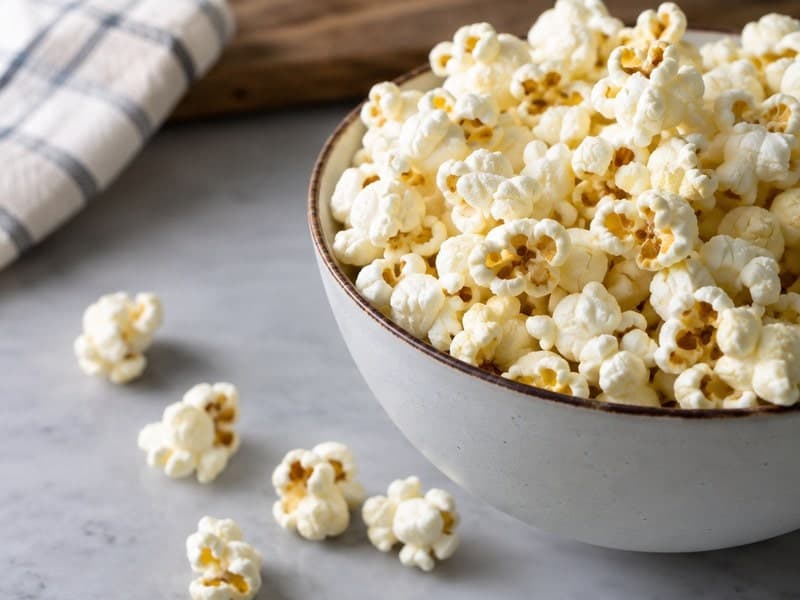
- Popped kernels come in two main shapes: butterfly, also called snowflake, and mushroom. Butterfly popcorn has irregular wings, while mushroom popcorn forms a round, compact ball.
- Butterfly popcorn is the classic choice for movie theaters and home snacking because its wings are light and catch toppings easily. Mushroom popcorn is sturdier, which makes it a favorite for candy coatings like caramel corn.
- Popcorn kernels can be yellow, white, red, blue, or even black. The color sits mainly in the hull, so the popped flakes of most varieties look white or cream-colored.
- So-called hulless popcorn still has hulls. These varieties simply have thinner hulls that break into smaller pieces, so they are less likely to get stuck in your teeth.
- Corn isn’t the only grain that pops. Sorghum can be popped in a similar way, and popped amaranth is the main ingredient in a traditional Mexican sweet called alegría.
Ancient Origins
- The oldest known popcorn comes from Peru, where archaeologists found corncobs and kernels dating back about 6,700 years. Some of the remains showed signs that the corn had been popped.
- Spanish accounts from the 1500s describe the Aztecs using popped corn in religious ceremonies. Popcorn decorated statues and was worn in garlands and headdresses.
- A popular legend says Native Americans brought popcorn to the first Thanksgiving in 1621. This is a legend: historians have found no evidence that popcorn was served at that feast. [Learn more: 25 Fun Facts About Thanksgiving Day: America’s Feast]
Recommended Read: 50 Interesting Facts About Peru: Land of Incas
Popcorn Goes Commercial

- Charles Cretors of Chicago built the first commercial steam-powered popcorn machine. He introduced it to the public at the 1893 World’s Columbian Exposition in Chicago, which allowed vendors to pop corn fresh wherever crowds gathered. [Learn more: 89 Fun Facts About Illinois: Prairie Stories]
- Cracker Jack, a mix of caramel-coated popcorn and peanuts, earned lasting fame through the 1908 song “Take Me Out to the Ball Game.” The line “Buy me some peanuts and Cracker Jack” tied the snack to baseball for generations.
- During the Great Depression, popcorn was one of the few treats many families could still afford. It sold for just a few cents a bag, and its popularity soared while many other businesses struggled.
- Sugar rationing in the United States during World War II limited candy production. Americans turned to popcorn instead, which helped boost its consumption even further.
At the Movies and in the Kitchen
- Early movie theaters often banned popcorn because owners considered it messy and wanted to keep a refined atmosphere. When the snack proved hugely popular, theaters began selling it themselves, and concessions became a major source of their profits.
- Popcorn has a special place in microwave history. Engineer Percy Spencer, who discovered that microwaves could heat food, tested popcorn kernels as one of his early experiments.
- Microwave popcorn became a household staple once home microwave ovens were common. Special bags help trap heat and steam around the kernels so they pop evenly.
- The golden “butter” on movie theater popcorn is usually a butter-flavored oil topping rather than real melted butter. Many theaters also pop their corn in coconut oil.
Popcorn in Culture
- National Popcorn Day is celebrated in the United States on January 19. Fans mark the day by popping a batch and trying new flavors.
- In 2003, Illinois named popcorn its official state snack food. The campaign for the title was led by schoolchildren.
- Stringing popcorn into garlands is a long-standing American holiday tradition. People thread popped kernels onto string, sometimes mixed with cranberries, to decorate Christmas trees.
- Nebraska and Indiana are among the leading popcorn-growing states in the United States. Much of the country’s popcorn crop is grown across the Midwest.
Recommended Read: 38 Festive Facts About Christmas Trees: Evergreen History
Nutrition and Health
- Popcorn is a whole grain because each kernel includes the bran, germ, and endosperm. That makes it a source of dietary fiber.
- Plain air-popped popcorn contains around 30 calories per cup. Butter, oil, sugar, and salt can turn this light snack into a much heavier one.
- The term “popcorn lung” refers to a serious lung disease called bronchiolitis obliterans. It became associated with popcorn after workers in microwave popcorn factories were sickened by breathing in diacetyl, a chemical once commonly used for butter flavoring.
Recommended Read:


