
30 Fascinating Facts About Prague: Heart of Bohemia
Facts about Prague highlight one of Europe’s most historic capitals, known for its medieval castle complex, the still-working astronomical clock, and a skyline shaped by centuries of Gothic, Baroque, and Renaissance architecture.
Straddling the Vltava River in the heart of Bohemia, Prague has survived empires, wars, and political revolutions while preserving one of the best-kept historic centers in Europe.
Prague Facts At-a-Glance
Location: Central Europe, Czech Republic, along the Vltava River
Population: Approx. 1.3 million (city limits)
Area: Approx. 496 km²
Capital of: Czech Republic (since 1 January 1993)
UNESCO Status: Historic centre inscribed as World Heritage Site in 1992
Oldest University: Charles University, founded 1348
Tallest Structure: Žižkov Television Tower — 216 m
Nickname: “The City of a Hundred Spires” (500+ towers and spires in reality)
Facts About Prague Geography and Physical Features
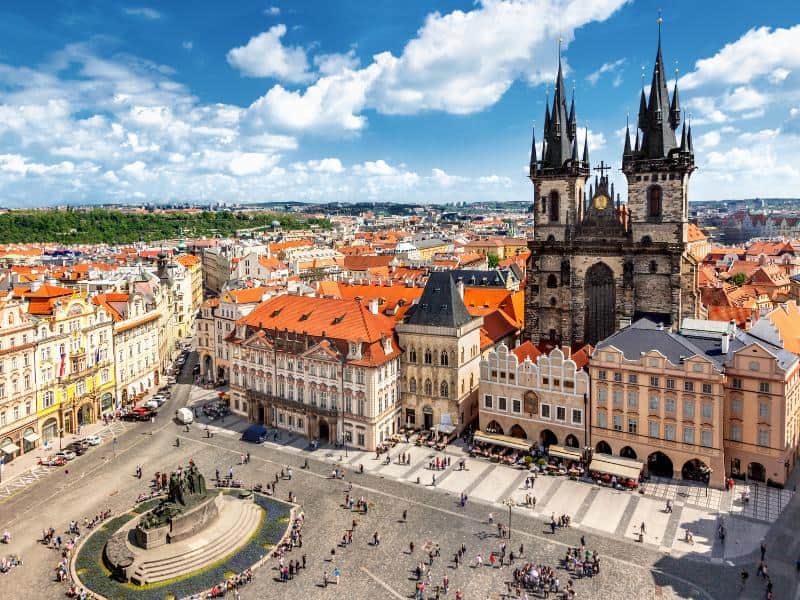
Prague sits at the crossroads of Central Europe, shaped by the Vltava River and a dramatically hilly landscape that has influenced its architecture and history for over a millennium.
- Prague is the capital and largest city of the Czech Republic, situated in the heart of Central Europe along the Vltava River, covering an area of approximately 496 square kilometers.
- The city has a population of roughly 1.3 million people within its city limits, placing it among the largest cities in the European Union.
- The city is divided into 22 administrative districts and sits at an elevation of approximately 177 to 399 meters above sea level, giving it a varied and hilly topography.
- The Vltava River flows through Prague for about 31 kilometers within city limits and has flooded the city numerous times throughout history — most devastatingly in August 2002, when floodwaters reached levels not seen in 500 years, causing billions of euros in damage.
- The city experiences a temperate oceanic climate with warm summers and cold winters. Average temperatures range from about -1°C in January to 19°C in July, with annual precipitation of approximately 500 millimeters.
Facts About Prague History

Prague’s history spans more than a thousand years, encompassing imperial glory, wartime survival, communist rule, and a peaceful democratic revolution.
- Prague was the capital of the Kingdom of Bohemia and became one of the most important cities in the Holy Roman Empire, particularly during the reign of Emperor Charles IV in the 14th century, when it was one of the largest cities in Europe.
- Prague escaped significant bombing during World War II, which is a primary reason its medieval and Baroque architecture remains so remarkably intact compared to many other European capitals.
- The Velvet Revolution of November 1989 was a peaceful transition of power that ended communist rule in Czechoslovakia. Prague was its epicenter, with massive student-led protests on Wenceslas Square leading to the resignation of the Communist government within weeks.
- The Prague Spring of 1968 was a period of political liberalization under Communist leader Alexander Dubček, which ended abruptly when Soviet-led Warsaw Pact troops invaded Czechoslovakia on August 20–21, 1968, occupying the country for the next two decades.
- Prague served as the capital of Czechoslovakia from its founding in 1918 until the peaceful dissolution of the country on January 1, 1993 — known as the Velvet Divorce — after which it became the capital of the newly independent Czech Republic.
- Prague has been known by several names throughout history, including Praga in Latin and Zlatá Praha meaning “Golden Prague” in Czech, a nickname reflecting both the golden hue of its historic buildings in sunlight and its centuries-long status as a center of culture, learning, and imperial power.
Facts About Prague Architecture and Landmarks

Few cities in the world can match Prague’s density of historic landmarks, with architectural styles ranging from Romanesque foundations to striking 20th-century modernism.
- Prague’s historic center was inscribed as a UNESCO World Heritage Site in 1992, recognized for its extraordinary collection of Baroque, Gothic, Renaissance, and Art Nouveau architecture spanning over a thousand years.
- Prague Castle, known in Czech as Pražský hrad, is widely cited as the largest ancient castle complex in the world, stretching over 70,000 square meters and dating back to the 9th century around 870 AD.
- The Charles Bridge, or Karlův most, was commissioned by King Charles IV and construction began in 1357. It features 30 Baroque statues of saints and served as the only bridge crossing the Vltava River in Prague for over 400 years.
- The Astronomical Clock, called the Orloj, was installed in 1410 on the Old Town Hall. It is among the oldest astronomical clocks in the world and is often cited as the oldest one still in operation — every hour, animated figures including the Twelve Apostles appear in its windows.
- Prague has more than 500 towers and spires, earning it the nickname “The City of a Hundred Spires,” though the actual count far exceeds that romantic figure.
- Prague’s Wenceslas Square is not actually a square but a long boulevard stretching 750 meters, named after Saint Wenceslas, the patron saint of Bohemia, whose equestrian statue stands at its upper end.
- The Strahov Monastery, founded in 1143, houses what is widely regarded as one of the most beautiful historic libraries in the world, including the Theological Hall and the Philosophical Hall, containing approximately 200,000 volumes of rare books and manuscripts.
- Prague’s Žižkov Television Tower, completed in 1992 and standing 216 meters tall, is the tallest structure in Prague and is famously decorated with ten giant crawling baby sculptures created by artist David Černý, added in 2000.
- The Nusle Bridge, completed in 1973 and spanning 485 meters over the Nusle Valley, is one of Prague’s most striking pieces of infrastructure — it carries both road traffic and metro line C, with the metro running inside the bridge’s hollow structure.
Facts About Prague Culture and Arts

Prague has long been a magnet for artists, composers, and writers, producing and inspiring some of the most celebrated creative figures in Western history.
- Franz Kafka, one of the most influential writers of the 20th century, was born in Prague on July 3, 1883, and spent most of his life in the city. His works, including The Metamorphosis and The Trial, were largely written in German.
- Composer Antonín Dvořák was born near Prague in 1841 and is one of the most celebrated composers associated with the city. His New World Symphony was composed during his time in America but remains deeply connected to his Bohemian roots.
- The historic Estates Theatre in Prague, opened in 1783, is where Wolfgang Amadeus Mozart personally conducted the world premiere of his opera Don Giovanni on October 29, 1787. Mozart reportedly said that Prague understood him better than Vienna did.
- Alphonse Mucha, the renowned Art Nouveau artist famous for his decorative posters, was born in Moravia but spent significant time in Prague, where his monumental work The Slav Epic — a cycle of 20 large canvases depicting Slavic history — is now permanently displayed.
Facts About Prague Education and Religion
Prague is a city of deep intellectual and spiritual heritage, home to one of Europe’s oldest universities and a uniquely preserved Jewish quarter.
- Prague is home to Charles University, founded in 1348 by Emperor Charles IV, often cited as the oldest university in Central Europe and one of the oldest in the world still in continuous operation.
- The Jewish Quarter of Prague, known as Josefov, contains six historic synagogues and the Old Jewish Cemetery, where burials took place from the 15th to 18th centuries. Due to limited space, bodies were buried in layers up to 12 deep, with an estimated 100,000 people interred there.
Facts About Modern Prague
Today, Prague is a thriving European metropolis that balances its extraordinary historic legacy with a dynamic modern economy, world-class transit, and a globally recognized tourism industry.
- Prague’s metro system, opened in 1974, consists of three lines covering 65.2 kilometers with 61 stations and transports approximately 600 million passengers per year, making it one of the busiest metro systems in Central Europe.
- The Czech Republic, with Prague as its capital, is one of the world’s leading beer-consuming nations, with Czechs drinking an average of approximately 142 liters of beer per person per year — consistently ranked as the highest per capita beer consumption in the world.
- Prague is one of Europe’s most visited cities, attracting approximately 9 million international tourists annually, placing it among the top ten most visited cities on the continent.
- Prague’s economy is the strongest in the Czech Republic, contributing roughly 25 percent of the country’s GDP, with significant industries in finance, technology, tourism, and manufacturing driving its highly developed service sector.
Interesting Facts About Europe’s Iconic Cities:


