
32 Juicy Facts About Pumpkins: Harvest Highlights
Pumpkins are far more than autumn decorations. These sprawling vine plants have fed people in the Americas for thousands of years, inspired folklore and fairy tales, and grown into giants weighing more than a ton. Here are fun facts about pumpkins, covering their biology, history, traditions, food uses, and record-breaking competitions.
Pumpkins Facts At-a-Glance
Genus: Cucurbita
Family: Cucurbitaceae (gourd family)
Native To: The Americas
Botanical Type: Fruit (a berry type called a pepo)
Main Species: Cucurbita pepo, Cucurbita maxima, Cucurbita moschata
Peak Season: Autumn in the Northern Hemisphere
Famous Uses: Jack-o’-lanterns, pies, soups, roasted seeds
Leading US State: Illinois
Pumpkin Plant Basics
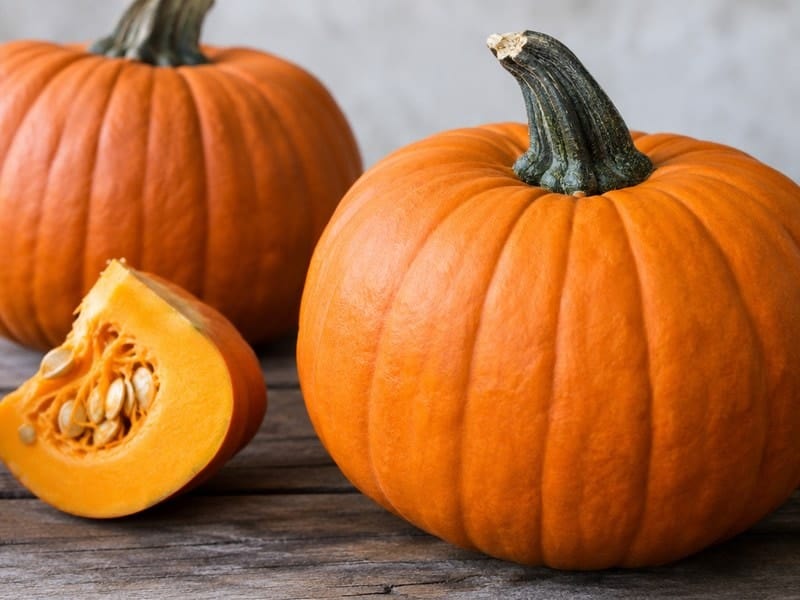
Pumpkins belong to a large and varied plant family with some surprising relatives.
- Pumpkins belong to the genus Cucurbita in the gourd family, Cucurbitaceae. Their relatives include cucumbers, melons, watermelons, zucchini, and other squash.
- Botanically, a pumpkin is a fruit. It is a type of berry called a pepo, which has a tough outer rind and a fleshy interior packed with seeds.
- Pumpkin is not a strict scientific category. The name refers to certain rounded squash varieties, most often Cucurbita pepo, though some come from Cucurbita maxima and Cucurbita moschata.
- A single pumpkin plant produces separate male and female flowers. Pollen must travel from male to female blossoms, a job usually done by bees, before fruit can form. [Learn more: 10 Interesting Facts About Flowers: Nature’s Masterpieces]
- Pumpkin vines can sprawl across large areas, using curly tendrils to grip nearby supports as they spread.
- Raw pumpkin flesh is more than 90 percent water, which helps explain why pumpkins are low in calories.
- The bright orange color comes from carotenoids such as beta-carotene, which the human body can convert into vitamin A. [Learn more: 36 Juicy Facts About Oranges: Citrus Secrets]
- Not every pumpkin is orange. Varieties come in white, yellow, green, striped, and blue-gray shades, such as the white ‘Lumina’ and the blue-gray ‘Jarrahdale’.
Ancient Roots and History
Long before pumpkins became a fall symbol, they were an important food crop.
- Pumpkins and their squash relatives are native to the Americas. Cucurbita pepo seeds found in a cave in Oaxaca, Mexico, are roughly 10,000 years old, making squash among the earliest domesticated plants in the region. [Learn more: 120 Interesting Facts About Mexico]
- Many Indigenous peoples of North America grew squash alongside corn and beans in a system known as the Three Sisters. The broad squash leaves shade the soil, helping hold in moisture and keep weeds down.
- The word pumpkin traces back to the Greek word pepon, meaning a large melon. It passed through French and older English forms like pumpion before settling into its modern spelling.
- After European contact with the Americas, pumpkins and other squash spread to Europe, Africa, and Asia as part of the wider exchange of crops between hemispheres.
- Amelia Simmons’s American Cookery, published in 1796 and recognized as the first cookbook by an American author, included recipes for pumpkin pudding baked in a crust, an early ancestor of pumpkin pie.
Suggested Read:
Halloween, Folklore, and Stories

Pumpkins have carved out a big place in holiday traditions and popular culture.
- Carving lanterns began in Ireland and Britain, where people hollowed out turnips, potatoes, and other root vegetables. Immigrants to North America found that native pumpkins were larger and much easier to carve. [Learn more: 27 Fun Facts About Ireland: Emerald Isle Wonders]
- Legend: According to Irish folklore, a trickster named Stingy Jack fooled the Devil and was later barred from both heaven and hell. He was said to wander the earth with a coal glowing inside a carved turnip, giving rise to the name jack-o’-lantern.
- Before it meant a carved pumpkin, jack-o’-lantern was also a name for will-o’-the-wisp, the eerie flickering lights sometimes seen over marshes at night.
- In Charles Perrault’s 1697 version of Cinderella, the fairy godmother transforms a pumpkin into a golden coach, an image that has defined the story ever since.
- Washington Irving’s 1820 tale The Legend of Sleepy Hollow features the Headless Horseman, who hurls what turns out to be a shattered pumpkin at the schoolteacher Ichabod Crane.
- The 1966 TV special It’s the Great Pumpkin, Charlie Brown features Linus waiting all Halloween night in a pumpkin patch for a figure who never arrives.
Recommended Read: 50 Fun Facts About October: Autumn’s Golden Month
Pumpkins in the Kitchen
Nearly every part of the pumpkin plant can end up on a plate somewhere in the world.
- Small pie pumpkins, often called sugar pumpkins, have sweeter, smoother flesh than the large pumpkins grown for carving, which tend to be watery and stringy.
- Much of the canned pumpkin sold in the United States comes from the Dickinson pumpkin, a tan-skinned Cucurbita moschata variety that looks more like a butternut squash than a jack-o’-lantern.
- Illinois grows more pumpkins than any other US state, much of it for processing. The town of Morton, home to a major pumpkin canning plant, calls itself the Pumpkin Capital of the World. [Learn more: 89 Fun Facts About Illinois: Prairie Stories]
- Pumpkin spice usually contains no pumpkin at all. The blend typically combines cinnamon, nutmeg, ginger, and cloves or allspice, the spices traditionally used in pumpkin pie.
- Starbucks introduced its Pumpkin Spice Latte in 2003, and the drink helped turn pumpkin spice into an annual autumn craze.
- In Haiti, families eat soup joumou, a hearty pumpkin soup, on January 1 to celebrate independence. UNESCO added the tradition to its list of Intangible Cultural Heritage in 2021.
- Pumpkin seeds, often called pepitas, are a popular snack. Some varieties, such as the Styrian pumpkin of Austria, grow hull-less seeds that are pressed into a dark green seed oil. [Learn more: 50 Remarkable Facts About Austria: Imperial Legacy]
- Pumpkin flowers and young leaves are edible too. The blossoms are often stuffed or fried, and the leaves are cooked as greens in parts of Africa and Asia.
Giant Pumpkins and Pumpkin Fun
Some growers and festivals take pumpkins to extraordinary extremes.
- Most competition giant pumpkins are Cucurbita maxima, and many descend from the Atlantic Giant variety developed by Nova Scotia grower Howard Dill. [Learn more: 87 Interesting Facts About Nova Scotia: Atlantic Canada]
- During peak growing season, a giant pumpkin can put on dozens of pounds in a single day.
- In 2023, Minnesota grower Travis Gienger set a world record with a 2,749-pound pumpkin at the weigh-off in Half Moon Bay, California.
- At pumpkin regattas, such as the one in Windsor, Nova Scotia, people hollow out giant pumpkins and paddle them across the water like boats.
- In the sport known as punkin chunkin, teams build catapults, trebuchets, and air cannons to see who can hurl a pumpkin the farthest.
Recommended Read:


