
25 Facts About The Sahara Desert: Earth’s Largest Hot Desert
Embark on a journey through the mesmerizing facts about the Sahara Desert, a vast expanse of sand and rock that has captivated explorers, scientists, and dreamers for centuries.
This iconic landscape, stretching across North Africa, is a testament to nature’s raw power and beauty. From its ever-shifting dunes to its hidden oases, the Sahara holds secrets that continue to intrigue researchers and adventurers alike.
Sahara Desert Facts At-a-Glance
Type/Classification: Hot desert
Geographic Distribution: North Africa (spanning 11 countries)
Notable Examples: Erg Chebbi dunes, Tassili n’Ajjer plateau
Key Characteristics: Extreme heat, minimal rainfall, sand dunes
Scientific Significance: Climate research, geological studies
Environmental Impact: Influences global climate patterns
Human Interaction: Ancient trade routes, modern resource extraction
Research Status: Ongoing studies on climate change impacts
Scientific Understanding
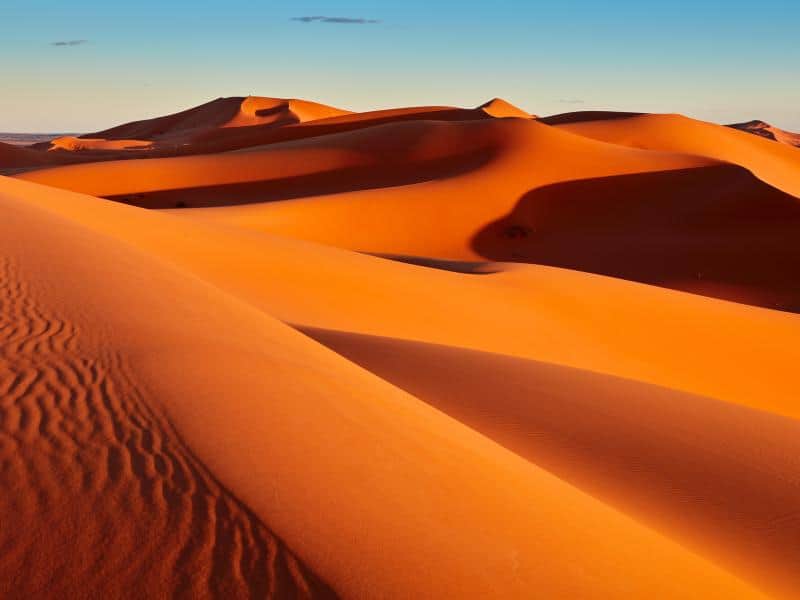
The Sahara Desert has long been a subject of scientific fascination, offering researchers unique insights into extreme environments, climate patterns, and geological processes. As we explore the scientific understanding of this vast desert, we’ll uncover surprising facts about its composition, climate, and role in global systems.
- The Sahara Desert covers an area of approximately 3.6 million square miles (9.4 million square kilometers), making it nearly as large as the United States or China. This vast expanse accounts for about 31% of Africa’s total land area.
- Contrary to popular belief, only about 25% of the Sahara is covered in sand. The majority of the desert consists of rocky hamada (stone plateaus), gravel plains, dry valleys, and salt flats.
- The Sahara experiences extreme temperature variations with daytime highs reaching up to 117°F (47°C) and nighttime lows dropping to 32°F (0°C) in winter months, particularly in the desert’s interior regions.
Formation and Processes
The Sahara’s formation is a testament to the dynamic nature of Earth’s climate and geological processes. Understanding how this desert came to be and continues to evolve provides valuable insights into our planet’s past and potential future.
- The Sahara Desert formed approximately 3 million years ago during the late Pliocene epoch, though the region has experienced multiple shifts between wet and dry periods throughout its history (meaning it hasn’t always been a desert).
- Wind plays a crucial role in shaping the Sahara’s landscape. The desert’s iconic sand dunes, some reaching heights of over 500 feet (152 meters), are constantly reshaped by powerful winds.
- The Sahara undergoes a 20,000-year cycle of greening and desertification due to variations in Earth’s orbit and tilt. The last “Green Sahara” period ended about 5,000 years ago.
Global Distribution and Patterns

While the Sahara is unique in its vastness, it’s part of a global system of deserts. Examining its distribution and patterns helps us understand broader climate dynamics and the interconnectedness of Earth’s ecosystems.
- The Sahara Desert spans 11 countries: Algeria, Chad, Egypt, Libya, Mali, Mauritania, Morocco, Niger, Sudan, Tunisia, and Western Sahara. Its vast expanse influences climate patterns across North Africa and beyond.
- The Sahara is part of a band of deserts that circles the Earth at similar latitudes, including the Arabian, Iranian, Thar, and Sonoran deserts. This pattern is due to global atmospheric circulation patterns known as Hadley cells.
- Despite its aridity, the Sahara contains several mountain ranges, including the Ahaggar Mountains in Algeria and the Tibesti Mountains in Chad, which can receive significantly more rainfall than the surrounding lowlands.
Environmental Impact

The Sahara Desert plays a significant role in global environmental systems, influencing climate patterns, nutrient cycles, and ecosystems far beyond its boundaries. Understanding these impacts is crucial for predicting and managing global environmental changes.
- The Sahara is a major source of mineral dust, with an estimated 60-200 million tons of dust particles carried by winds annually. This dust plays a crucial role in fertilizing the Amazon Rainforest and Caribbean Coral Reefs with essential nutrients. [Read more: Interesting facts about the Great Barrier Reef.]
- Climate change is altering the Sahara’s boundaries. Studies show the desert has expanded by approximately 8% since 1920, affecting primarily the Sahel region to the south.
- The Sahara Desert significantly influences global weather patterns. The hot, dry air from the Sahara can suppress hurricane formation in the Atlantic Ocean and affect rainfall patterns in Europe and the Middle East.
Explore More African Natural Wonders:
Research and Discoveries
The Sahara continues to be a rich field for scientific research, yielding new discoveries that shed light on Earth’s history, climate dynamics, and potential future scenarios.
- Satellite imagery has revealed ancient river systems beneath the Sahara’s sands. The most recently discovered paleodrainage system in 2020 was found in Mauritania, stretching over 500 kilometers and likely active during the last Green Sahara period.
- The Sahara Desert is ideal for meteorite hunting due to its flat terrain and preserved specimens. Over 5,000 meteorites have been found in the Sahara, including the NWA 7034 (Black Beauty) Mars meteorite discovered in 2011.
- Recent studies have discovered vast groundwater reserves beneath the Sahara, estimated to contain more than 150,000 cubic kilometers of fossil water. This discovery has significant implications for water resource management in the region.
Human Interaction and Cultural Significance

Despite its harsh conditions, the Sahara has been home to human civilizations for thousands of years. Its landscapes have shaped cultures, trade routes, and mythologies, leaving an indelible mark on human history.
- The Sahara was once home to thriving civilizations. Rock art discovered in the Tassili n’Ajjer plateau in Algeria depicts a lush landscape with abundant wildlife, dating back to 8000 BCE when the region was much wetter.
- The desert has been crossed by trade caravans for millennia. The famous Tuareg salt caravans still operate today, transporting salt slabs across the desert using traditional methods.
- The Sahara holds significant mineral resources, including oil, natural gas, uranium, and phosphates. These resources have become increasingly important in the global economy, influencing geopolitics in the region.
Conservation and Future Challenges
As the Sahara faces increasing pressures from climate change and human activities, conservation efforts are becoming increasingly crucial. Understanding these challenges is essential for developing sustainable strategies to protect this unique ecosystem and the communities that depend on it.
- The Great Green Wall initiative, launched in 2007, aims to combat desertification by planting a 7,775 km long and 15-50 km wide belt of trees across the southern edge of the Sahara. This ambitious project spans 11 countries and could potentially restore 100 million hectares of degraded land.
- Climate change models predict that the Sahara Desert could experience increased rainfall in the coming decades, potentially leading to a greening of parts of the desert. However, this change could also disrupt existing ecosystems and human settlements.
- The Sahara is home to critically endangered species, including the addax antelope (fewer than 100 remain in the wild) and dama gazelle. Conservation efforts are crucial to protect these unique desert-adapted species from extinction.
- Renewable energy projects in the Sahara, such as large-scale solar farms, could potentially provide sustainable energy for millions. However, these projects must be carefully managed to minimize environmental impacts and benefit local communities.
- Overgrazing and unsustainable agricultural practices along the Sahara’s edges contribute to desertification, expanding the desert’s boundaries. Sustainable land management practices are crucial to halt this trend.
- The Sahara hosts unique extremophiles like the bacteria found in the Saharan salt pans, which can survive extreme salinity and heat. These organisms are studied for potential applications in biotechnology and medicine.
- Despite its harsh conditions, the Sahara Desert supports a surprising level of biodiversity, with over 2,800 plant species, 70 known mammal species, 90 bird species, and 100 reptile species. Protecting this biodiversity is a key conservation challenge for the future.
Discover More African Countries Across the Continent in Depth:
- 50 Fascinating Facts About Africa: Cradle of Humanity
- 35 Fun Facts About Algeria: North Africa’s Gem
- 32 Interesting Facts About Morocco, the Gateway to Africa
- 35 Interesting Facts About Egypt: Ancient & Modern
- 35 Interesting Facts About Uganda: The Pearl of Africa
- 35 Interesting Facts About Zimbabwe You Might Not Know
- 35 Interesting Facts About Mozambique


