
25 Fun Facts About San Marino: The World’s Oldest Republic
If you are curious about one of Europe’s most extraordinary microstates, these facts about San Marino will take you on a journey through over 1,700 years of unbroken republican history, stunning medieval architecture, and a remarkably modern society packed into just 61 square kilometers.
Nestled entirely within Italy, this tiny mountain nation punches far above its weight in culture, governance, and global recognition — and its story is far more surprising than most people expect.
San Marino Facts At-a-Glance
Official Name: Most Serene Republic of San Marino
Location: Enclave within central Italy, atop Mount Titano
Area: 61.2 km² (23.6 sq mi)
Population: Approximately 34,000
Founded: September 3, 301 AD
Government Type: Parliamentary republic with two Captains Regent
Official Language: Italian
UNESCO Status: Historic Centre & Mount Titano inscribed in 2008
Facts About San Marino Geography
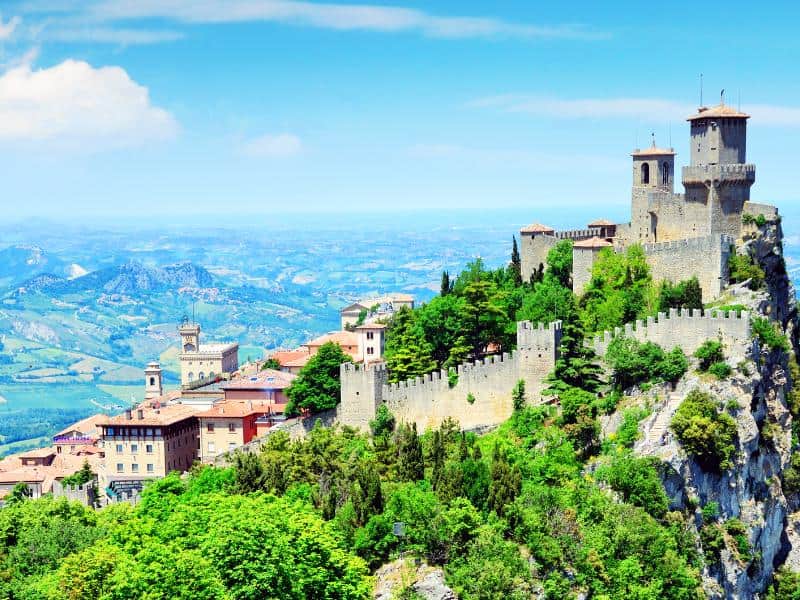
San Marino’s geography is as distinctive as its history — a landlocked mountain enclave that has shaped everything from its military defense to its tourism appeal.
- San Marino is officially known as the Most Serene Republic of San Marino (Serenissima Repubblica di San Marino) and is one of the world’s smallest countries, covering just 61.2 square kilometers (23.6 square miles).
- San Marino is entirely surrounded by Italy, making it one of only three countries in the world that are completely encircled by a single other nation, alongside Vatican City and Lesotho.
- Mount Titano, the country’s highest point at 755 meters (2,477 feet) above sea level, is a UNESCO World Heritage Site along with the historic center of San Marino City — a designation granted in 2008.
- San Marino’s Three Towers—Guaita, Cesta, and Montale—stand along the ridges of Mount Titano. Guaita, the oldest, dates back to the 11th century. Cesta, built in the 13th century, sits on the highest peak and houses a museum of ancient arms. Montale, from the 14th century, served a defensive role and, while not open to the public, can be reached via a scenic ridge walk. Together, these iconic towers appear on San Marino’s flag and coat of arms.
- The historic center of San Marino City, situated atop Mount Titano, features winding medieval streets, ancient stone buildings, and three fortresses connected by a walkway — preserving an architectural landscape that has remained largely unchanged for centuries and draws visitors from around the globe.
Facts About San Marino History

San Marino’s historical record is one of the most remarkable of any nation on Earth, defined by peaceful continuity and a fierce commitment to independence.
- Founded on September 3, 301 AD, San Marino is widely recognized as the world’s oldest surviving republic, with a continuous republican government spanning over 1,700 years.
- According to tradition, San Marino was founded by a Christian stonemason named Marinus, who fled religious persecution from the island of Rab (in modern-day Croatia) and established a small community on Mount Titano.
- The country has never been conquered — a remarkable feat attributed partly to its geographic position on a steep mountain and partly to its long-standing policy of offering refuge to those fleeing persecution, including political exiles and dissidents from across Europe.
- Napoleon Bonaparte reportedly offered to expand San Marino’s territory in 1797, but the Sammarinese leaders declined, preferring to maintain their small, peaceful republic rather than risk entanglement in European power politics.
Facts About San Marino Government and Politics
San Marino’s system of governance is among the oldest and most unusual in the world, blending medieval tradition with modern democratic principles.
- The country is governed by two Captains Regent who serve simultaneously as heads of state — a system dating back to 1243. They are elected every six months and cannot be re-elected for three years after their term ends.
- San Marino’s constitution, known as the Statutes of 1600, is considered one of the oldest written constitutions still in effect in the world.
- San Marino granted women the right to vote in local elections in 1960 — later than many Western nations — and women were able to stand for office from 1973 onward.
- San Marino has a unique legal tradition where judges are required to be foreign nationals — a practice designed to ensure impartiality and prevent corruption within the small, tightly-knit community.
Facts About San Marino Demographics and Culture

Despite its tiny size, San Marino supports a well-educated, prosperous population with a distinct cultural identity rooted in Italian language and Catholic tradition.
- San Marino has a population of approximately 34,000 people, making it one of the least populous countries in the world, yet it maintains a remarkably high standard of living.
- The official language of San Marino is Italian, and the vast majority of its citizens are ethnically Sammarinese or Italian, with Roman Catholicism being the predominant religion.
- The country has a literacy rate of nearly 100% and provides free education to all citizens, with the University of the Republic of San Marino (Università degli Studi della Repubblica di San Marino) founded in 1985.
Facts About San Marino Military
San Marino’s military is one of the smallest and most ceremonially distinctive in the world, with roots stretching back to the Middle Ages.
- Despite its tiny size, San Marino has its own military forces, including the Crossbow Corps, which dates back to the 13th century and still performs ceremonial duties today.
Facts About San Marino Economy

San Marino’s economy defies expectations for a microstate, combining fiscal discipline with diverse revenue streams that have kept it prosperous.
- San Marino uses the euro as its official currency through a monetary agreement with the European Union, even though it is not an EU member state. It is permitted to mint its own euro coins, which are highly sought after by collectors.
- The country has one of the higher GDP per capita figures in Europe — estimated at around $50,000 to $60,000 USD — driven largely by tourism, banking, and the manufacturing of ceramics, clothing, and electronics.
- Tourism is a massive part of San Marino’s economy, with the country attracting approximately 3 million visitors per year — nearly 90 times its own population.
- San Marino has its own postage stamps, which are highly prized by philatelists worldwide. The country has been issuing distinctive stamps since 1877, and stamp sales contribute meaningfully to government revenue.
- The country maintains very low national debt and has historically aimed for a balanced budget — a financial discipline that has contributed to its economic stability and high standard of living.
Facts About San Marino Sports and International Relations
On the world stage, San Marino has carved out a surprisingly prominent profile in both international sport and diplomacy.
- San Marino has participated in the Olympic Games since 1960 and has sent athletes to both the Summer and Winter Olympics. It had not won an Olympic medal until the Tokyo 2020 Games, where it won three medals — one gold, one silver, and one bronze — making it widely reported as the smallest nation ever to win an Olympic gold medal.
- The country has its own Formula 1 Grand Prix — the San Marino Grand Prix — which was held at the Autodromo Enzo e Dino Ferrari in Imola, Italy, from 1981 to 2006, despite the circuit being located outside San Marino’s borders.
- San Marino maintains diplomatic relations with over 100 countries and became a member of the United Nations in 1992, despite having existed as a sovereign state for nearly 1,700 years before joining.
Explore the Vibrant Nations of Europe:
- 50 Interesting Facts About Italy: La Dolce Vita
- 50 Interesting Facts About France: History & Culture
- 35 Remarkable Facts About Switzerland: Alpine Nation
- 50 Remarkable Facts About Austria: Imperial Legacy
- 35 Fun Facts About Germany You Probably Didn’t Know
- 25 Fun Facts About Liechtenstein: The Alpine Microstate


