
40 Fascinating Facts About Snakes: Slithering Wonders
Snakes have no legs, no eyelids, and no external ears, yet they thrive in deserts, rainforests, oceans, and backyards around the world. These facts explore how snakes sense their surroundings, hunt, move, and reproduce, and how they have shaped human myths, medicine, and culture.
Snakes Facts At-a-Glance
Classification: Reptiles in the order Squamata, suborder Serpentes
Species: More than 3,000, about 600 of them venomous
Range: Every continent except Antarctica
Diet: Carnivorous
Longest: Reticulated python
Heaviest: Green anaconda
Smallest: Barbados threadsnake, about 4 inches (10 cm)
Anatomy and Senses
A snake’s body is a long, flexible package built around some remarkable adaptations.
- Snakes are reptiles in the order Squamata, the same group that includes lizards. Scientists agree that snakes evolved from lizard ancestors that gradually lost their legs.
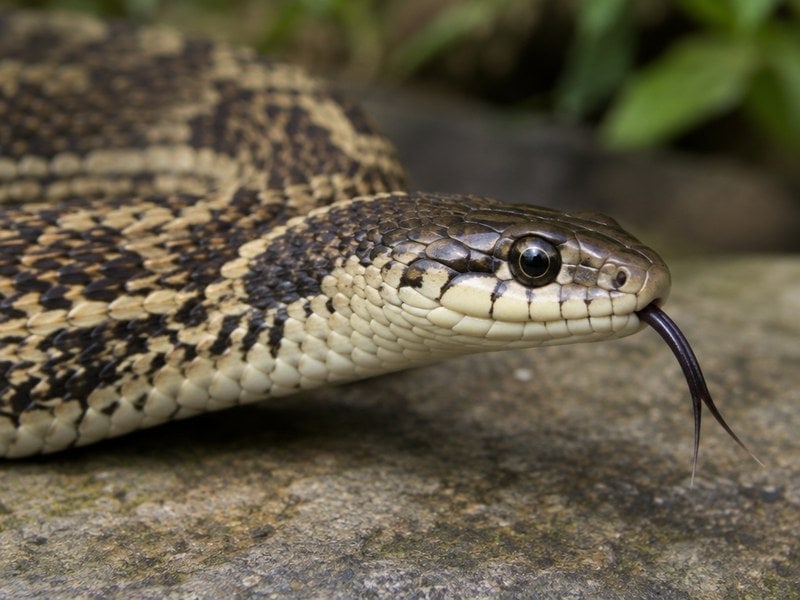
- Snakes have no eyelids. Each eye is protected by a clear scale called a brille, or spectacle, which is why snakes always seem to be staring.
- Snakes lack external ears and eardrums, but they still have inner ears. They pick up vibrations through the ground and their jawbones and can sense some low-frequency sounds.
- A snake flicks its forked tongue to collect scent particles from the air and ground. The tongue delivers those particles to the Jacobson’s organ, also called the vomeronasal organ, in the roof of the mouth, where the scents are analyzed.
- A snake’s long spine can contain several hundred vertebrae, most of them attached to pairs of ribs. This gives snakes their extraordinary flexibility.
- Most snakes have only one fully working lung. The right lung is long and does the heavy lifting, while the left lung is greatly reduced or missing entirely.
- Snakes don’t actually unhinge their jaws. The two halves of the lower jaw are joined by a stretchy ligament rather than fused bone, which lets the mouth open wide enough to swallow prey bigger than the snake’s head.
- Snakes shed their outer skin, often in a single piece that even includes the eye caps. Shortly before shedding, a snake’s eyes turn cloudy and bluish, and its vision temporarily worsens.
- Many pythons and boas still carry traces of their legged ancestry. Small claw-like pelvic spurs near the vent are remnants of hind limbs, and males use them during courtship.
- Pit vipers, along with many pythons and boas, have special pit organs that detect infrared heat. These pits let them sense warm-blooded prey even in complete darkness.
Size, Species, and Range
- The reticulated python of Southeast Asia is the world’s longest snake. Large individuals can stretch beyond 20 feet (6 m).
- The green anaconda of South America is the heaviest snake. Big females can weigh well over 200 pounds (90 kg) and spend much of their time in water, which helps support their bulk.
- The Barbados threadsnake, described by scientists in 2008, is among the smallest known snakes. Adults reach only about 4 inches (10 cm) long, short enough to curl up on a coin.
- Titanoboa, an extinct snake that lived in what is now Colombia about 60 million years ago, is estimated to have reached around 42 feet (13 m) long. Its fossils were found in the Cerrejón coal mine.
- Snakes live on every continent except Antarctica. A few places, including Ireland, Iceland, and New Zealand, have no native land snakes.
- True sea snakes are highly adapted to ocean life, with paddle-shaped tails for swimming. Most of them give birth to live young at sea and never need to come ashore.
Recommended Read:
Hunting and Venom
- Of the more than 3,000 known snake species, only about 600 are venomous. Most snakes are harmless to people.
- Snake venom is a modified form of saliva produced in specialized glands. It is usually delivered through fangs, and vipers have long hinged fangs that fold back against the roof of the mouth when not in use.
- Boas and pythons kill by constriction, wrapping their coils around prey and squeezing. Research has shown that constriction mainly works by cutting off blood flow rather than simply causing suffocation.
- The inland taipan of Australia has the most toxic venom of any land snake, based on laboratory tests. Despite that, it is shy, lives in remote areas, and rarely bites people. [Learn more: 35 Fun Facts About Australia]
- The king cobra is the world’s longest venomous snake, capable of reaching about 18 feet (5.5 m). Its scientific genus name, Ophiophagus, means snake-eater, and other snakes make up most of its diet.
- Snakes can survive long stretches without food. Large pythons may go months between meals, and a Burmese python’s heart and other organs actually grow larger while it digests a big meal.
Defense Tricks

- Several species of spitting cobras can spray venom from their fangs toward the eyes of a threat. The venom can cause intense pain and even blindness if not washed out.
- A rattlesnake’s rattle is made of interlocking segments of keratin, the same material as human fingernails. A new segment is added each time the snake sheds, and because segments break off, counting them is not a reliable way to tell age.
- Harmless milk snakes and kingsnakes have red, black, and yellow or white bands that mimic venomous coral snakes. The rhyme “red touches yellow” for identifying coral snakes works only for species in North America, not elsewhere.
- When threatened, hognose snakes may hiss and flatten their necks like cobras. If that fails, they often play dead, rolling onto their backs with their mouths open and tongues hanging out.
On the Move
- Snakes use several main methods of movement: lateral undulation in S-shaped waves, straight-line rectilinear creeping, accordion-like concertina movement, and sidewinding. Heavy snakes such as pythons often use rectilinear movement, gripping the ground with their belly scales.
- Sidewinding helps desert snakes cross loose, hot sand by lifting parts of the body so only a few points touch the ground at a time. The sidewinder rattlesnake of the southwestern United States is named for this motion.
- The so-called flying snakes of the genus Chrysopelea, found in South and Southeast Asia, can glide from tree to tree. They launch themselves into the air and flatten their bodies to catch the air like a ribbon.
Reproduction
- Most snakes lay eggs, but many give birth to live young. Boas, garter snakes, and most vipers are among the live-bearers.
- Some female snakes can reproduce without a male through parthenogenesis. This has been documented in species including boas, pythons, and copperheads.
- The tiny Brahminy blind snake is the only snake species known to consist entirely of females, all reproducing by parthenogenesis. It has spread around the world hidden in the soil of potted plants, earning it the nickname flowerpot snake.
- Female Burmese pythons coil around their eggs and twitch their muscles in a kind of shivering. This generates heat that helps keep the eggs warm as they develop.
Snakes and People
Snakes have inspired fear, reverence, and symbolism across human history.
- In 2017, the World Health Organization added snakebite envenoming to its list of neglected tropical diseases. The burden falls most heavily on rural communities in parts of Africa, Asia, and Latin America.
- Antivenom is typically made by injecting animals, often horses, with small, safe doses of venom. The animals produce antibodies, which are then collected and purified to treat bite victims.
- The Rod of Asclepius, a staff with a single snake wrapped around it, is a traditional symbol of medicine. It comes from the Greek god of healing and is often confused with the caduceus, which has two snakes and wings.
- Legend says Saint Patrick drove all the snakes out of Ireland. In reality, Ireland has had no native snakes since the last Ice Age, so there were none for him to banish. [Learn more: 27 Fun Facts About Ireland: Emerald Isle Wonders]
- The ouroboros, an image of a snake swallowing its own tail, is an ancient symbol of cycles and eternity. It appears in ancient Egyptian art and later in Greek and alchemical traditions.
- The Snake is one of the 12 animals of the Chinese zodiac. In that tradition, people born in the Year of the Snake are often described as wise and intuitive.
- Burmese pythons have become an invasive species in the Florida Everglades, where they prey on native mammals and birds. Florida runs programs that encourage people to remove them from the wild. [Learn more: 25 Fun Facts About the Everglades: River of Grass]
Recommended Read:


