
32 Bright Facts About Sunflowers: Golden Giants
Sunflowers are among the most cheerful and recognizable plants on Earth, with huge golden heads, towering stalks, and seeds loved by people and birds alike. These facts about sunflowers cover their surprising anatomy, sun-tracking behavior, long history in the Americas, and their roles in food, art, and science.
Sunflowers Facts At-a-Glance
Scientific Name: Helianthus annuus (common sunflower)
Family: Asteraceae (daisy family)
Native Range: The Americas, with the common sunflower native to North America
Name Origin: Greek helios (sun) + anthos (flower)
Life Cycle: Annual (common sunflower); some wild species are perennial
Famous For: Sun-tracking buds, edible seeds, and sunflower oil
Symbol Of: Kansas (state flower) and Ukraine (national symbol)
Botany and Anatomy
A sunflower looks like one big bloom, but its structure is far more complex.
- The genus name Helianthus combines the Greek words helios, meaning sun, and anthos, meaning flower. The common sunflower’s full scientific name is Helianthus annuus, reflecting its annual life cycle.
- Sunflowers belong to the Asteraceae family, the same large plant group that includes daisies, asters, dandelions, and lettuce.
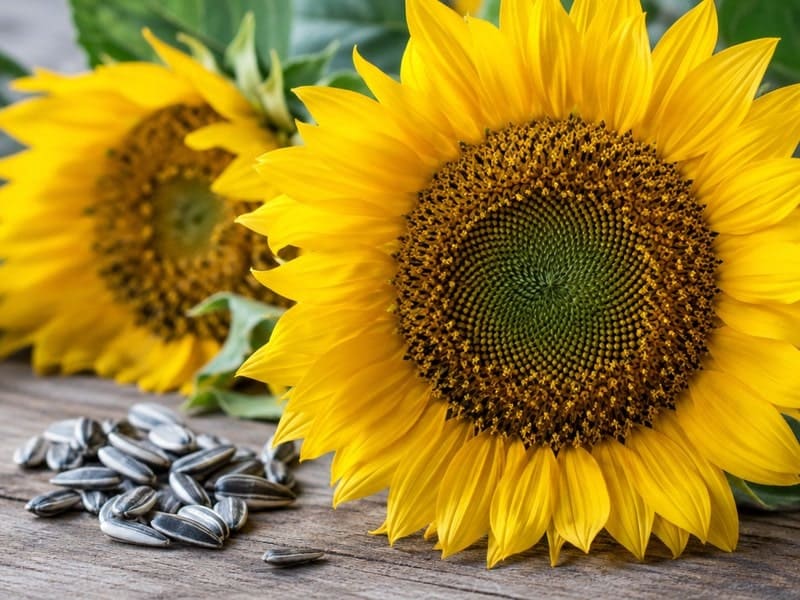
- A sunflower head is not a single flower. It is a cluster of hundreds or even thousands of tiny florets packed together on one disk.
- The bright yellow “petals” around the edge are actually ray florets, while the center is filled with disk florets. Each fertilized disk floret can develop into a single seed.
- What we call a sunflower seed is technically a fruit called an achene. The striped or black shell is the fruit wall, and the edible kernel inside is the true seed.
- Sunflower seeds are arranged in interlocking spirals that typically match consecutive Fibonacci numbers, such as 34 and 55. This pattern comes from each new floret forming at roughly 137.5 degrees, known as the golden angle, which packs seeds efficiently.
- Sunflower petals have ultraviolet-absorbing bases that create a bullseye pattern invisible to humans. Bees and other pollinators can see this pattern, which helps guide them to the flower.
Recommended Read: 10 Interesting Facts About Flowers: Nature’s Masterpieces
Following the Sun
- Young sunflower plants track the sun across the sky, turning from east to west during the day. At night, they swing back to face east, ready for sunrise.
- Once a sunflower reaches full bloom, it stops tracking the sun and generally stays facing east. The plant’s internal clock drives this daily rhythm while it is still growing.
- A 2016 study found that east-facing sunflower heads warm up faster in the morning and attract more pollinating insects than heads facing west. That helps explain why mature blooms settle into an eastward position.
Species and Sizes
- The Helianthus genus includes dozens of species, and all of them are native to the Americas. Many grow wild across prairies, roadsides, and open fields in North America.
- Wild sunflowers usually branch and produce many small flower heads. Domesticated varieties were bred to grow a single tall stalk topped with one large head.
- The Jerusalem artichoke is actually a sunflower species, Helianthus tuberosus, grown for its edible tubers. Despite its name, it is neither from Jerusalem nor a type of artichoke.
- Sunflower varieties range from dwarf types that stay small enough for containers to giants that can tower well over 10 feet tall.
- Hans-Peter Schiffer of Germany set a Guinness World Record in 2014 with a sunflower measuring 9.17 meters (30 feet 1 inch) tall.
A Long History

Sunflowers traveled from ancient North American gardens to fields around the world.
- Indigenous peoples of North America domesticated the sunflower thousands of years ago. Archaeological evidence of early domesticated sunflowers has been found in eastern North America.
- Native American communities used sunflowers in many ways, grinding seeds into flour, pressing them for oil, eating them as snacks, and making dyes from parts of the plant.
- Spanish explorers carried sunflowers from the Americas to Europe in the 16th century. At first, Europeans grew them mainly as ornamental curiosities.
- Sunflowers became a major oil crop in Russia, where sunflower oil gained popularity partly because it was not on the Russian Orthodox Church’s list of oils restricted during Lent. [Learn more: 50 Fascinating Facts About Russia: Land of Extremes]
- Large-seeded varieties developed in Russia, such as Mammoth Russian, later made their way back to North America and helped shape modern sunflower farming.
Food and Farming
- Sunflower oil is one of the world’s most widely used cooking oils, and Ukraine and Russia rank among the leading producers of sunflower seeds.
- Farmers grow two main kinds of sunflower seeds. Black oilseed types are pressed for oil, while larger striped types are sold for snacking and baking.
- Sunflower seeds are a good source of vitamin E, magnesium, and selenium. Sunflower oil is also notably rich in vitamin E.
- Sunflower seed butter is a popular spread for people with peanut or tree nut allergies, since it offers a similar texture without nuts.
- Black oil sunflower seeds are a favorite in backyard bird feeders because their thin shells and high fat content appeal to many bird species.
- After oil is pressed from sunflower seeds, the leftover material, called sunflower meal, is commonly used as protein-rich livestock feed.
- Sunflowers release natural chemicals that can slow the growth of certain nearby plants. This effect, called allelopathy, is worth keeping in mind when planning a garden.
Culture and Science
- Vincent van Gogh painted a famous series of sunflower still lifes in Arles, France, in 1888 and 1889. He created some of them to decorate a room for his fellow artist Paul Gauguin.
- Kansas adopted the wild native sunflower as its state flower in 1903, and the state is nicknamed the Sunflower State. [Learn more: 90 Fascinating Facts About Kansas: The Sunflower State]
- The sunflower is a beloved national symbol of Ukraine, and it became a worldwide emblem of support for the country after Russia’s full-scale invasion in 2022.
- Sunflowers have been used in phytoremediation, a technique that uses plants to pull pollutants from soil or water. After the Chernobyl nuclear disaster, sunflowers were tested for absorbing radioactive contaminants from water.
- Astronaut Don Pettit grew a sunflower aboard the International Space Station in 2012 and shared its progress with the public, showing how plants respond to life in orbit.
Recommended Read:


