
50 Fascinating Facts About Sweden: Land of Innovation
Discover compelling facts about Sweden, a Scandinavian nation known for its Arctic landscapes, Viking heritage, global brands, and progressive society — offering a well-rounded look beyond IKEA and ABBA.
Sweden Facts At-a-Glance
Official Name: Kingdom of Sweden
Location: Northern Europe, Scandinavian Peninsula
Population: Approximately 10.5 million (2024)
Area: 450,295 km² — 5th largest in Europe
Capital City: Stockholm
Currency: Swedish krona (SEK)
Government: Constitutional monarchy, parliamentary democracy
EU & NATO Member: EU since 1995; NATO since March 7, 2024
Facts About Sweden Geography
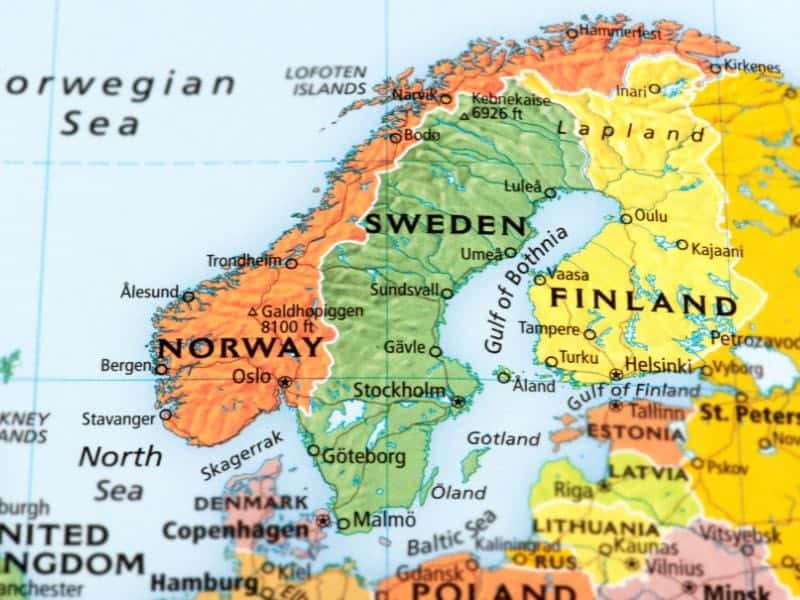
Sweden’s physical landscape is one of the most varied in Europe, stretching from fertile southern plains to Arctic tundra, and encompassing thousands of islands, lakes, and ancient forests.
- Sweden is the largest country in Scandinavia, covering an area of approximately 450,295 square kilometers, making it the fifth-largest country in Europe by land area.
- Sweden shares borders with Norway to the west and north, Finland to the northeast, and is connected to Denmark via the Øresund Bridge in the south.
- Sweden has the longest coastline of any Scandinavian country, stretching approximately 3,218 kilometers along the Baltic Sea and the Kattegat strait.
- The Swedish archipelago contains more than 220,000 islands, islets, and rocks, with the Stockholm Archipelago alone comprising around 30,000 islands.
- Sweden experiences a phenomenon called “Midnight Sun” in the far north, where the sun does not set for several weeks during summer, while polar night brings complete darkness for weeks in winter.
- Sweden has more than 97,500 lakes, with Lake Vänern being the largest, covering 5,655 square kilometers and ranking as the third-largest lake in Europe.
- The Northern Lights, or Aurora Borealis, are regularly visible in northern Sweden, particularly in the region of Lapland, drawing thousands of tourists annually.
Suggested Read:
Facts About Sweden Government and Politics
Sweden’s political history spans centuries of monarchy, empire, and modern democratic governance, culminating in a series of landmark decisions that have shaped its role on the world stage.
- The official name of the country is the Kingdom of Sweden, and it has been a constitutional monarchy since the early 19th century.
- Sweden became a member of the European Union on January 1, 1995, but has retained its own currency, the Swedish krona, rather than adopting the euro.
- Sweden was officially neutral during both World War I and World War II, though it made significant concessions to Nazi Germany, including allowing German troops to transit through Swedish territory.
- Sweden abolished the death penalty for all crimes in 1972, and the last execution in the country took place in 1910.
- Sweden has one of the world’s lowest corruption rates, regularly ranking among the least corrupt countries in Transparency International’s Corruption Perceptions Index.
- Sweden joined NATO on March 7, 2024, ending over 200 years of military non-alignment and neutrality — a historic shift in Swedish foreign and security policy prompted largely by Russia’s full-scale invasion of Ukraine in February 2022.
Suggested Read:
Facts About Sweden Demographics and Society

Despite its large land area, Sweden is relatively sparsely populated, with a diverse and multicultural society shaped by both ancient indigenous traditions and modern immigration.
- As of 2024, Sweden has a population of approximately 10.5 million people, making it one of the more sparsely populated countries in Europe relative to its size.
- Stockholm, the capital city, is built across 14 islands where Lake Mälaren meets the Baltic Sea, earning it the nickname “The Venice of the North.”
- The Sami people are the indigenous inhabitants of northern Sweden, Norway, Finland, and Russia, and they have lived in the region for at least 5,000 years, traditionally herding reindeer.
- Gothenburg, Sweden’s second-largest city with approximately 600,000 inhabitants in the city proper, is home to one of Northern Europe’s largest ports and serves as a major hub for Scandinavian trade.
Facts About Sweden Social Welfare and Healthcare
Sweden’s welfare model is internationally recognized as one of the most comprehensive in the world, balancing high taxation with exceptional public services and quality of life.
- Sweden has one of the highest life expectancy rates in the world, with an average of approximately 83 years, attributed to its high standard of living and universal healthcare system.
- The Swedish welfare state, known as the “Swedish Model,” provides universal healthcare, free education through university level, and extensive social security benefits funded by some of the world’s highest tax rates.
- Sweden ranks consistently among the world’s top countries for gender equality, regularly appearing among the top-ranked nations in the World Economic Forum’s Global Gender Gap Index.
- Sweden has among the highest rates of paternity leave usage in the world, with fathers entitled to 90 days of paid leave specifically reserved for them, part of a broader 480-day parental leave system shared between parents.
Facts About Sweden Education and Technology
Sweden’s commitment to education and digital infrastructure has helped produce a highly skilled, connected population and a thriving innovation economy.
- The Swedish education system provides free schooling from preschool through university, and Sweden spends approximately 6.5% of its GDP on education, among the higher rates in the OECD.
- Sweden has one of the world’s highest rates of internet penetration, with over 95% of the population having regular access to the internet as of recent years.
Facts About Sweden History
Sweden’s history stretches from the age of the Vikings through a powerful Baltic empire to its modern role as a peaceful, prosperous democracy.
- The Swedish Empire, known as Stormaktstiden or the “Age of Greatness,” lasted from 1611 to 1721, during which Sweden controlled much of the Baltic region and was one of Europe’s dominant powers.
- The Viking Age in Scandinavia, which included Swedish Vikings known as Varangians, lasted roughly from 793 to 1066 AD, during which Swedish Vikings primarily traveled east, establishing trade routes through Russia to Byzantium and the Middle East.
- The Vasa warship, a Swedish royal warship that sank on its maiden voyage in Stockholm harbor in 1628, was salvaged in 1961 and is now displayed in the Vasa Museum in Stockholm, attracting over 1.5 million visitors annually.
- The Falun copper mine in Dalarna, Sweden, was one of the world’s most important copper producers from the 10th century until the 20th century, and at its peak in the 17th century, it supplied two-thirds of Europe’s copper demand, helping finance the Swedish Empire.
Facts About Sweden Language and Culture

Swedish culture is a rich blend of ancient Nordic traditions, progressive social values, and a deep love of nature — all reflected in the country’s language, customs, and daily life.
- The Swedish language belongs to the North Germanic branch of the Indo-European language family and is closely related to Norwegian and Danish, with approximately 10 million native speakers worldwide.
- Sweden has among the highest rates of coffee consumption in the world, with Swedes consistently ranked among the top coffee-consuming nations per capita globally, averaging approximately 3.2 cups per day.
- The concept of “fika,” a Swedish tradition of taking a break to enjoy coffee and pastries with colleagues or friends, is deeply embedded in Swedish culture and is considered an important social institution.
- The Swedish tradition of Midsommar, celebrated around the summer solstice in late June, is one of the most important holidays in Sweden, featuring maypole dancing, flower crowns, and traditional foods.
- Sweden has a tradition called “Allemansrätten,” or the Right of Public Access, which grants everyone the legal right to roam freely in nature, camp on any land, and pick berries and mushrooms, regardless of who owns the land.
- Sweden has one of the world’s highest rates of newspaper readership per capita, and freedom of the press is deeply rooted in Swedish law, with the Freedom of the Press Act dating back to 1766 — widely regarded as the world’s oldest law protecting press freedom.
Facts About Sweden Business and Economy

Sweden punches well above its weight in global business, having given the world some of the most recognizable brands and financial institutions in history.
- IKEA, the world’s largest furniture retailer, was founded by Ingvar Kamprad in Älmhult, Sweden, in 1943 when he was just 17 years old.
- Sweden is home to the Riksbank, founded in 1668 and widely regarded as the world’s oldest central bank still in operation; it was also among the earliest central banks to issue banknotes in Europe.
- Volvo, one of the world’s most recognized automobile brands, was founded in Gothenburg, Sweden, in 1927 and is credited with inventing the three-point seatbelt in 1959, a safety innovation later shared freely with the entire automotive industry.
- The Swedish company Ericsson, founded in 1876, is one of the world’s leading telecommunications equipment manufacturers and played a pivotal role in developing 2G, 3G, 4G, and 5G mobile network technologies.
- Spotify, one of the world’s most popular music streaming platforms, was founded in Stockholm in 2006 by Daniel Ek and Martin Lorentzon and launched publicly in 2008.
- The Swedish krona is a long-established currency, having been introduced in 1873 as part of the Scandinavian Monetary Union and remaining in continuous use since then.
Facts About Sweden Science and Innovation
Sweden has a remarkable track record of scientific discovery and technological innovation, contributing ideas and inventions that have changed the world.
- The Nobel Prize was established by Swedish inventor Alfred Nobel, who invented dynamite in 1867 and left his fortune to fund the prizes upon his death in 1896.
- The game Minecraft was created by Swedish developer Markus “Notch” Persson and released in 2011, becoming one of the best-selling video games of all time with over 238 million copies sold across all platforms.
Facts About Sweden Arts and Entertainment
From world-class literature and cinema to chart-topping pop music, Sweden has produced an extraordinary volume of cultural exports relative to its population size.
- The Swedish author Astrid Lindgren, creator of Pippi Longstocking in 1945, is one of the best-selling children’s book authors of all time, with her works translated into over 100 languages.
- Sweden has produced numerous globally successful music acts, including ABBA, Roxette, Ace of Base, and Avicii, and is often cited as one of the world’s leading exporters of popular music per capita.
- ABBA, formed in Stockholm in 1972, became one of the best-selling music acts in history, with estimated record sales of hundreds of millions of copies worldwide.
- The Swedish film director Ingmar Bergman, known for masterpieces such as “The Seventh Seal” (1957) and “Wild Strawberries” (1957), is widely regarded as one of the greatest filmmakers in cinema history.
Facts About Sweden Environment and Conservation

Sweden has long been a global leader in environmental protection, combining ambitious climate targets with a genuine cultural reverence for the natural world.
- In 1909, Sweden established nine national parks simultaneously — including Abisko and Sarek — widely regarded as the first national parks created in Europe, and all of which remain protected wilderness areas today.
- The Sarek National Park in Swedish Lapland is one of Europe’s last true wilderness areas, covering 1,970 square kilometers with no roads, no tourist facilities, and over 100 glaciers.
- Sweden has a strong tradition of environmental consciousness and has stated an ambition to become one of the world’s first fossil fuel-free nations, with a target of achieving net-zero greenhouse gas emissions by 2045.
- As of recent years, approximately 54% of Sweden’s electricity is generated from hydropower, with wind and nuclear power contributing significantly to the remainder, making Sweden’s energy mix among the cleanest in the world.
Facts About Sweden Tourism and Attractions

Sweden offers travelers a remarkable range of experiences, from its vibrant capital and historic warships to remote Arctic wilderness and one-of-a-kind frozen architecture.
- Sweden is home to the ICEHOTEL in Jukkasjärvi, widely regarded as the world’s first ice hotel, which has been rebuilt every winter since 1990 using ice from the nearby Torne River.


