
35 Remarkable Facts About Switzerland: Alpine Nation
Surrounded by mountains and bordering five nations, Switzerland has shaped international diplomacy, innovation, and culture far beyond its size. Here are 35 remarkable facts about Switzerland, a country in the heart of Europe known for its Alpine landscapes, long-standing neutrality, and global reputation for precision industries and finance.
Switzerland Facts At-a-Glance
Location: Central Europe, landlocked; bordered by Germany, France, Italy, Austria, and Liechtenstein
Capital: Bern (federal city since 1848)
Population: Approximately 8.7 million (≈25% foreign nationals)
Area: 41,285 km² (roughly twice the size of New Jersey)
Official Languages: German, French, Italian, Romansh
Founded: August 1, 1291 (Federal Charter signed)
Currency: Swiss franc (CHF)
Government Type: Federal republic with direct democracy; 26 cantons
Facts About Switzerland Geography
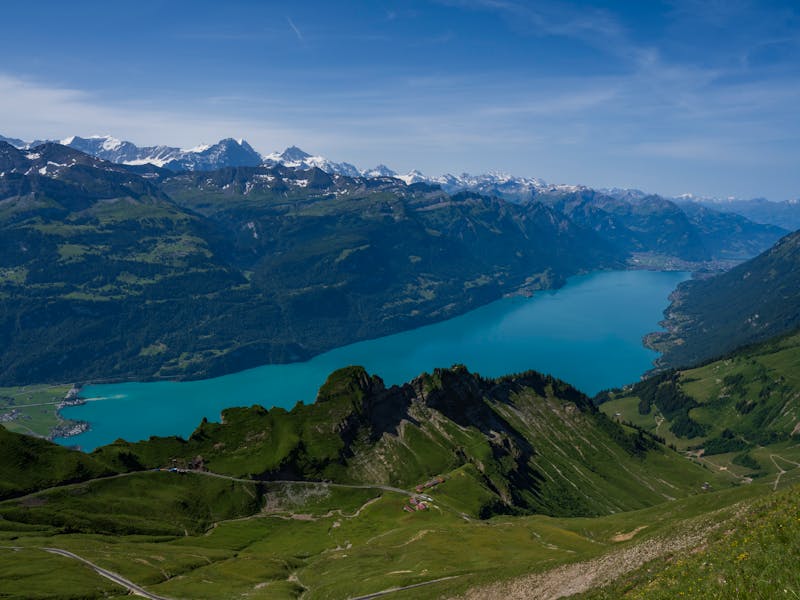
Switzerland packs an astonishing variety of landscapes into a compact area, from glacier-capped peaks to vast lake shores. Its position at the heart of Europe makes it a natural crossroads of cultures and borders.
- Switzerland is a landlocked country in Central Europe bordered by five nations: Germany to the north, Austria and Liechtenstein to the east, Italy to the south, and France to the west.
- The country covers an area of approximately 41,285 square kilometers, making it roughly twice the size of the state of New Jersey in the United States.
- The country’s capital is Bern, not Zurich as many people assume. Bern has served as the federal city since 1848, and its medieval old town is a UNESCO World Heritage Site.
- Switzerland is home to the Matterhorn, widely regarded as one of the most iconic and photographed mountains in the world, standing at 4,478 meters above sea level on the border between Switzerland and Italy.
- The highest point in Switzerland is Dufourspitze, part of the Monte Rosa massif, which reaches 4,634 meters above sea level, making it the second-highest peak in the Alps after Mont Blanc.
- Switzerland is home to Lake Geneva, known in French as Lac Léman, which is one of the largest lakes in Western Europe by surface area, covering approximately 580 square kilometers and shared between Switzerland and France.
- The Swiss Alps cover about 60% of the country’s total land area and attract millions of tourists annually. Switzerland has over 1,500 lakes and more than 1,800 glaciers, though many glaciers are retreating rapidly due to climate change.
- The Aletsch Glacier in the Swiss Alps is the largest glacier in the Alps, stretching approximately 23 kilometers in length and covering an area of about 81 square kilometers. It is part of a UNESCO World Heritage Site.
Facts About Switzerland History
Switzerland’s history spans more than seven centuries of confederation-building, humanitarian leadership, and carefully maintained neutrality.
- The Swiss Confederation, known officially as the Confoederatio Helvetica, was founded on August 1, 1291, when three cantons — Uri, Schwyz, and Unterwalden — signed the Federal Charter, a mutual defense agreement considered the founding document of the nation.
- Switzerland has remained officially neutral in international conflicts since the Congress of Vienna in 1815, a policy that has been maintained through two World Wars and continues to define Swiss foreign policy today.
- Despite its neutrality, Switzerland only joined the United Nations in 2002, making it among the last countries in the world to become a full member of the organization.
- Switzerland is the birthplace of the Red Cross. Henry Dunant, a Swiss businessman, founded the organization in 1863 after witnessing the Battle of Solferino in 1859, and he became the first recipient of the Nobel Peace Prize in 1901.
- The Geneva Conventions, a series of international treaties establishing humanitarian standards during wartime, were first adopted in Geneva in 1864 largely due to the efforts of Henry Dunant. The conventions have since been updated and are now ratified by 196 countries.
Facts About Switzerland Government and Politics

Switzerland’s political system is widely regarded as one of the most participatory and decentralized in the world, blending federal governance with robust direct democracy.
- Switzerland is divided into 26 cantons, which function similarly to states or provinces, each with its own constitution, parliament, government, and courts.
- Switzerland practices a form of direct democracy that allows citizens to challenge any law passed by parliament or propose constitutional amendments through referendums and popular initiatives, making it one of the most participatory democracies in the world.
- The Swiss Federal Council, which serves as the country’s executive branch, consists of seven members who collectively share the role of head of government. The presidency rotates annually among the seven councillors.
- Switzerland is not a member of the European Union, though it has negotiated over 120 bilateral agreements with the EU and uses its own currency, the Swiss franc (CHF), rather than the euro.
- Switzerland has a compulsory military service system for male citizens, who are required to serve in the Swiss Armed Forces. After completing initial training, soldiers keep their service weapons at home, contributing to one of the higher rates of civilian gun ownership in Europe.
Facts About Switzerland Language and Culture

Switzerland’s cultural identity is shaped by four national languages and a rich tapestry of regional traditions that coexist within a single, cohesive nation.
- Switzerland has four official national languages: German, French, Italian, and Romansh. German is spoken by about 63% of the population, French by 23%, Italian by 8%, and Romansh by less than 1%.
- The country has a population of approximately 8.7 million people, and notably, about 25% of its residents are foreign nationals, one of the highest proportions of immigrants relative to population among developed nations.
- William Tell, the legendary Swiss folk hero said to have shot an apple off his son’s head with a crossbow, is a central figure in Swiss national identity. Though his historical existence is disputed, his story, set in the early 14th century, symbolizes Swiss resistance to tyranny.
- Zurich consistently ranks as one of the world’s most livable cities, frequently appearing near the top of global quality of life indices published by organizations such as Mercer and the Economist Intelligence Unit, due to its safety, infrastructure, healthcare, and cultural offerings.
Facts About Switzerland Economy and Finance

Switzerland’s economy is one of the most prosperous and stable in the world, built on a foundation of precision manufacturing, financial services, and globally recognized exports.
- The Swiss franc is consistently ranked among the world’s most stable and trusted currencies, and Switzerland’s banking sector manages an estimated one-quarter of all global offshore private wealth.
- Switzerland has one of the highest GDP per capita figures in the world, with a nominal GDP per capita that has exceeded approximately $90,000 USD in recent years, placing it among the top-ranked nations globally by that measure.
- The Swiss watch industry, known as haute horlogerie, produces some of the world’s most prestigious timepieces. Brands such as Rolex, Patek Philippe, Omega, and TAG Heuer are all Swiss, and the industry exports watches worth over 20 billion Swiss francs annually.
- Switzerland is widely regarded as one of the world’s leading exporters of chocolate by value, and Swiss chocolate consumption per capita is among the highest in the world, with Swiss residents consuming an average of about 10 kilograms of chocolate per person per year.
- The Swiss cheese industry is equally famous, producing iconic varieties such as Emmental, Gruyère, Appenzeller, and Raclette. Switzerland produces over 185,000 tonnes of cheese annually, with a significant portion exported worldwide.
- The Swiss Army Knife, originally manufactured by Karl Elsener in 1891 for the Swiss Army, has become one of the most recognizable Swiss symbols worldwide. The Victorinox company, based in Ibach, produces over 35,000 knives per day.
Facts About Switzerland Science and Innovation

Despite its small size, Switzerland has made outsized contributions to global science, from Einstein’s theory of relativity to the invention of the World Wide Web.
- Albert Einstein developed his special theory of relativity while working as a patent clerk in Bern, Switzerland. He published his groundbreaking paper in 1905, a year now referred to as his “Annus Mirabilis” or miracle year.
- CERN, the European Organization for Nuclear Research, is located near Geneva, Switzerland, and is home to the Large Hadron Collider, the world’s largest and most powerful particle accelerator, which stretches 27 kilometers in circumference beneath the Swiss-French border.
- The World Wide Web was invented at CERN by British scientist Tim Berners-Lee in 1989, though the invention took place on Swiss soil, making Switzerland an unlikely birthplace of the modern internet.
- Switzerland has among the highest Nobel Prize counts per capita in the world, with Swiss nationals and residents having received over 25 Nobel Prizes across categories including physics, chemistry, medicine, and peace.
Facts About Switzerland Transportation and Infrastructure
Switzerland’s transport network is a global benchmark for efficiency, punctuality, and engineering ambition, connecting its mountainous terrain with remarkable precision.
- Switzerland has one of the world’s most extensive and punctual public transportation networks. The Swiss Federal Railways (SBB) operates over 3,300 kilometers of track, and trains run with an average delay of less than three minutes.
- The Gotthard Base Tunnel, which opened in June 2016, is the world’s longest and deepest railway tunnel, stretching 57.1 kilometers through the Alps and taking 17 years to construct at a cost of approximately 12 billion Swiss francs.
Facts About Switzerland International Relations
Switzerland’s global influence extends well beyond its borders, serving as a hub for international diplomacy, finance, and high-level economic dialogue.
- Switzerland is home to Davos, a small Alpine town that hosts the annual World Economic Forum, where global leaders in business, politics, and civil society gather each January to discuss pressing international economic and social issues. The event has been held there since 1971.
Related Reading:


