
30 Tasty Facts About Tacos: Folded Favorites
Few foods are as simple or as endlessly varied as the taco. A warm tortilla wrapped around a filling has fed Mexico for generations, inspired dozens of regional specialties, and gone global through street stalls, fast-food chains, and food trucks. These facts explore where tacos come from, how they are made, and how the world fell for them.
Tacos Facts At-a-Glance
Origin: Mexico
Basic Form: A corn or flour tortilla folded or rolled around a filling
Key Technique: Nixtamalization of corn for masa
Famous Styles: Al pastor, carnitas, barbacoa, cochinita pibil, fish tacos
Classic Toppings: Onion, cilantro, salsa, and lime
Celebration Days: Día del Taco on March 31 (Mexico), National Taco Day on October 4 (US)
Cultural Recognition: Traditional Mexican cuisine joined UNESCO’s Intangible Cultural Heritage list in 2010
Roots and Tortillas
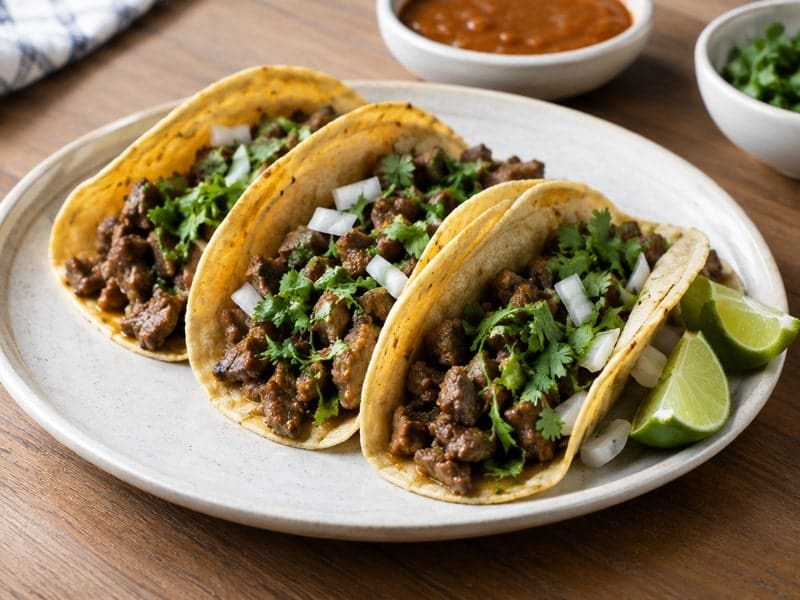
- The foundation of most traditional tacos is the corn tortilla, a flatbread made in Mesoamerica long before Europeans arrived in the Americas.
- Corn tortillas are made from masa, a dough produced through nixtamalization. In this process, dried corn is cooked and soaked in an alkaline solution such as limewater.
- Nixtamalization is more than a cooking step. It makes the corn easier to grind, improves its flavor, and makes niacin, a B vitamin, more available to the body.
- In Nahuatl, the language of the Aztecs, the corn flatbread is called tlaxcalli. The Spanish name tortilla means “little cake.”
- Spanish colonists brought wheat to Mexico. This is why flour tortillas became especially common in northern Mexico, while corn tortillas remain the standard in much of central and southern Mexico. [Learn more: 120 Interesting Facts About Mexico]
- Tortillas are traditionally warmed on a comal, a flat griddle used in Mexican kitchens for centuries.
Where the Word Came From
- In everyday Spanish, the word taco can mean a plug or a wad, which fits a tortilla stuffed with filling. [Learn more: 35 Fun Facts About the Spanish Language: Latin Legacy]
- One leading theory ties the food’s name to Mexican silver mines, where workers used small paper-wrapped explosive charges called tacos. This is a theory and has not been proven.
- The word taco appears in writing to describe the food relatively late, in the 19th century, even though people had been wrapping food in tortillas for far longer.
Regional Taco Styles

Mexico’s taco map is full of local specialties, each shaped by its own ingredients and cooking methods.
- Tacos al pastor grew out of shawarma-style cooking that Lebanese immigrants brought to Mexico. Pork is marinated in chiles and spices, roasted on a vertical spit called a trompo, and often topped with pineapple. [Learn more: 85 Interesting Facts About Lebanon: The Land of Cedars]
- Puebla is known for tacos árabes, a close relative of al pastor. They are usually served in a pita-style flatbread instead of a corn tortilla.
- Cochinita pibil from the Yucatán Peninsula features pork marinated in achiote and sour orange, wrapped in banana leaves, and traditionally cooked in an underground pit called a pib.
- Barbacoa refers to meat slow-cooked until tender. In central Mexico it is often lamb wrapped in maguey leaves and cooked in an earthen pit.
- Carnitas, strongly associated with the state of Michoacán, is pork cooked slowly in lard until it becomes tender inside and crisp at the edges.
- Baja California is famous for fish tacos, typically made with battered and fried fish and topped with cabbage and a creamy sauce.
- Tacos de canasta, or basket tacos, are filled ahead of time and packed into a cloth-lined basket. There they steam in their own warmth, which is why they are also called tacos sudados, or sweaty tacos.
- Tacos dorados are rolled or folded tortillas fried until crisp. Rolled versions are often called taquitos or flautas.
- Mexican street tacos are commonly served on small corn tortillas, often doubled up, and finished simply with chopped onion, cilantro, salsa, and a squeeze of lime.
Tacos in the United States
- The U-shaped, crunchy hard-shell taco became a hallmark of American and Tex-Mex cooking, often filled with seasoned ground beef, shredded lettuce, and cheddar cheese.
- Glen Bell opened the first Taco Bell in Downey, California, in 1962. The chain helped turn the hard-shell taco into a familiar fast food across the country.
- Taco Bell introduced the Doritos Locos Taco, with a shell made to taste like Doritos chips, in 2012.
- For decades, Taco John’s held the trademark for “Taco Tuesday” in 49 states. The company gave up the trademark in 2023 after Taco Bell challenged it.
- Breakfast tacos, usually made with flour tortillas and fillings like eggs, potatoes, and bacon, are a beloved tradition in Texas cities such as Austin and San Antonio.
- San Antonio is also known for puffy tacos, made by frying fresh masa so it puffs up into a light, crisp shell.
- Chef Roy Choi’s Kogi food truck in Los Angeles helped launch the Korean taco craze in 2008 by tucking Korean barbecue into tortillas.
Recommended Read:
Taco Culture and Celebrations
- A taquería is a restaurant or stand specializing in tacos, and the cook who makes them is often called a taquero.
- Mexico celebrates Día del Taco, or Taco Day, on March 31. [Learn more: Engaging Facts About March 31: Notable Events]
- In the United States, National Taco Day falls on October 4.
- In 2010, UNESCO added traditional Mexican cuisine to its list of the Intangible Cultural Heritage of Humanity, recognizing the knowledge, rituals, and community traditions behind it.
- In 2024, Taquería El Califa de León in Mexico City earned a Michelin star, making a humble taco stand one of the most talked-about restaurants in the first Michelin Guide to Mexico.
Recommended Read:


