
25 Fun Facts About Thanksgiving Day: America’s Feast
Discover the surprising history behind America’s most beloved holiday with these fun facts about Thanksgiving Day. Thanksgiving is far more than turkey and football—it’s a celebration rooted in a 1621 harvest feast, shaped by a determined magazine editor, and transformed over centuries into a day of family, gratitude, and unforgettable traditions.
Thanksgiving Facts At-a-Glance
Date: Fourth Thursday of November
Also Known As: Turkey Day
Commemorates: The 1621 Plymouth harvest feast and the autumn harvest
National Holiday Since: 1863 (Lincoln’s proclamation); fixed by Congress in 1941
Typical Celebrations: Family feasts, parades, football, gratitude gatherings
Symbols: Turkey, cornucopia, pumpkins, autumn leaves
Sources: Library of Congress, National Archives
The First Thanksgiving of 1621
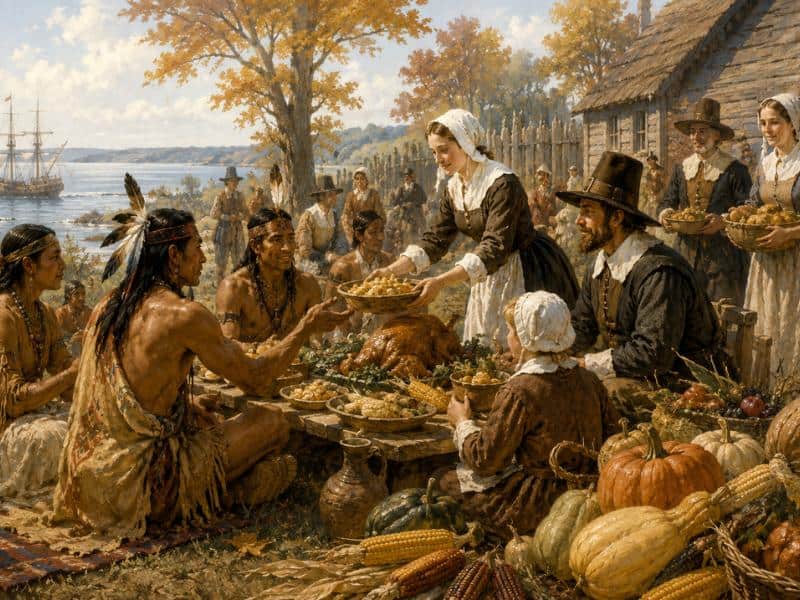
The origins of Thanksgiving trace back to a three-day autumn gathering in colonial New England—one that looked very different from the holiday we know today.
- The first Thanksgiving was a 1621 harvest feast in Plymouth, Massachusetts. The English colonists (later called Pilgrims) and the Wampanoag people shared a celebration marking a successful harvest.
- The feast lasted three days. According to colonist Edward Winslow’s firsthand account, the celebration stretched across three days of eating, games, and festivity.
- About 90 Wampanoag men attended, joining roughly 50 colonists. Their leader, Massasoit, brought his men to the gathering—meaning the Native guests significantly outnumbered the Pilgrims.
- Turkey probably wasn’t the main dish. The only meats documented in period accounts are venison, brought by the Wampanoag, and wild fowl—not the roast turkey we picture today.
- There was no pumpkin pie or mashed potatoes. The colonists had no ovens for pie crust, and white potatoes hadn’t yet reached New England tables. [Learn more: 32 Juicy Facts About Pumpkins: Harvest Highlights]
- The Pilgrims didn’t call it “Thanksgiving.” To them, a religious “day of thanksgiving” meant solemn prayer and fasting—not a festive harvest meal.
Suggested Read: 50 Facts About The United States: Discover America
How Thanksgiving Became a National Holiday
It took more than two centuries—and one persistent writer—for Thanksgiving to become the official holiday Americans celebrate today.
- A magazine editor campaigned for decades to make it a national holiday. Sarah Josepha Hale, who also wrote the nursery rhyme “Mary Had a Little Lamb,” spent years writing to presidents and lawmakers urging a national Thanksgiving.
- Abraham Lincoln established the modern holiday in 1863. In the midst of the Civil War, Lincoln proclaimed a national day of Thanksgiving to be held on the last Thursday of November.
- FDR once moved Thanksgiving up a week. In 1939, Franklin D. Roosevelt shifted the date earlier to lengthen the Christmas shopping season, sparking a public backlash nicknamed “Franksgiving.”
- Congress fixed the date as the fourth Thursday of November in 1941. After the Franksgiving confusion, lawmakers settled the matter with legislation signed into law.
Parades and Football Traditions

Some of Thanksgiving’s most-watched traditions began in the early 20th century and have grown into national spectacles.
- The Macy’s Thanksgiving Day Parade began in 1924. The very first parade featured live animals borrowed from the Central Park Zoo instead of the giant balloons we know today. [Learn more: 150 Notable Facts About New York City]
- Felix the Cat was the parade’s first giant balloon. The now-iconic helium character balloons debuted in 1927, with Felix leading the way.
- The Detroit Lions have hosted a Thanksgiving game since 1934. They’ve played nearly every Thanksgiving since—aside from a break during World War II—making it one of football’s oldest holiday traditions.
- The Dallas Cowboys started their Thanksgiving tradition in 1966. They’ve since become the NFL’s other regular Thanksgiving host team. [Learn more: 80 Interesting Facts About Dallas]
The Great American Feast

Modern Thanksgiving revolves around the table, where a few now-classic dishes have surprisingly recent origins.
- Americans eat roughly 46 million turkeys on Thanksgiving. The National Turkey Federation’s estimate makes it by far the biggest turkey-eating day of the year.
- Green bean casserole was invented in 1955. Dorcas Reilly created the now-classic dish in the Campbell Soup Company test kitchen, and it became a holiday staple.
- The TV dinner was born from a Thanksgiving surplus. In 1953, Swanson was left with around 260 tons of unsold frozen turkey and repackaged it into single-serving trays—launching the frozen TV dinner.
- A Thanksgiving day of eating can top 4,500 calories. The Calorie Control Council estimates the average American consumes several thousand calories across the meal and snacking.
- Ripe cranberries bounce. Because good cranberries have tiny air pockets inside, growers have long used a “bounce test” to sort the fresh ones from the duds.
- The Butterball Turkey Talk-Line has taken cooking questions since 1981. Every November, staff field thousands of calls from cooks anxious about their birds.
Turkeys, Pardons, and Curious Traditions

Beyond the feast, Thanksgiving comes with a flock of quirky facts—about the birds themselves and the customs surrounding the holiday.
- Wild turkeys can fly, but domestic ones can’t. Wild turkeys reach speeds around 55 mph in short bursts, while farm-raised turkeys are simply too heavy to get airborne.
- The presidential turkey “pardon” became an annual tradition in 1989. Presidents had been given turkeys since 1947, but George H. W. Bush formalized the yearly sparing of the bird.
- Canada has its own Thanksgiving—on a different day. Canadians celebrate their Thanksgiving on the second Monday of October, weeks before the U.S. holiday.
- Thanksgiving kicks off the busiest travel and shopping stretch of the year. The holiday is among the heaviest U.S. travel periods, and the following day—Black Friday—launches the Christmas shopping season.
- The Thanksgiving wishbone tradition is ancient. Snapping a bird’s wishbone for luck dates back to the Etruscans over 2,000 years ago, long before it became a Thanksgiving custom.
Explore More American Facts
Continue your journey through American history and culture with our comprehensive collection of location-based facts.
- 55 Interesting Facts About North America – Discover fascinating facts about the entire North American continent.
- Interesting Facts About US States – Explore fun facts about every US state, from their unique histories and landmarks to cultural traditions and natural wonders.
- 20 Fun Facts About 4th of July: America’s Birthday
- 25 Facts About Memorial Day: Honoring America’s Fallen
- 20 Facts About Veterans Day: Honoring Those Who Served
Featured State Fact Collections:
- 100 California Fun Facts – The Golden State’s entertainment industry and natural diversity
- 75 Fun Facts About Texas – The Lone Star State’s cowboy culture and space exploration
- 100 Interesting Facts About New York State – The Empire State’s iconic landmarks and cultural influence
- 100 Fascinating Facts About Florida – The Sunshine State’s unique wildlife and theme park capital
- 100 Meaningful Facts About Massachusetts – The Bay State’s Revolutionary War history and founding heritage
- 80 Unique Facts About Utah – The Beehive State’s stunning national parks and pioneer heritage
- 100 Fascinating Facts About Louisiana – The Pelican State’s Creole culture and jazz music birthplace
- 80 Interesting Facts About Nebraska – The Cornhusker State’s agricultural heritage and pioneer trails
- 88 Fun Facts About Kentucky – The Bluegrass State’s bourbon distilleries and horse racing tradition
- 95 Fun Facts About Pennsylvania – The Keystone State’s Independence Hall and founding father legacy


