
25 Fun Facts About The Golden Gate Bridge
There are countless remarkable facts about Golden Gate Bridge that continue to captivate engineers, historians, and travelers from around the world. Stretching across the windswept Golden Gate Strait in San Francisco, California, this iconic suspension bridge is far more than a feat of steel and cable — it is a symbol of human ambition, artistic vision, and resilience that has defined an entire city’s identity since it opened in 1937.
Golden Gate Bridge Facts At-a-Glance
Location: San Francisco, California, USA
Established: Opened May 27–28, 1937
Total Length: 1.7 miles (2.7 km)
Main Span: 4,200 feet (1,280 meters)
Tower Height: 746 feet (227 meters) above water
Deck Clearance: ~220 feet (67 meters) above water
Color: International Orange
Daily Traffic: ~112,000 vehicles per day
Annual Visitors: ~10 million
Facts About Golden Gate Bridge History
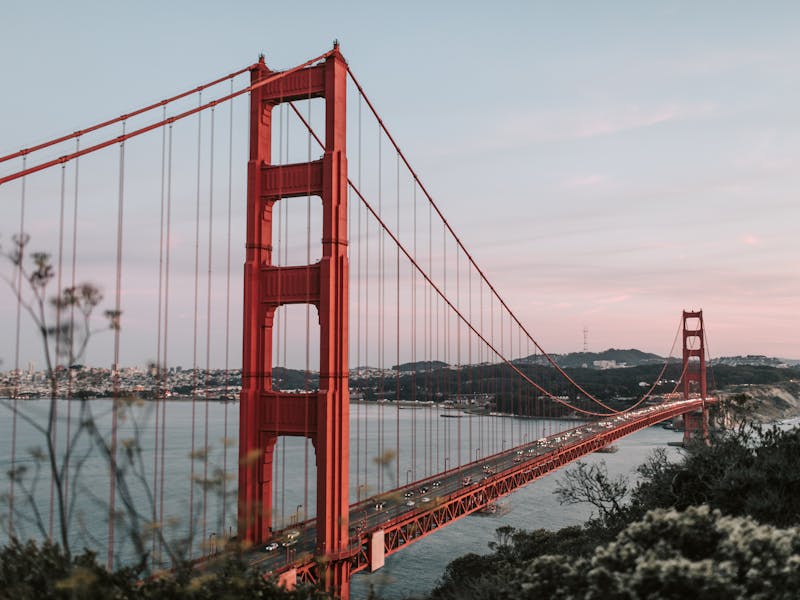
The Golden Gate Bridge has one of the most dramatic construction stories in American engineering history. From its groundbreaking in 1933 to its triumphant opening in 1937, the bridge was built against formidable odds — fierce tidal currents, dense fog, and the ever-present threat of earthquakes.
- Construction of the bridge began on January 5, 1933, and it opened to pedestrians on May 27, 1937, with vehicular traffic beginning the following day on May 28, 1937.
- The bridge took approximately four years to build and cost around $35 million to construct, which is equivalent to roughly $760 million in today’s dollars when adjusted for inflation.
- Chief Engineer Joseph Strauss is most commonly credited with the bridge’s design, though much of the actual engineering and aesthetic work was contributed by Charles Ellis and architect Irving Morrow, who chose the distinctive Art Deco styling.
- During construction, a safety net was installed beneath the bridge — a pioneering safety measure at the time — which saved the lives of 19 workers who fell into it. These men proudly called themselves the “Halfway to Hell Club.”
- Eleven workers died during the construction of the Golden Gate Bridge, with ten of them perishing in a single accident on February 17, 1937, when a scaffold collapsed and fell through the safety net.
- The bridge’s foundations rest on bedrock, with the south pier sitting on a submerged rock ledge 65 feet (20 meters) below the surface of the water, requiring workers to construct a unique fender structure to protect the pier from ship traffic during construction.
- During World War II, the U.S. Army installed a submarine net across the Golden Gate Strait and placed gun batteries on both shores to protect San Francisco Bay from potential enemy submarine attacks, with the bridge serving as a critical military landmark.
Facts About Golden Gate Bridge Geography and Location

The bridge’s setting is as dramatic as its design. Positioned at the mouth of one of the world’s great natural harbors, the Golden Gate Bridge connects two distinct landscapes and serves as a gateway between the open Pacific and the sheltered bay.
- The Golden Gate Bridge spans the Golden Gate Strait, the opening of San Francisco Bay into the Pacific Ocean, connecting the city of San Francisco to Marin County in California.
- The Golden Gate Bridge stretches 1.7 miles (2.7 kilometers) in total length, with the main suspension span measuring 4,200 feet (1,280 meters), making it widely regarded as the longest suspension bridge main span in the world at the time of its completion.
- The two main towers of the bridge rise 746 feet (227 meters) above the water, making them taller than the Washington Monument and visible from miles away on clear days.
- The bridge’s roadway deck hangs approximately 220 feet (67 meters) above the water at its center, and the clearance beneath the bridge at the center of the main span is about 220 feet, allowing large naval vessels and container ships to pass underneath.
Facts About Golden Gate Bridge Engineering and Design

The engineering innovations behind the Golden Gate Bridge set new global standards for suspension bridge construction. Its design blends structural ingenuity with striking visual elegance in ways that remain influential to this day.
- The distinctive color of the bridge is officially called “International Orange,” a color chosen by consulting architect Irving Morrow because it complemented the natural surroundings and enhanced the bridge’s visibility in San Francisco’s frequent fog.
- Each of the two main cables supporting the bridge is composed of 27,572 individual wire strands bundled together, and each cable measures about 36.5 inches (93 centimeters) in diameter, containing enough wire to circle the Earth three times.
- The bridge was designed to withstand winds of up to 100 miles per hour (161 kilometers per hour) and can sway up to 27 feet (8.2 meters) at mid-span during extreme wind conditions.
- The bridge experiences significant thermal expansion and contraction due to temperature changes, with the main span capable of expanding or contracting by as much as 10 feet (3 meters) between the coldest and hottest days of the year.
Facts About Golden Gate Bridge Maintenance and Operations
Keeping the Golden Gate Bridge in pristine condition is a year-round endeavor. The bridge’s exposure to salt air, moisture, and heavy traffic demands constant vigilance from a dedicated maintenance crew.
- The bridge requires continuous maintenance and repainting, with a crew of painters working year-round to touch up areas where salt air and moisture cause the paint to deteriorate, debunking the popular myth that it is repainted from end to end every year.
- Approximately 10 million pounds (4.5 million kilograms) of paint are used to maintain the bridge’s coating, and the painting crew uses approximately 1,000 gallons of paint per year for touch-up work.
- The Golden Gate Bridge District, which operates and maintains the bridge, also runs ferry services across San Francisco Bay, providing an important public transportation link for commuters and tourists throughout the region.
Facts About Golden Gate Bridge Traffic and Transportation

As one of the busiest toll bridges in the United States, the Golden Gate Bridge plays a vital daily role in the movement of people and goods throughout the greater Bay Area.
- The Golden Gate Bridge carries about 112,000 vehicles per day across its six lanes of traffic, which can be reconfigured using movable median barriers to accommodate varying traffic flow in each direction.
- A movable median barrier system, known as the “zipper truck,” was introduced in 2015 to improve safety by creating a physical separation between opposing lanes of traffic, replacing the previous painted-line system that contributed to head-on collisions.
Facts About Golden Gate Bridge Cultural Impact and Recognition
Few structures anywhere in the world have achieved the level of cultural resonance that the Golden Gate Bridge commands. It is simultaneously a working piece of infrastructure and a global icon of American ingenuity.
- The Golden Gate Bridge is widely regarded as one of the most photographed structures in the world and attracts approximately 10 million visitors annually, making it among the most visited landmarks in the United States.
- The bridge has been named one of the Seven Wonders of the Modern World by the American Society of Civil Engineers, recognizing its extraordinary engineering achievement and lasting impact on infrastructure design.
- When the Golden Gate Bridge celebrated its 50th anniversary in 1987, approximately 300,000 people walked across it simultaneously, causing the bridge deck to flatten noticeably under the weight and prompting engineers to study the structural implications of such concentrated pedestrian loads.
Facts About Golden Gate Bridge Safety
Beyond its engineering legacy, the Golden Gate Bridge has also been at the center of a long and difficult public conversation about mental health, public safety, and the responsibilities of landmark stewardship.
- Tragically, the Golden Gate Bridge has been the site of one of the highest numbers of suicides of any location in the world, with over 1,700 confirmed deaths since its opening. A suicide deterrent net was completed and opened in 2023 after decades of debate and fundraising.
- The stainless steel suicide deterrent net extends 20 feet (6 meters) out from each side of the bridge and sits about 20 feet below the roadway, costing approximately $400 million to design and install.
Related Reading:


