
25 Fun Facts About the Grand Canyon: Geologic Marvel
There are countless fascinating facts about The Grand Canyon that reveal why this colossal chasm in northwestern Arizona continues to captivate millions of visitors, scientists, and adventurers every single year.
Stretching nearly 277 miles long and plunging more than a mile deep, the Grand Canyon is far more than a scenic overlook — it is a living record of Earth’s geological history, a sanctuary for extraordinary biodiversity, a sacred homeland for eleven Native American tribes, and one of the most economically significant natural landmarks in the United States.
The Grand Canyon Facts At-a-Glance
Location: Northwestern Arizona, USA
Area: Approx. 1,904 sq miles (4,931 sq km)
Elevation: South Rim ~6,800 ft; North Rim ~8,000 ft above sea level
Established: February 26, 1919 (National Park)
Climate: Semi-arid to alpine; extreme temperature variation by elevation
Highest Peak: North Rim, ~8,800 ft (2,682 m)
Region: Colorado Plateau, Southwestern United States
Visitors: Approx. 6 million per year
Facts About The Grand Canyon Geography and Physical Features
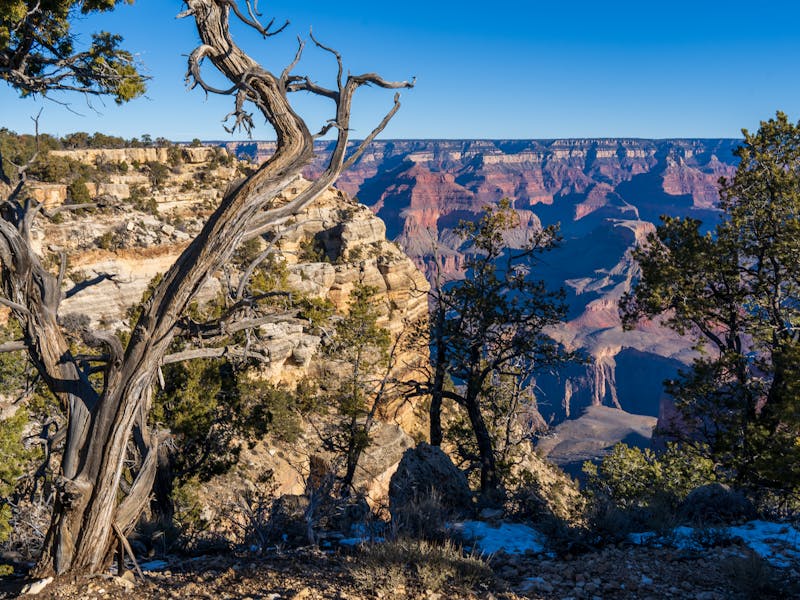
The Grand Canyon’s sheer scale and dramatic landscape make it one of the most recognizable natural features on the planet. Located in Arizona, it spans multiple climate zones and offers some of the most extreme terrain found anywhere in North America.
- The Grand Canyon is located in northwestern Arizona, USA, and stretches approximately 277 miles (446 kilometers) long, up to 18 miles (29 kilometers) wide, and reaches depths of over 6,093 feet (1,857 meters), making it one of the most dramatic geological features on Earth.
- The North Rim of the Grand Canyon sits about 1,000 feet higher than the South Rim, averaging around 8,000 feet above sea level, and receives significantly more snowfall, causing it to close to visitors from mid-October through mid-May each year.
- Temperatures within the Grand Canyon vary dramatically depending on elevation, with the canyon floor often exceeding 110 degrees Fahrenheit (43 degrees Celsius) in summer while the rims remain significantly cooler, creating multiple climate zones within a single geographic feature.
- The Grand Canyon experiences a phenomenon called a temperature inversion, where warm air traps cold air and fog in the canyon below, occasionally filling the entire canyon with a sea of clouds visible from the rim — a rare and spectacular meteorological event.
Facts About The Grand Canyon Geology and Formation

Few places on Earth expose as much geological history as the Grand Canyon. Its layered rock walls tell a story spanning nearly two billion years of our planet’s past.
- The Colorado River carved the Grand Canyon over a period of approximately 5 to 6 million years, though the rock layers exposed within its walls are far older, with some Vishnu Basement Rocks at the canyon’s bottom dating back nearly 1.8 billion years.
- The Grand Canyon’s rock layers serve as a remarkable geological record, with distinct strata including the Kaibab Limestone at the top, the Coconino Sandstone, the Hermit Shale, and the Redwall Limestone, each representing different ancient environments spanning hundreds of millions of years.
- The canyon contains approximately 1,000 caves, though only 335 have been documented and just one — the Cave of the Domes — is open to the public. Many caves contain archaeological artifacts and unique geological formations.
- The total volume of rock removed by erosion to create the Grand Canyon is estimated at approximately 4.7 cubic miles (19.6 cubic kilometers), a staggering amount of material that was carried downstream by the Colorado River over millions of years to form the canyon’s iconic shape.
Facts About The Grand Canyon History and Exploration
The Grand Canyon has drawn explorers, scientists, and leaders for centuries, each leaving their mark on how the world understands and protects this extraordinary landmark.
- Grand Canyon National Park was officially established on February 26, 1919, by President Woodrow Wilson, though President Theodore Roosevelt had previously designated it a national monument in 1908 after visiting and famously declaring it beyond human improvement.
- Spanish explorer García López de Cárdenas is widely regarded as the first European to see the Grand Canyon, in 1540, when he led an expedition from the Hopi villages; his party was unable to descend to the Colorado River and left after three days.
- John Wesley Powell led the first documented expedition through the Grand Canyon by boat in 1869, navigating the Colorado River with a crew of nine men over 99 days — an extraordinarily dangerous journey that brought the canyon to national attention.
- The Grand Canyon was designated a UNESCO World Heritage Site in 1979, recognized for its outstanding universal value as both a natural wonder and a site of significant cultural and scientific importance to humanity.
Facts About The Grand Canyon Indigenous Peoples and Culture
Long before European explorers arrived, the Grand Canyon was — and remains — a deeply sacred homeland for multiple Native American nations whose histories are inseparable from the canyon itself.
- Indigenous peoples have lived in and around the Grand Canyon for at least 10,000 to 12,000 years, with evidence of human habitation including split-twig figurines found in caves that date back roughly 4,000 years.
- The Havasupai Tribe, whose name means “people of the blue-green water,” have lived continuously in the Grand Canyon region for over 800 years and today reside in Havasu Canyon, a side canyon famous for its stunning turquoise waterfalls.
- Eleven Native American tribes are officially affiliated with Grand Canyon National Park, including the Navajo Nation, Hopi Tribe, Zuni Tribe, Havasupai, Hualapai, and Southern Paiute, each maintaining deep cultural and spiritual connections to the canyon.
Facts About The Grand Canyon Wildlife and Biodiversity

The Grand Canyon’s range of elevations and ecosystems supports a remarkable variety of plant and animal life, some of which exists nowhere else on Earth.
- The Grand Canyon is home to over 1,500 plant species, 355 bird species, 89 mammal species, 47 reptile species, 9 amphibian species, and 17 fish species, representing an extraordinary range of biodiversity across its multiple distinct ecological zones.
- The California condor, one of North America’s most endangered birds with a wingspan reaching up to 9.5 feet, was reintroduced to the Grand Canyon region in 1996 after becoming extinct in the wild. Today, more than 100 condors soar over the canyon.
Facts About The Grand Canyon Colorado River and Water Features
The Colorado River is the force that created the Grand Canyon and continues to shape it today, offering some of the most thrilling whitewater experiences in the world.
- The Colorado River within the Grand Canyon contains 160 rapids, with some of the most challenging whitewater in North America. Lava Falls Rapid, rated a 10 on a scale of 1 to 10, is widely regarded as one of the most difficult commercially run rapids in North America.
Facts About The Grand Canyon Tourism and Recreation

From glass-floored skywalks to mule rides and stargazing, the Grand Canyon offers an unmatched variety of experiences that draw millions of visitors from around the globe each year. It stands alongside iconic parks like Yellowstone, Yosemite, and Zion as one of America’s most treasured natural destinations.
- The Grand Canyon receives approximately 6 million visitors per year, making it one of the most visited national parks in the United States, with the South Rim being the most accessible and popular section, open year-round.
- The Grand Canyon Skywalk, a horseshoe-shaped glass bridge extending 70 feet over the canyon’s edge on the Hualapai Tribe’s land, opened in March 2007 and stands approximately 4,000 feet above the canyon floor, offering a vertigo-inducing transparent walkway.
- Phantom Ranch, located at the bottom of the Grand Canyon near the Colorado River, is the only lodging facility below the canyon rim and can only be reached by hiking, mule ride, or rafting. It was designed by architect Mary Colter and opened in 1922.
- Mule trips into the Grand Canyon have been offered since the late 1800s and remain one of the most iconic ways to experience the canyon. The mules are specially trained, and the trips are so popular that reservations are often booked more than a year in advance.
- Bright Angel Trail, one of the most popular hiking routes in the Grand Canyon, follows a natural fault line and was originally used by the Havasupai people. It descends approximately 4,380 feet over 9.5 miles from the South Rim to the Colorado River.
- Light pollution is actively managed at Grand Canyon National Park, which has been designated a Dark Sky Park by the International Dark-Sky Association. On clear nights, visitors can observe the Milky Way and thousands of stars with remarkable clarity due to the park’s remote location.
- The Grand Canyon generates significant economic activity for Arizona, with studies having estimated that the park and its visitors contribute over $700 million annually to the surrounding regional economy and support thousands of jobs in gateway communities.
Explore More Iconic U.S. National Parks
If you’re fascinated by the Grand Canyon, these national parks offer equally remarkable landscapes, unique ecosystems, and unforgettable natural features.


