
30 Interesting Facts About The Great Wall of China
These facts about the Great Wall of China reveal why this massive ancient fortification remains one of the world’s greatest engineering achievements — from its 2,000-year construction history and vast scale across northern China to the fascinating myths, military strategies, and preservation efforts that continue to surround it today.
Great Wall of China Facts At-a-Glance
Location: Northern China, spanning 15 provinces, municipalities, and autonomous regions
Total Length (All Sections): Approx. 21,196 km (13,171 miles)
Construction Period: 7th century BC – 1644 AD (over 2,000 years)
Best-Preserved Era: Ming Dynasty (1368–1644 AD)
UNESCO Status: World Heritage Site since 1987
Most Visited Section: Badaling — over 300 million visitors since 1957
Peak Military Garrison: Estimated 1 million soldiers (Ming Dynasty)
Conservation Law: Great Wall Protection Ordinance, 2006
History and Construction
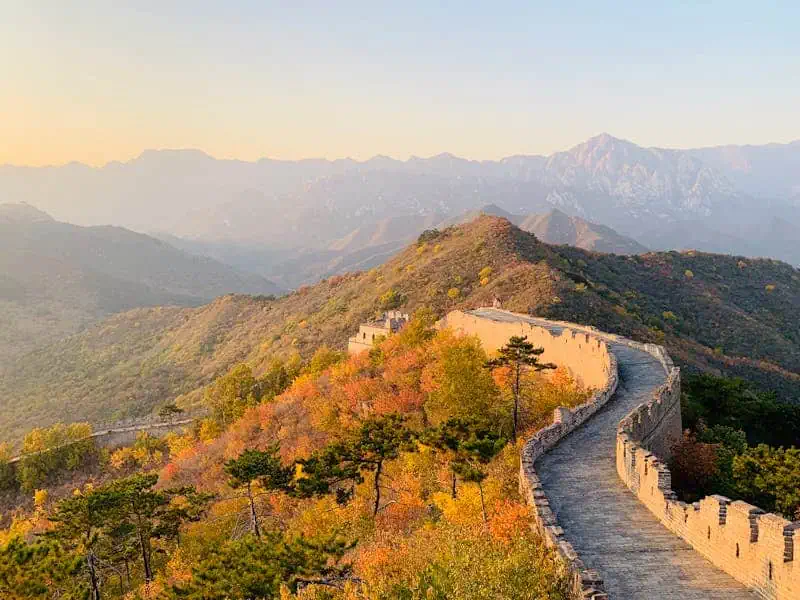
The Great Wall’s story spans more than two millennia, shaped by dozens of rulers, millions of laborers, and the ever-present threat of invasion from the north. Understanding its origins reveals just how complex — and deeply human — this monument truly is.
- Construction of the Great Wall began as early as the 7th century BC, when individual Chinese states built their own defensive walls to protect against neighboring rivals and northern nomadic tribes.
- The first emperor of a unified China, Qin Shi Huang, ordered the connection and extension of existing walls around 221 BC, creating an early version of what would become the Great Wall.
- Among the best-known and best-preserved sections of the Great Wall are those built during the Ming Dynasty (1368–1644 AD), and these are the sections most commonly visited by tourists today.
- During the Ming Dynasty, the wall was constructed primarily using bricks and stone, whereas earlier versions were built using rammed earth, wood, and other locally available materials.
- The Mongols, who established the Yuan Dynasty (1271–1368), largely neglected the Great Wall after conquering China, as they had no need for a barrier against themselves.
- The Great Wall is widely regarded as one of the most ambitious construction projects in human history, representing over 2,000 years of continuous building effort across multiple dynasties, making it a living record of Chinese political, military, and cultural history.
Suggested Read: 50 Fascinating Facts About China: Ancient Civilization
Geography and Physical Characteristics

Few structures on Earth match the sheer geographic scale of the Great Wall, which winds through some of China’s most dramatic and varied landscapes. Its physical dimensions alone make it a subject of endless fascination.
- The Great Wall of China is not a single continuous wall but rather a series of multiple walls, fortifications, and barriers built over many centuries by different Chinese states and dynasties.
- The total length of all Great Wall sections combined is approximately 21,196 kilometers (13,171 miles), according to a comprehensive survey conducted by China’s State Administration of Cultural Heritage in 2012.
- The Great Wall stretches across northern China, passing through 15 provinces, municipalities, and autonomous regions, including Beijing, Hebei, Shanxi, Inner Mongolia, and Gansu.
- At its widest points, the Ming Dynasty wall measures approximately 9 meters (30 feet) wide at the base and 4.5 to 9 meters (15 to 30 feet) wide at the top — reportedly wide enough for five horses to ride abreast.
- The wall reaches heights of up to 8 meters (26 feet) in many sections, with watchtowers rising even higher to provide soldiers with elevated vantage points for spotting approaching enemies.
- The wall passes through dramatically varied terrain, including deserts, grasslands, mountains, and plateaus, with some sections built at elevations exceeding 1,500 meters (4,900 feet) above sea level.
Suggested Read:
Facts About the Great Wall of China: Military and Defense Systems

The Great Wall was far more than a passive barrier — it was an integrated military communication and control network that coordinated the defense of an entire empire. Its design reflects centuries of hard-won strategic thinking.
- Watchtowers were built at regular intervals along the wall, typically every 150 to 500 meters, and served as signal stations where soldiers could communicate using smoke signals during the day and fire signals at night.
- During the Ming Dynasty, the wall was garrisoned by an estimated one million soldiers at its peak, stationed in forts and barracks built along its length.
- The Great Wall was not always effective as a military barrier. Nomadic groups, including the Mongols during the era of Genghis Khan, successfully bypassed or exploited weaknesses in it on multiple occasions throughout history, often through political manipulation or undefended routes rather than direct assault.
- The Great Wall served not only as a military defense but also as a means of controlling the movement of goods and people, helping to regulate activity along associated trade routes including portions of the broader Silk Road network.
- Beacon towers, which were part of the Great Wall system, could relay military signals across hundreds of kilometers in just a few hours using a combination of smoke, fire, flags, and drums.
Construction Materials and Techniques

The engineering ingenuity behind the Great Wall is as remarkable as its scale. Builders adapted their methods and materials to whatever the local environment provided, producing results that have endured for centuries.
- The mortar used to bind bricks in many Ming Dynasty sections contained sticky rice flour mixed with slaked lime — a surprisingly durable combination that modern scientists have studied for its remarkable binding properties.
- It is estimated that hundreds of thousands to over one million workers died during the construction of the Great Wall over the centuries, earning it the grim nickname “the longest cemetery on Earth.”
- Workers who died during construction were sometimes buried within the wall itself, though modern archaeological research suggests this practice was less widespread than popular legend claims.
Facts About the Great Wall of China: Notable Sections and Locations
Not all sections of the Great Wall are equal — each has its own history, character, and strategic significance. From the tourist-thronged Badaling to the remote Jiayuguan Pass, these locations tell distinct stories. Visitors to the wall often base themselves in Beijing, which provides easy access to several of the most celebrated sections.
- The Badaling section of the Great Wall, located about 70 kilometers northwest of Beijing, is the most visited section and has welcomed over 300 million visitors since it opened to tourists in 1957.
- The Jiayuguan Pass, located at the western end of the Ming Dynasty wall in Gansu Province, was built in 1372 and served as the last major fortification before the wall ended at the edge of the Gobi Desert.
- The eastern terminus of the Ming Dynasty wall is Shanhaiguan, known as the “First Pass Under Heaven,” where the wall meets the Bohai Sea in Hebei Province.
- The Simatai section of the Great Wall, located in Beijing’s Miyun District, is one of the few sections that has been preserved in its original, unrestored state and is considered among the most authentic remaining portions.
Modern Status and Conservation
Despite its legendary status, the Great Wall faces serious threats from erosion, neglect, and human activity. Preservation efforts have intensified in recent decades, but the scale of the challenge remains enormous.
- The Great Wall was designated a UNESCO World Heritage Site in 1987, recognized for its outstanding universal value as a monumental feat of human engineering and military architecture.
- Significant portions of the Great Wall have been lost to erosion, vandalism, and human activity. A 2016 report estimated that approximately 30 percent of the Ming Dynasty wall had disappeared entirely.
- Local farmers and villagers dismantled significant portions of the Great Wall over the centuries, using its bricks and stones to build homes, roads, and other structures, particularly during the 19th and early 20th centuries.
- China has implemented laws to protect the Great Wall, including the 2006 Great Wall Protection Ordinance, which prohibits activities such as carving on the wall, removing bricks, and conducting unauthorized construction near it.
Facts About the Great Wall of China: Culture and Myths
The Great Wall has generated as many myths as it has historical facts, and separating legend from reality is part of what makes studying it so rewarding. Its cultural footprint extends well beyond China’s borders.
- The popular claim that the Great Wall is visible from space with the naked eye is a myth. NASA astronauts and scientists have confirmed it is far too narrow to be seen from low Earth orbit without optical aids.
- Richard Nixon’s historic visit to the Great Wall in February 1972 during his trip to China helped bring global attention to the monument and contributed to its status as an international symbol of Chinese civilization.


