
45 Fun Facts About The Netherlands: Lowland Wonders
The Netherlands is a small, low-lying country with an outsized story. Its people have spent centuries holding back the sea, building a trading empire, and producing some of the world’s most beloved art. These facts cover its watery landscape, history, government, culture, and the everyday habits that make Dutch life distinctive.
The Netherlands Facts At-a-Glance
Location: Western Europe, on the North Sea
Population: About 18 million
Area: 41,543 sq km (16,040 sq mi)
Languages: Dutch (official), with Frisian also official in Friesland
Capital: Amsterdam (seat of government: The Hague)
Government: Constitutional monarchy and parliamentary democracy
Climate: Temperate maritime
Highest Point: Vaalserberg, 322.4 m (1,058 ft), in the European Netherlands
Geography and Landscape
- The name “Netherlands” means “low lands,” and it fits. About a quarter of the country lies below sea level, and much more would be at risk of flooding without its defenses.
- The lowest point is in the Zuidplaspolder near Rotterdam, at nearly 7 meters below sea level.
- The highest point in the European part of the country is the Vaalserberg, at 322.4 meters (1,058 feet). It sits near the spot where the Netherlands, Belgium, and Germany meet.
- The tallest peak in the whole Kingdom is Mount Scenery on the Caribbean island of Saba, which rises 887 meters (2,910 feet).
- “Holland” is not the country’s proper name. North Holland and South Holland are just two of the Netherlands’ twelve provinces, and in 2020 the government shifted its official branding away from “Holland.”
- The Kingdom of the Netherlands is made up of four constituent countries: the Netherlands, Aruba, Curaçao, and Sint Maarten. Bonaire, Sint Eustatius, and Saba are special municipalities of the Netherlands itself.
- Flevoland, the newest province, became official in 1986. Most of its land was reclaimed from the water, and its city of Almere was built from scratch on that new ground.
- The Wadden Sea, a vast tidal area of mudflats and islands along the northern coast, was named a UNESCO World Heritage Site in 2009. The Netherlands shares it with Germany and Denmark.
Suggested Read:
Living With Water
- Much of the country consists of polders, low areas of land enclosed by dikes and kept dry by drainage. Windmills once did much of this pumping work.
- The village of Kinderdijk has a famous group of 19 windmills built to drain the surrounding land. They became a UNESCO World Heritage Site in 1997.
- The Afsluitdijk, a dam about 32 kilometers long completed in 1932, closed off the Zuiderzee from the sea. The enclosed water became a freshwater lake called the IJsselmeer.
- In 1953, a massive North Sea flood killed more than 1,800 people in the Netherlands. The disaster led to the Delta Works, a huge network of dams, sluices, and storm surge barriers.
- The Maeslantkering near Rotterdam, completed in 1997, is a storm surge barrier with two enormous swinging arms. Each arm is roughly as long as the Eiffel Tower is tall.
- The Dutch water boards, which manage dikes and water levels, date back to the Middle Ages and are among the oldest democratic institutions in the country. Residents still elect their members.
- The tale of a little Dutch boy saving his town by plugging a leaky dike with his finger is a legend, not history. It became widely known through an American novel, Mary Mapes Dodge’s Hans Brinker, or the Silver Skates, published in 1865.
Recommended Read: 10 Interesting Facts About Floods: Nature’s Watery Fury
History
- The Dutch fought the Eighty Years’ War against Spanish rule from 1568 to 1648. Their independence was formally recognized in the Peace of Münster in 1648.
- William of Orange, who led the revolt against Spain, is often called the “Father of the Fatherland.” The current royal family, the House of Orange-Nassau, descends from his line.
- The Dutch East India Company, or VOC, was founded in 1602. It is often described as the first company to issue publicly tradable shares.
- The 17th century is known as the Dutch Golden Age, when the young republic became a leading power in trade, science, and art.
- Dutch colonists founded New Amsterdam on Manhattan Island. The English took control in 1664 and renamed it New York.
- Dutch explorer Abel Tasman reached New Zealand in 1642. The country’s name comes from Zeeland, a Dutch province. [Learn more: 35 Interesting Facts About New Zealand: Epic Wonders]
- During Tulip Mania in the 1630s, prices for certain tulip bulbs soared to extraordinary heights before collapsing in 1637.
- Germany invaded the Netherlands in May 1940, and the center of Rotterdam was heavily bombed on May 14. The country now celebrates Liberation Day every May 5.
- Anne Frank and her family hid from the Nazis in a secret annex in Amsterdam from 1942 until they were discovered in 1944. The building is now the Anne Frank House museum.
Government and Society

- Amsterdam is the capital under the Dutch constitution, but the parliament, the cabinet, and the king’s working palace are all in The Hague.
- In April 2001, the Netherlands became the first country in the world to legalize same-sex marriage.
- King Willem-Alexander became king in 2013 when his mother, Queen Beatrix, abdicated. His birthday, April 27, is celebrated nationwide as King’s Day.
- On King’s Day, crowds dress in orange, the color of the royal House of Orange-Nassau, and streets fill with flea markets and parties.
- The Hague is home to the International Court of Justice, housed in the Peace Palace, as well as the International Criminal Court.
- The Dutch are among the tallest people in the world on average.
- The national anthem, “Het Wilhelmus,” has lyrics dating back to the 16th century, making it one of the oldest national anthems in the world.
Art, Science, and Culture
- Rembrandt’s huge 1642 painting The Night Watch is the star attraction of the Rijksmuseum in Amsterdam.
- Johannes Vermeer’s Girl with a Pearl Earring hangs in the Mauritshuis museum in The Hague.
- Vincent van Gogh was born in Zundert, in the southern Netherlands, in 1853. Amsterdam’s Van Gogh Museum holds the world’s largest collection of his work.
- Amsterdam’s ring of canals was laid out in the 17th century and was added to the UNESCO World Heritage list in 2010.
- Antonie van Leeuwenhoek, a self-taught scientist from Delft, used his handmade microscopes to become one of the first people to observe bacteria and other microorganisms.
- Dutch scientist Christiaan Huygens invented the pendulum clock in 1656, dramatically improving the accuracy of timekeeping.
- Delft Blue, the famous blue-and-white pottery from the city of Delft, began as a local answer to the Chinese porcelain imported by Dutch traders.
Recommended Read: 108 Interesting Facts About Amsterdam
Food, Sports, and Everyday Life
- Gouda and Edam cheeses are named after Dutch towns. In Alkmaar, a traditional cheese market still draws visitors to watch porters carry cheeses on wooden sledges.
- Stroopwafels, thin waffles sandwiched with caramel-like syrup, originated in the city of Gouda.
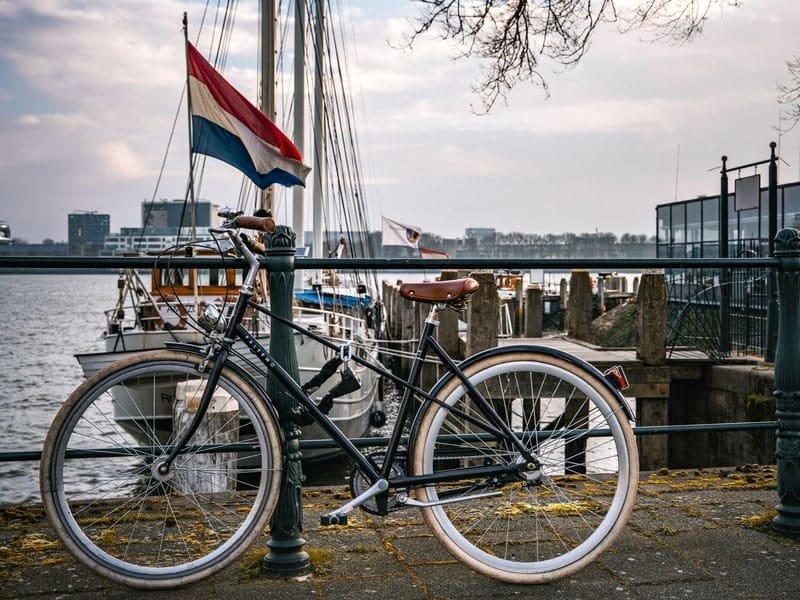
- There are more bicycles than people in the Netherlands, and dedicated bike lanes and parking garages are a normal part of city life.
- Keukenhof, in the town of Lisse, is one of the world’s most famous flower gardens, opening each spring to show off millions of blooming bulbs. The Netherlands is the world’s leading producer of tulips.
- The Elfstedentocht is a legendary ice-skating race of about 200 kilometers through eleven cities in Friesland. It can only be held when the ice is thick enough, and it was last run in 1997.
- The Port of Rotterdam is the largest port in Europe and a major gateway for goods entering the continent.
- Dutch soccer is famous for “Total Football,” a fluid style in which players swap positions freely. Johan Cruyff became its best-known star in the 1970s.
Recommended Read:


