
25 Fun Facts About The Statue of Liberty: A Symbol of Freedom
There are so many remarkable facts about The Statue of Liberty that even frequent visitors to New York Harbor are often surprised by what they learn.
From its French origins and engineering genius to its hidden symbolism and dramatic restoration, Lady Liberty is far more than an iconic silhouette on the skyline — she is a layered monument to freedom, friendship, and the enduring power of democratic ideals that has captivated the world for well over a century.
The Statue of Liberty Facts At-a-Glance
Official Name: Liberty Enlightening the World (French: La Liberté éclairant le monde)
Location: Liberty Island, New York Harbor, New York, USA
Dedicated: October 28, 1886
Height (ground to torch tip): 305 feet 1 inch (approx. 93 meters)
Designer: Frédéric Auguste Bartholdi (sculpture); Alexandre Gustave Eiffel (internal framework)
Material: Copper skin (~62,000 lbs) over iron framework
UNESCO World Heritage Site: Designated 1984
Managed by: National Park Service (since 1933)
Facts About The Statue of Liberty History and Origins
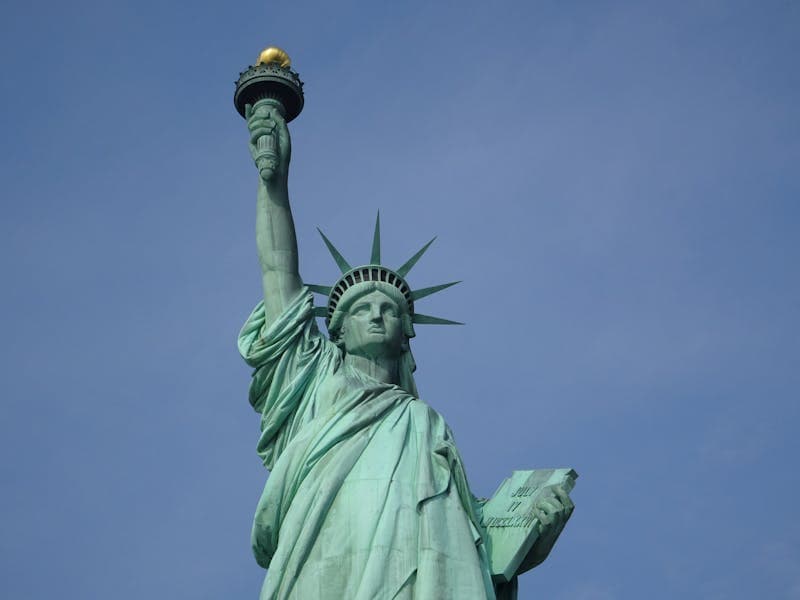
The Statue of Liberty’s story begins not in America, but in France, born from a shared vision of democracy and transatlantic friendship that took decades to realize.
- The Statue of Liberty, officially named “Liberty Enlightening the World,” was a gift from France to the United States, conceived as a symbol of the shared democratic values and friendship between the two nations.
- French political thinker Édouard de Laboulaye first proposed the idea of gifting a statue to America in 1865, inspired by the end of the Civil War and the abolition of slavery.
- France and the United States shared the cost of the project under a formal agreement: France funded the statue itself, while the United States was responsible for funding and constructing the pedestal.
- The statue was officially dedicated on October 28, 1886, in a ceremony presided over by U.S. President Grover Cleveland, attended by thousands of spectators on land and in the harbor.
Facts About The Statue of Liberty Design and Construction

Building one of the world’s most recognizable monuments required the combined genius of a visionary sculptor, a pioneering structural engineer, and a celebrated American architect.
- French sculptor Frédéric Auguste Bartholdi designed the statue, and he is said to have modeled Liberty’s face after his own mother, Charlotte Beysser Bartholdi.
- The statue’s internal iron framework was engineered by Alexandre Gustave Eiffel — the same engineer who later became world-famous for building the Eiffel Tower in Paris.
- The pedestal was designed by American architect Richard Morris Hunt and is built on top of an 11-point star-shaped fort known as Fort Wood, which was reportedly constructed between 1807 and 1811.
- The Statue of Liberty’s full construction in France took nine years, from 1876 to 1885. It was then disassembled into 350 individual pieces, packed into 214 crates, and shipped across the Atlantic Ocean aboard the French naval transport ship Isère.
Suggested Read: 50 Interesting Facts About France: History & Culture
Facts About The Statue of Liberty Physical Characteristics

Lady Liberty’s sheer scale and the engineering choices behind her copper exterior make her as impressive up close as she is from a distance.
- The Statue of Liberty stands on Liberty Island in New York Harbor, within the jurisdiction of New York State, though the island is physically closer to the New Jersey shoreline.
- From the ground to the tip of the torch, the Statue of Liberty measures 305 feet and 1 inch (approximately 93 meters) tall, making it among the tallest statues in the world at the time of its dedication.
- The statue’s copper skin is approximately 3/32 of an inch thick — roughly the thickness of two pennies — and the entire structure uses about 62,000 pounds of copper.
- The iconic green color of the statue is the result of patina, a natural chemical process called oxidation. The copper was originally a shiny reddish-brown color, similar to a new penny, and it took about 20 to 30 years to fully turn green after its 1886 unveiling.
The Statue of Liberty Symbolism and Features
Every element of the Statue of Liberty’s design was deliberately chosen to communicate a powerful message about liberty, independence, and human dignity.
- Lady Liberty’s right hand holds a torch aloft, symbolizing enlightenment, while her left hand clutches a tablet inscribed with the Roman numerals for July 4, 1776 — the date of American independence.
- The statue wears a crown with seven rays, each measuring up to 9 feet in length and weighing as much as 150 pounds. The seven rays are said to represent the seven seas and seven continents of the world.
- At Liberty’s feet lie broken chains and shackles, symbolizing freedom from oppression and tyranny. This detail is largely hidden from ground-level view but is clearly visible from aerial perspectives.
- American poet Emma Lazarus wrote the famous sonnet “The New Colossus” in 1883 to help raise funds for the pedestal. Its most celebrated lines — “Give me your tired, your poor, your huddled masses yearning to breathe free” — were engraved on a bronze plaque and mounted inside the pedestal in 1903.
Facts About The Statue of Liberty Administration and Recognition
Over its long history, the statue has transitioned between government agencies and earned the highest level of international cultural recognition.
- The Statue of Liberty was administered by the U.S. Army until 1933, when management was transferred to the National Park Service, which continues to oversee it today.
- The statue was designated a UNESCO World Heritage Site in 1984, recognized for its universal significance as a symbol of freedom and democracy.
Facts About The Statue of Liberty Visitor Experience
Millions of people make the journey to Liberty Island every year, but climbing to the crown remains one of the most sought-after — and hardest to book — experiences in the United States.
- Liberty Island has historically attracted approximately 3.2 to 4 million visitors each year, making it one of the most visited national monuments in the United States.
- There are 354 steps inside the statue leading from the ground floor to the crown, equivalent to climbing a 22-story building. Access to the crown requires advance reservations, often booked months in advance.
- The statue was closed to the public following the September 11, 2001 terrorist attacks and did not reopen until August 2004. The crown specifically remained closed until July 4, 2009, after extensive security upgrades were completed.
Facts About The Statue of Liberty Damage and Restoration
Century-old copper and iron do not last without intervention — the statue has survived wartime sabotage, structural fatigue, and a landmark restoration effort that transformed her for future generations.
- During World War I, an explosion at a nearby munitions depot on Black Tom Island in 1916 — believed to be an act of German sabotage — caused significant damage to the torch arm, which is one reason visitors have been prohibited from climbing into the torch ever since.
- The original torch was replaced in 1986 during a major restoration project. The new torch is covered in 24-karat gold leaf and illuminated by floodlights, while the original torch is now on display inside the monument’s lobby.
- In 1986, the statue underwent a major two-year restoration to celebrate its centennial. Workers replaced the iron armature bars connecting the skin to the framework, installed a new torch, and made numerous structural improvements, with the total restoration costing approximately $87 million.
Facts About The Statue of Liberty Related Monuments
Lady Liberty’s influence extends far beyond New York Harbor, inspiring full-scale replicas on multiple continents.
- A full-scale replica of the Statue of Liberty stands on the Île aux Cygnes in Paris, France, facing west toward New York. It was given to France by American residents of Paris in 1889 and stands about 37 feet tall.
Suggested Read:


