
36 Facts About the Violin: Strings Attached
The violin is small enough to tuck under your chin, yet it can lead an entire orchestra or carry a country dance all night. These facts cover where it came from, how it’s built, how players coax so many sounds from it, and the music and makers that made it famous.
The Violin Facts At-a-Glance
Instrument Type: Bowed string instrument, the highest-pitched member of the violin family
Strings: Four, tuned G-D-A-E in perfect fifths
Origin: Northern Italy, early 16th century
Typical Woods: Spruce top, maple back and sides, ebony fingerboard
Lowest Note: G3, the G below middle C
Notation: Treble clef
Legendary Makers: Amati, Stradivari, and Guarneri families of Cremona
Origins and Master Makers
- The violin took shape in northern Italy in the early 1500s. Within a few decades its basic design was settled, and it has changed surprisingly little since.
- Andrea Amati of Cremona is one of the earliest known violin makers. His workshop helped set the elegant proportions that later makers would refine.
- Cremona became the most celebrated violin-making town in history, home to the Amati, Stradivari, and Guarneri families.
- Antonio Stradivari lived from about 1644 to 1737 and worked into his 90s. The instruments he made in the early 1700s are often called his “golden period” work.
- Giuseppe Guarneri, known as “del Gesù,” lived from 1698 to 1744. His violins are prized as highly as Stradivari’s, and one was the favorite instrument of the virtuoso Niccolò Paganini.
- In 2012, UNESCO added traditional violin craftsmanship in Cremona to its list of the Intangible Cultural Heritage of Humanity.
- The violin isn’t a descendant of the viol, despite the similar names. Viols are a separate family with frets and usually six strings, and the two families developed side by side for a time.
Recommended Read: 50 Interesting Facts About Italy: La Dolce Vita
Anatomy of a Violin
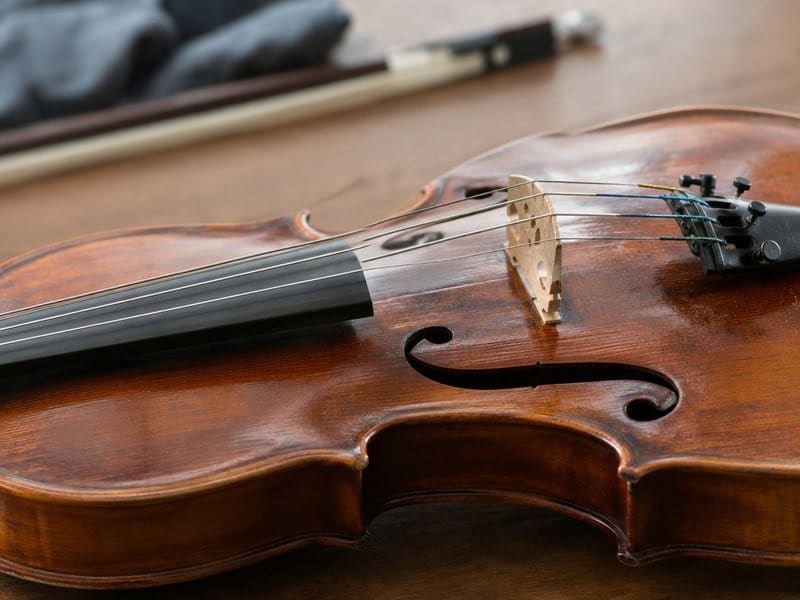
- A violin has four strings tuned in perfect fifths: G, D, A, and E. The lowest string sounds the G just below middle C.
- The top, or belly, is usually made of spruce, while the back, sides, and neck are typically maple. The fingerboard is traditionally ebony.
- Inside the body stands a small wooden dowel called the sound post, held in place by pressure rather than glue. It carries vibrations between the top and back, and in French it’s called l’âme, meaning “the soul.”
- A thin strip of wood called the bass bar is glued lengthwise under the top on the side of the lowest string. It strengthens the top and helps it vibrate evenly.
- The two elegant openings on the top are called f-holes because of their shape. They let sound escape from the hollow body.
- Most violins have purfling, a thin inlaid strip running around the edges. It looks decorative, but it also helps stop cracks from spreading across the wood.
- Violin makers traditionally use hide glue, which can be softened and undone. That lets repairers open an instrument without destroying it, which is one reason centuries-old violins are still played.
- The violin has no frets, so players must place their fingers by ear and feel to play in tune.
- A full-size violin body measures about 14 inches (35.5 cm) long. Children often start on smaller fractional sizes such as 1/2 or 1/4, and some sizes are even smaller.
Recommended Read: 25 Cool Facts About Sound Waves: Physics Made Simple
Bows, Strings, and Accessories
- Violin bows are traditionally strung with horsehair. Players rub the hair with rosin, a sticky tree resin, so it can grip the string and make it vibrate.
- The finest bows are traditionally made from pernambuco, a dense wood from Brazil. French bow maker François Xavier Tourte is credited with setting the design of the modern bow in the late 1700s.
- Violin strings were originally made of gut. Today many players use synthetic-core strings, and the high E string is usually steel.
- The German violinist and composer Louis Spohr is credited with inventing the chinrest around 1820, which helped players hold the violin securely without gripping it with the left hand.
Playing Techniques

- Playing pizzicato means plucking the strings with the fingers instead of using the bow, which gives a short, crisp sound.
- In col legno, Italian for “with the wood,” the player strikes or draws the string with the stick of the bow instead of the hair, creating an eerie, clicking effect.
- Violinists can play two strings at once, a technique called a double stop. Bowing across three or four strings in quick succession produces full chords.
- By touching a string lightly rather than pressing it down, players produce harmonics, which are pure, flute-like tones.
- A small clip called a mute can be placed on the bridge to soften and darken the violin’s sound. Composers often mark this with the Italian word con sordino.
Famous Music and Memorable Moments
- Antonio Vivaldi’s The Four Seasons is a set of four violin concertos published in 1725. Each one paints a season in sound, from birdsong in spring to shivering in winter.
- Johann Sebastian Bach’s Sonatas and Partitas for solo violin date from a manuscript of 1720. Their Chaconne is one of the most admired and demanding pieces in the violin repertoire.
- Niccolò Paganini (1782–1840) dazzled audiences with his 24 Caprices for solo violin. His skill was so astonishing that a legend spread claiming he had sold his soul to the devil.
- Orchestras usually divide their violins into first and second sections. The leader of the first violins, called the concertmaster, serves as the orchestra’s lead musician and often directs the tuning.
- In 2007, star violinist Joshua Bell played incognito in a Washington, D.C., subway station as an experiment by The Washington Post. Most commuters hurried past without stopping to listen.
- In 2011, the “Lady Blunt” Stradivarius sold at auction for about $15.9 million, with the proceeds going to relief efforts after the earthquake and tsunami in Japan.
- In a widely discussed 2012 study, experienced violinists playing blindfolded could not reliably tell top old Italian violins from fine new ones, and many preferred a new instrument.
The Violin Around the World
- A fiddle and a violin are the same instrument. The difference lies in the style of music, such as folk, bluegrass, or Celtic tunes, rather than the instrument itself.
- Norway’s Hardanger fiddle is a violin relative with extra sympathetic strings beneath the main strings. They vibrate on their own, giving the instrument a shimmering, ringing tone. [Learn more: 40 Notable Facts About Norway: Land of the Vikings]
- The violin became an important instrument in Carnatic music of South India, where players often sit on the floor and rest the scroll against their foot. [Learn more: 30 Fascinating Facts About India: Culture, History & Diversity]
- Japanese violinist Shinichi Suzuki developed the Suzuki method, which teaches young children by ear, much like learning a native language, before introducing written music. [Learn more: 40 Interesting Facts About Japan]
Recommended Read:


