
39 Juicy Facts About Tomatoes: Garden Favorites
Tomatoes may seem like everyday kitchen staples, but they have a surprisingly rich story. These facts about tomatoes trace the plant from its wild roots in South America to sauces, salads, and festivals around the world, covering its botany, history, flavor science, culture, and the gardens where it grows.
Tomatoes Facts At-a-Glance
Scientific Name: Solanum lycopersicum
Plant Family: Nightshade family (Solanaceae)
Botanical Type: Berry (a fruit)
Native Region: Western South America
Name Origin: Nahuatl word “tomatl”
Key Red Pigment: Lycopene
Famous Festival: La Tomatina in Buñol, Spain
Botany and Biology
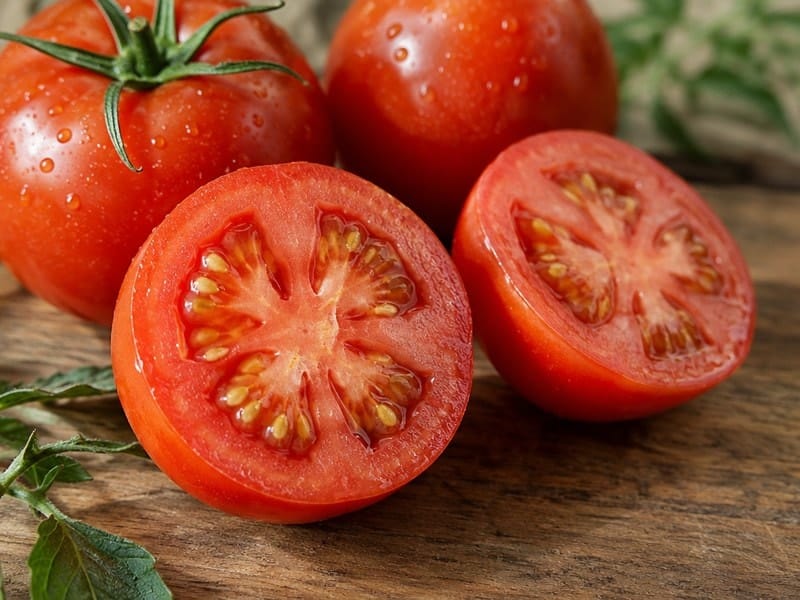
- The tomato’s scientific name is Solanum lycopersicum. It belongs to the nightshade family, which makes it a close relative of potatoes, eggplants, and peppers.
- Botanically speaking, a tomato is a fruit. More specifically, it is a berry, because it develops from the ovary of a flower and holds seeds inside.
- The leaves and stems of tomato plants contain tomatine, a natural compound that helps protect the plant from pests. Unripe green tomatoes contain it too, while ripe fruit contains much less.
- A tomato’s red color comes from lycopene, a carotenoid pigment that is also an antioxidant. Some varieties ripen to yellow, orange, purple, or even green, depending on their pigments.
- Tomatoes are mostly water, at about 95 percent. That high water content helps explain why they feel so juicy and refreshing.
- Tomato flowers can fertilize themselves, but they release pollen best when vibrated. Bumblebees do this through a technique called buzz pollination, which is why many commercial greenhouses keep bumblebee colonies.
- Tomato stems and leaves are covered in tiny hairs called trichomes. These hairs release the strong, earthy scent many gardeners recognize instantly.
Recommended Read: 43 Fascinating Facts About Plants: Green Wonders
Flavor, Ripening, and Science
- Tomatoes ripen in response to ethylene, a natural plant hormone. Many commercial tomatoes are picked while still green and later exposed to ethylene so they turn red before reaching stores.
- Storing tomatoes in the refrigerator can dull their flavor and make their texture mealy. Cold temperatures interfere with the compounds that give ripe tomatoes their aroma.
- Ripe tomatoes are naturally rich in glutamate, the compound behind umami, or savory taste. That is one reason tomato sauces and pastes add so much depth to cooking.
- Your body absorbs lycopene more easily from cooked tomatoes than from raw ones, especially when they are prepared with some fat, such as olive oil.
- Scientists published the complete genome sequence of the tomato in 2012. The project was carried out by an international research group called the Tomato Genome Consortium. [Learn more: 38 Fascinating Facts About DNA: Life’s Blueprint]
- The Flavr Savr tomato, developed by the company Calgene, went on sale in 1994. It was the first genetically engineered whole food approved for commercial sale, designed to stay firm longer after ripening.
History and Origins

- Wild tomatoes are native to western South America, particularly the Andes region of countries like Peru and Ecuador.
- One wild relative, the currant tomato (Solanum pimpinellifolium), produces fruits about the size of a pea. It is considered a close relative of the plant that gave rise to today’s cultivated tomatoes.
- Tomatoes were domesticated and widely grown in Mesoamerica long before Europeans arrived. Indigenous peoples in what is now Mexico had made them part of their cuisine.
- The English word “tomato” comes from “tomatl,” a word in Nahuatl, the language of the Aztecs.
- Spanish explorers brought tomatoes to Europe in the 16th century. From there, the plant spread across the Mediterranean and beyond.
- The Italian word for tomato, “pomodoro,” comes from “pomo d’oro,” meaning “golden apple.” The name hints that some of the first tomatoes known in Italy may have been yellow.
- Many Europeans were wary of tomatoes at first, partly because the plant resembled poisonous members of the nightshade family. In some places, tomatoes were grown as ornamental plants before they became a common food.
- A popular legend says Colonel Robert Gibbon Johnson ate a basket of tomatoes on the courthouse steps in Salem, New Jersey, in 1820 to prove they were safe. Historians have found no solid evidence that the event happened.
- Thomas Jefferson grew tomatoes in his gardens at Monticello, his Virginia estate. His garden records helped document their early cultivation in the United States.
- In the 1893 case Nix v. Hedden, the US Supreme Court ruled that tomatoes should be treated as vegetables under tariff law. The justices acknowledged that tomatoes are botanically fruits but went with how people commonly cook and eat them.
Recommended Read:
Food and Culture
- Early ketchups were often made from ingredients like fish or mushrooms rather than tomatoes. Heinz began selling tomato ketchup in 1876, helping make the tomato version the standard.
- According to a well-known story, Pizza Margherita was named for Queen Margherita of Italy in 1889. Its tomato, mozzarella, and basil are said to represent the red, white, and green of the Italian flag, though the tale is often treated as legend.
- La Tomatina is a festival held each year in Buñol, Spain, on the last Wednesday of August. Participants pelt each other with ripe tomatoes, a tradition that began in 1945.
- Gazpacho is a chilled tomato-based soup from Andalusia in southern Spain. It is typically made with raw vegetables and served cold, making it a classic hot-weather dish.
- San Marzano tomatoes are an Italian variety grown in the volcanic soil near Mount Vesuvius. Under European Union rules, they carry a protected designation of origin. [Learn more: 20 Facts About Mount Vesuvius: The Sleeping Giant of Naples]
- Arkansas named the South Arkansas Vine Ripe Pink Tomato as both its official state fruit and its official state vegetable, a playful nod to the tomato’s double identity.
- Fried green tomatoes are a well-known dish in the southern United States. Firm, unripe tomatoes are sliced, coated, and fried until crisp.
- Despite the name, the tomatillo is not a tomato. It belongs to a different genus, Physalis, and grows inside a papery husk, though it is also part of the nightshade family.
Growing Tomatoes
- Tomatoes are warm-season plants that are easily damaged by frost. Gardeners usually wait until the danger of frost has passed before planting them outdoors.
- Tomato plants come in two main growth types. Determinate varieties grow to a set size and ripen their fruit in a short window, while indeterminate varieties keep growing and producing until cold weather stops them.
- Thousands of tomato varieties exist, ranging from tiny cherry tomatoes to large beefsteaks. Heirloom varieties are open-pollinated, so seeds saved from them grow into plants much like the parent.
- Blossom end rot creates dark, sunken patches on the bottom of tomatoes. It is linked to a calcium shortage in the developing fruit, often caused by uneven watering rather than a lack of calcium in the soil.
- The tomato hornworm is a large green caterpillar that can strip tomato plants of their leaves. It is the larva of the five-spotted hawk moth.
- Late blight is a serious disease of tomato plants caused by Phytophthora infestans. It is the same organism behind the potato blight that triggered the Irish Potato Famine in the 1840s.
- China has long been the world’s top tomato producer, growing more tomatoes than any other country.
- In the United States, California grows the vast majority of tomatoes used for processing, which become products like canned tomatoes, paste, and sauce.
Recommended Read:


