
35 Fascinating Facts About Trains: Rail History
Trains changed how people travel, trade, and even tell time. These facts about trains cover early steam engines, high-speed rail, record-setting routes, and the ideas that keep millions of tons of steel rolling smoothly along the tracks.
trains Facts At-a-Glance
First Railway Steam Locomotive: Richard Trevithick's engine, Wales, 1804
First Public Steam Railway: Stockton and Darlington Railway, 1825
Standard Gauge: 1,435 mm (4 ft 8½ in)
Steam Speed Record: Mallard, 126 mph (203 km/h), 1938
Rail Speed Record: Japanese L0 maglev, 603 km/h (375 mph), 2015
Longest Railway Line: Trans-Siberian Railway, 9,289 km (5,772 mi)
Longest Railway Tunnel: Gotthard Base Tunnel, Switzerland, 57 km (35 mi)
Early Railway History
- Long before engines, people used guided tracks. In ancient Greece, the Diolkos was a paved trackway with grooves, used to haul ships across the Isthmus of Corinth.
- Centuries before steam power, mines in Europe used wagonways, where horses or workers pulled carts along wooden rails to move coal and ore more easily.
- In 1804, Cornish engineer Richard Trevithick ran the first working steam locomotive on rails, hauling iron and passengers at the Penydarren ironworks in Wales.
- The Stockton and Darlington Railway in England opened on September 27, 1825, becoming the first public railway to use steam locomotives. George Stephenson's Locomotion No. 1 pulled the opening train.
- At the Rainhill Trials of 1829, Stephenson's locomotive Rocket beat its rivals and helped shape steam engine design for decades.
- The Liverpool and Manchester Railway opened in 1830 as the first intercity line to run scheduled passenger trains hauled entirely by steam locomotives.
Railways That Shaped Nations
- The first transcontinental railroad in the United States was completed on May 10, 1869, when a ceremonial golden spike was driven at Promontory Summit, Utah.
- Canada's transcontinental railway, the Canadian Pacific, drove its last spike on November 7, 1885, at Craigellachie, British Columbia, helping link the young country from coast to coast.
- Railroads gave North America its time zones. On November 18, 1883, railways in the United States and Canada switched to standard time to replace the confusing patchwork of local times.
- Russia's Trans-Siberian Railway runs 9,289 km (5,772 mi) from Moscow to Vladivostok, making it the longest railway line in the world. Construction began in 1891.
- The Orient Express launched in 1883, operated by Georges Nagelmackers' Compagnie Internationale des Wagons-Lits, and became famous for luxury travel between Paris and Constantinople (now Istanbul).
Recommended Read:
How Trains Work
- Most of the world's railways use standard gauge, which places the rails 1,435 mm (4 ft 8½ in) apart.
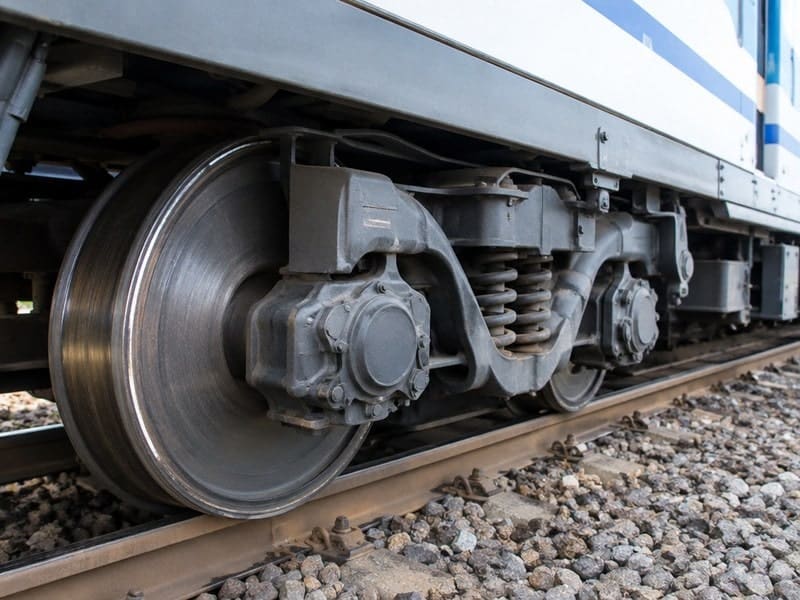
- Train wheels are not perfectly flat. Their tread is slightly cone-shaped, which helps a train steer itself around curves, while the inner flanges keep it on the track.
- A steel wheel rolling on a steel rail creates very little friction, which is one big reason trains can move heavy loads using relatively little energy.
- Most diesel locomotives are actually diesel-electric. The diesel engine runs a generator, and the electricity powers motors that turn the wheels.
- Werner von Siemens demonstrated an electric passenger railway at the Berlin Trade Fair in 1879, an early milestone for electric trains.
- George Westinghouse patented his railway air brake in 1869, making it possible to stop long trains far more safely than with manual brakes.
- In 1873, Eli Janney patented the knuckle coupler, an automatic coupling device that made connecting rail cars much safer for railroad workers.
Speed Records and Bullet Trains

- On July 3, 1938, the British locomotive Mallard reached 126 mph (203 km/h), a speed record for steam locomotives that still stands.
- Japan's first Shinkansen, or bullet train, line opened on October 1, 1964, linking Tokyo and Osaka just before the Tokyo Olympics.
- The Shinkansen is celebrated for safety: it has never had a passenger fatality caused by a derailment or collision.
- France's TGV high-speed service began in 1981 between Paris and Lyon. [Learn more: 50 Interesting Facts About France: History & Culture]
- A specially modified French TGV reached 574.8 km/h (357 mph) on April 3, 2007, setting the speed record for a conventional train running on wheels.
- In 2015, Japan's experimental L0 series maglev hit 603 km/h (375 mph), the fastest speed ever recorded by a rail vehicle. Maglev trains float above their guideway using magnets instead of wheels.
Recommended Read: 40 Interesting Facts About Japan
Tunnels, Subways, and Stations
- London's Metropolitan Railway opened on January 10, 1863, as the world's first underground railway. Its first trains were pulled by steam locomotives.
- In 1890, London's City and South London Railway became the first deep-level underground line to run electric trains.
- Switzerland's Gotthard Base Tunnel opened in 2016 and stretches about 57 km (35 mi) beneath the Alps, making it the longest railway tunnel in the world. [Learn more: 35 Remarkable Facts About Switzerland: Alpine Nation]
- The Channel Tunnel, which opened in 1994, connects England and France and has the longest undersea section of any tunnel in the world.
- New York's Grand Central Terminal holds the record for the most platforms of any train station, with 44 platforms serving 67 tracks.
- In Wuppertal, Germany, the Schwebebahn has carried passengers since 1901 in cars that hang beneath an elevated rail.
Remarkable Routes and Rail Culture
- The Qinghai–Tibet Railway in China is the highest railway in the world, crossing Tanggula Pass at about 5,072 m (16,640 ft) above sea level.
- Australia's Trans-Australian Railway crosses the Nullarbor Plain on the world's longest straight stretch of railway track, running 478 km (297 mi) without a single curve.
- In 2001, mining company BHP ran a record-breaking iron ore train in Western Australia that stretched more than 7 km long with 682 wagons.
- According to a popular legend, early audiences fled in fear when the Lumière brothers showed their short film of a train arriving at La Ciotat station in the 1890s, though the story is likely exaggerated.
- Thomas the Tank Engine was created by the Reverend Wilbert Awdry, whose Railway Series of children's books began with The Three Railway Engines in 1945.
Recommended Read:


