
25 Remarkable Facts About The Vatican Museums
These fascinating facts about Vatican Museums reveal one of the world’s most extraordinary cultural institutions — a sprawling complex of galleries, chapels, and courtyards nestled within the world’s smallest sovereign state.
Founded over five centuries ago by papal decree, the Vatican Museums house more than 70,000 works of art spanning ancient Egypt, classical antiquity, and the Renaissance, drawing millions of visitors each year who come to witness masterpieces that have shaped the course of Western civilization.
Vatican Museums Facts At-a-Glance
Location: Vatican City, Rome, Italy
Founded: c. 1506 by Pope Julius II
Total Area: Approx. 5.5 hectares (14 acres)
Gallery Corridors: Roughly 7 miles (11 km) of halls and corridors
Total Collection: Over 70,000 works of art
On Public Display: Approx. 20,000 works permanently exhibited
Annual Visitors: 6–7 million
Facts About Vatican Museums History and Foundation
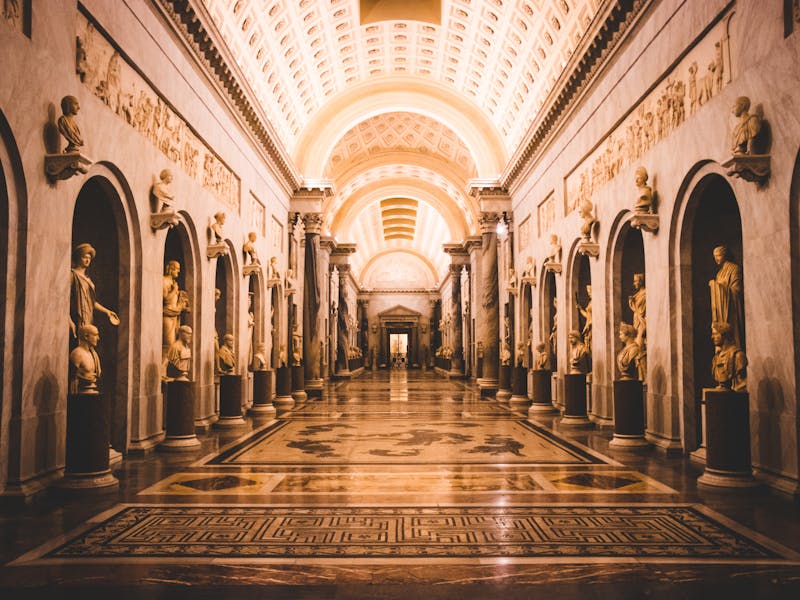
The Vatican Museums trace their origins to the early 16th century, making them among the oldest public museums on Earth. Successive popes expanded the collections dramatically over the following centuries, adding entire wings dedicated to Egyptian, Etruscan, and classical art.
- The Vatican Museums were founded in the early 16th century by Pope Julius II, who placed his personal collection of ancient sculptures on public display around 1506, making them one of the oldest public museums in the world.
- The Egyptian Museum within the Vatican Museums was established in 1839 by Pope Gregory XVI and contains artifacts including mummies, sarcophagi, and statues collected during papal expeditions and donations, spanning thousands of years of ancient Egyptian history.
- The Pio-Clementino Museum, established in the 18th century by Popes Clement XIV and Pius VI, houses among the world’s most celebrated collections of ancient Greek and Roman sculpture, including the renowned Apollo Belvedere, a Roman marble copy of a Greek original.
- The Gregorian Etruscan Museum, founded in 1837 by Pope Gregory XVI, contains among the most significant collections of Etruscan artifacts in existence, including the famous Mars of Todi, a large bronze statue dating from the late 5th or early 4th century BCE.
- During World War II, the Vatican Museums sheltered numerous refugees and displaced persons within Vatican City, and several artworks from other Italian institutions were secretly stored within the complex to protect them from potential looting or destruction.
Facts About Vatican Museums Physical Structure and Scale

The sheer scale of the Vatican Museums complex is staggering, encompassing dozens of galleries, open-air courtyards, and miles of interconnected corridors that would take days to explore thoroughly.
- The complex covers approximately 5.5 hectares (about 14 acres) and contains 54 galleries, known as rooms, connected by roughly 7 miles (11 kilometers) of corridors, halls, and open-air courtyards.
- The museums house a collection of over 70,000 works of art, of which approximately 20,000 are on permanent public display, with the remainder stored in archives and reserve collections.
- The Gallery of Maps, a 120-meter-long corridor painted between 1580 and 1585, features 40 large topographical maps of Italian regions and papal territories commissioned by Pope Gregory XIII, painted by cartographer Ignazio Danti.
Facts About Vatican Museums Famous Artworks and Masterpieces

The Vatican Museums are home to some of the most celebrated artworks in human history, drawing scholars and tourists alike to Rome from every corner of the globe.
- The Sistine Chapel, located within the Vatican Museums complex, features Michelangelo’s famous ceiling fresco painted between 1508 and 1512, depicting nine scenes from the Book of Genesis, including the iconic “Creation of Adam.”
- Michelangelo also painted “The Last Judgment” on the altar wall of the Sistine Chapel between 1536 and 1541, more than two decades after completing the ceiling, at the commission of Pope Paul III.
- The Laocoön and His Sons, a monumental ancient Greek marble sculpture discovered in Rome in 1506, is one of the most prized possessions of the Vatican Museums and is believed to date from approximately 40 to 30 BCE, though scholarly debate on its precise dating continues.
- The Raphael Rooms, a suite of four reception rooms in the Apostolic Palace, were painted by Renaissance master Raphael and his workshop between 1508 and 1524, featuring the celebrated fresco “The School of Athens,” which depicts great philosophers of antiquity.
- The Vatican Pinacoteca, or picture gallery, contains 460 paintings arranged chronologically across 18 rooms, including masterpieces by Leonardo da Vinci, Caravaggio, Titian, and Raphael, whose “Transfiguration” is considered one of the collection’s highlights.
- The museums contain a dedicated Gallery of Modern Religious Art, inaugurated by Pope Paul VI in 1973, which features over 800 works by 20th-century artists including Pablo Picasso, Salvador Dalí, Henri Matisse, and Francis Bacon, all selected for their spiritual or religious themes.
Facts About Vatican Museums Library and Research
Beyond its visual art collections, the Vatican Museums are closely linked to one of the world’s most significant repositories of historical and religious knowledge.
- The Vatican Apostolic Library, closely associated with the museums, holds over 1.1 million printed books, 75,000 codices, and 8,500 incunabula, and is widely regarded as one of the most significant research libraries in the world for historical and religious scholarship.
Facts About Vatican Museums Operations and Visitor Numbers

Managing one of the world’s busiest museum complexes requires a large, specialized workforce and generates substantial revenue that supports the operations of Vatican City State.
- The museums employ approximately 600 staff members, including curators, restorers, archaeologists, and administrative personnel, all working under the authority of the Holy See.
- The Vatican Museums attract approximately 6 to 7 million visitors annually in normal years, placing them among the most visited museum complexes in the world and often cited alongside the Louvre in Paris and the British Museum in London.
- The Vatican Museums generate significant revenue for the Holy See, with ticket sales and related tourism income estimated to contribute tens of millions of euros annually, representing one of the primary sources of income for Vatican City State.
Facts About Vatican Museums Conservation and Restoration
Preserving centuries-old masterpieces demands cutting-edge science alongside traditional craftsmanship, and the Vatican Museums have invested heavily in both.
- The Vatican Museums operate their own professional conservation and restoration laboratory, where specialists use advanced scientific techniques including infrared reflectography, X-ray analysis, and chemical testing to study, preserve, and restore artworks from the collection.
- A major restoration of the Sistine Chapel ceiling, completed in 1994 after 14 years of work, removed centuries of candle soot, glue, and grime, revealing far more vibrant and colorful tones in Michelangelo’s frescoes than previously known, sparking significant debate among art historians.
Explore Italy Through Fascinating Facts
Dive deeper into Italy’s most iconic places, landmarks, and stories with these carefully curated fact-packed guides.


