
75 Fun Facts About Vermont: Green Mountains
Vermont is a small, mountainous New England state with a big personality, known for maple syrup, covered bridges, and ski slopes. This article groups the supplied facts about Vermont by place, people, landscape, culture, and history, from the Champlain Sea to the storms of recent years.
Vermont Facts At-a-Glance
Region: Northeastern and New England regions of the US
Area: 9,616 mi² (24,923 km²), 6th smallest state
Population: 643,500, second lowest of any state
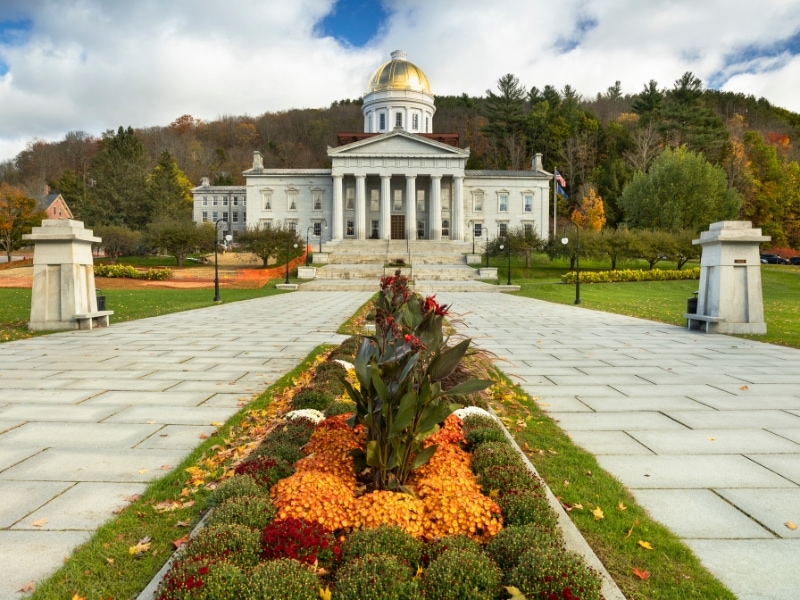
Capital: Montpelier, smallest capital city in the nation
Statehood: 14th state, 1791
Highest point: Mt. Mansfield, 4,393 ft (1339 m)
Top crop: Maple syrup, 35% of the nation’s supply
Motto: Freedom and Unity
Location, Size and Borders
- Vermont is in the Northeastern and New England regions of the US.
- The state borders Canada‘s Quebec province to the north, New Hampshire to the east, Massachusetts to the south, and New York state to the west.
- Vermont is the only state in New England that doesn’t border the Atlantic Ocean.
- Vermont is shaped like a V, while its twin (New Hampshire), is almost the same shape but upside down. Snuggled together, they form a rough rectangle.
- Vermont is only 9,616 mi² (24,923 km²) in size, the 6th smallest in the US. It is slightly larger than New Hampshire but slightly smaller than Massachusetts.
- If the state were a country, it would be about half the size of Slovakia.
Recommended Read: 155 Captivating Facts About Canada: The Great White North
Population, Cities and the Capital

- Vermont has a population of just 643,500, the second lowest of any state, after Wyoming. These two states are the only ones with a population lower than Washington D.C.
- Vermont’s capital, Montpelier, is the smallest capital city in the entire nation, with only around 8000 people residing there. It was named after a city in France. The French had helped the American colonies a lot during the Revolutionary War.
- There are five other cities in Vermont larger than Montpelier, with the largest being Burlington (population 45,000).
- In total, there are only 10 cities in Vermont. Their total population equals 130,000. In fact, 88% of all city residents in Vermont could squeeze into Michigan Stadium (the country’s largest stadium) at once.
- Montpelier is only state capital without a McDonald’s, although there is one just out of town in Barre.
- The Vermont State House in Montpelier is one of 10 capitol buildings in the country with a gold topped dome.
- The state has no skyscrapers at all.
Name, Symbols and Identity

- 75% of Vermont is covered in forests and mountains, so it is nicknamed the “Green Mountain State”.
- In fact, the state name Vermont is derived from the French words montagne verte or green mountain.
- Champlain gave Vermont its name in 1647. He drew the state on a map and named it “Verd Mont”, which means “Green Mountain”.
- By the 1760s the English settlers were calling Verd Mont “Vermont”.
- VT is the official abbreviation of Vermont.
- Residents of Vermont are called Vermonters.
- The official state motto of Vermont is “Freedom and Unity”.
- Vermont’s flag has a blue background with the state emblem at the center. The emblem features a pastoral scene with a large pine tree in the foreground, a cow, wheat sheaves, and the Green Mountains in the background, with a deer head on top of it.
- Vermont in one of only about a dozen states with a single area code. 802 is a source of pride in the state.
- Vermont is one of 4 states where commercial billboards are totally banned (the others are Hawaii, Maine, and Alaska).
Peoples and Demographics
- Vermont was originally inhabited by the Mahican and Abénaki Algonquian peoples. Today, the state has one of the smallest Native American populations in the country, at only 0.5% of the state’s total population.
- After that, people moved into the region, including Native American tribes such as the Pocomtuc, Massachusett, Pennacook, Abenaki and Mohicans.
- Vermont has the highest White population of any US state, at 95.6%.
- Vermont is one of the safest states in the country, with one of the lowest levels of violent crime.
Mountains, Lakes and Climate

- Mt. Mansfield is the highest point in Vermont, at 4,393 ft (1339 m) above sea level. Lake Champlain is the lowest point, at 95 ft (29 m).
- Other scarily named mountains in Vermont include Devils Gap, Terrible Mountain, and Vulture Mountain.
- Lake Champlain, which is shared with New York State, is the 7th largest lake in the US (not counting the Great Lakes).
- The highest temperature ever recorded in Vermont was 105°F (41°C) in Vernon on July 4, 1911. The lowest was -50°F (-46°C) on December 30, 1933 in Bloomfield.
- In the 1970s, DDT was banned, and thus Vermont’s population of bears doubled in just a couple decades.
- Beavers, which had been wiped out in the area, were reintroduced in 1924 and still thrive there today.
Parks, Landmarks and Covered Bridges

- There are 60 state parks in Vermont. The largest is Camel’s Hump State Park, with Camel’s Hump being the state’s 3rd tallest peak. The most popular state park in Vermont is Quechee State Park, famous for Quechee Gorge.
- There are 18 national historic landmarks in Vermont. The list includes Round Church, Brown Bridge (one of the state’s many covered bridges), Robert Frost Farm, and Mount Independence, where many Revolutionary War fortifications once stood.
- The state has over one hundred covered bridges, which is more per square mile than any other US state.
Maple, Milk and Marble

- Vermont is the largest producer of maple syrup in the US, producing 35% of the nation’s supply of the sweet, sticky syrup. Maple is even the official state flavor. Read our fun facts about maple trees here.
- The number one farmed product in Vermont is milk.
- The Washington Monument in Washington D.C. is partially made of marble quarried from Vermont’s Washington county.
- Vermont had its own currency called the Vermont copper which it issued when it was an independent state, called Vermont Republic, from 1785 to 1791.
Recommended Read:
Skiing and Snowboarding

- Vermont is one of only two states in the nation that offers snowboarding as a state championship and varsity sport.
- There are over 25 ski resorts in Vermont, with the largest being Killington Resort.
Inventors, Thinkers and Notable Vermonters
- Samuel Hopkins of Pittsford, Vermont received a patent for his invention, potash, which is used for fertilizers. The 1790 patent was signed off by both Thomas Jefferson and George Washington.
- Thaddeus Fairbanks built the first platform scale for weighing wagons in St. Johnsbury, Vermont in 1830.
- Julio Buel of Castleton, Vermont invented the first fishing spoon lure in 1834.
- In 1848, Gardner Blodgett invented the cast iron oven for cooking. The company still operates to this day in Burlington, Vermont.
- George Perkins Marsh of Woodstock, Vermont is often considered the “father of environmentalism” in the US. He was the author of Man and Nature (1864).
- Wilson “Snowflake” Bentley, a farmer from Jericho, Vermont, proved that no two snowflakes are alike by inventing the process of photographing snowflakes from 1885 to 1931. He used a microscope and a camera.
- Other important historical figures from Vermont include Thomas Davenport (inventor of the battery-powered electric motor), philosopher John Dewey, and “Father of the Agricultural Colleges” Justin Morrill.
- Henry M. Leland, founder of both Cadillac and Lincoln cars, was born in Barton, Vermont.
- In 2011, the largest ever parade of Cadillac cars took place in Barton, Vermont to honor the founder who was born there.
- The first African American to earn a college degree in the US was Alexander Twilight in Middlebury, Vermont in 1823.
- The first person to drive across the US was Dr. Horatio Nelson Jackson or Burlington, Vermont. He did so in 1903.
Presidents, Writers and Entertainers

- Two United States presidents were born in Vermont: Chester A. Arthur (21st) and Calvin Coolidge (30th).
- Famous novelist Rudyard Kipling wrote Jungle Book in 1894 while living in Vermont, but inspired by his upbringing in British India.
- Damon Wayans Jr., actor/comedian and son of the Saturday Night Live member Damon Wayans, was born in Huntington, Vermont.
Ice Age Seas to French Claims

- The region of Vermont was under the Champlain Sea, which was 2 miles deep, from around 13,000 to 10,000 yeas ago.
- The first European explorer to reach and claim what is now Vermont was the French explorer Jacques Cartier in 1535.
- French explorer Samuel de Champlain again claimed the area of Vermont area for France in 1609.
- The first permanent European settlement was built by the British in 1724, when they claimed the region for themselves.
- In 1754, war broke out between France and Great Britain, until the latter emerged victorious in 1763.
Independence and Statehood
- The area was folded into part of New York State by King George III. However, in 1777, just a year after the signing of the Declaration of Independence, Vermont declared independence from New York, becoming an independent state called Vermont Republic.
- Vermont’s constitution was the first to abolish the slave trade within its borders in 1777. When Vermont was admitted into the Union as a state, it became the first state in the US to outlaw slavery.
- Before Vermont was granted statehood, the region was claimed by New Hampshire and New York numerous times.
- 1791 was the year that Vermont officially became the 14th state in the US.
- Montpelier became the capital city in 1805.
- In a 1934 legal battle between states, New Hampshire gained all of the Connecticut River between the two states.
Nineteenth-Century Firsts

- In a series of snowstorms in 1816 (including in summer), people in Vermont were forced to eat hedgehogs and roots to survive, while others left the state. Ever since then, 1816 remains known as “the year without summer” and as the “eighteen-hundred-and-froze-to-death”.
- Burlington Free Press, the largest newspaper in Vermont today, was founded in 1827.
- In 1846, the first postage stamp in the US was made in Brattleboro, Vermont.
- The first railway in Vermont, Central Vermont Railway, opened in 1848.
- The first Republican was elected in 1855, and every governor elected since then was Republican until 1962.
Floods, Storms and Modern Change
- Nearly 100 people died in the Great Vermont Flood of 1927.
- Same-sex marriages were approved by Vermont’s assembly in 2000.
- Washed away bridges, major floods, and three deaths were all caused by the Tropical Storm Irene in 2011.
Recommended Read: 36 Interesting Facts About Israel, Ancient and Modern


