
25 Fun Facts About the Eiffel Tower: History & Surprises
Facts about the Eiffel Tower reveal how a temporary structure built for the 1889 World’s Fair became one of the most famous landmarks on Earth. From bold engineering to unexpected history, this iconic Paris tower is packed with surprises that continue to fascinate visitors today.
Eiffel Tower Facts At-a-Glance
Location: Paris, France
Built/Established: 1887–1889
Height/Size: 330 meters (1,083 ft) including antenna
Architect/Designer: Gustave Eiffel (engineering company)
Style/Type: Wrought iron lattice tower
Annual Visitors: Approximately 7 million
UNESCO Status: Part of the “Paris, Banks of the Seine” World Heritage Site (1991)
Famous For: Iconic Paris landmark and iron tower design
Best Time to Visit: April to June or September to October
History and Construction
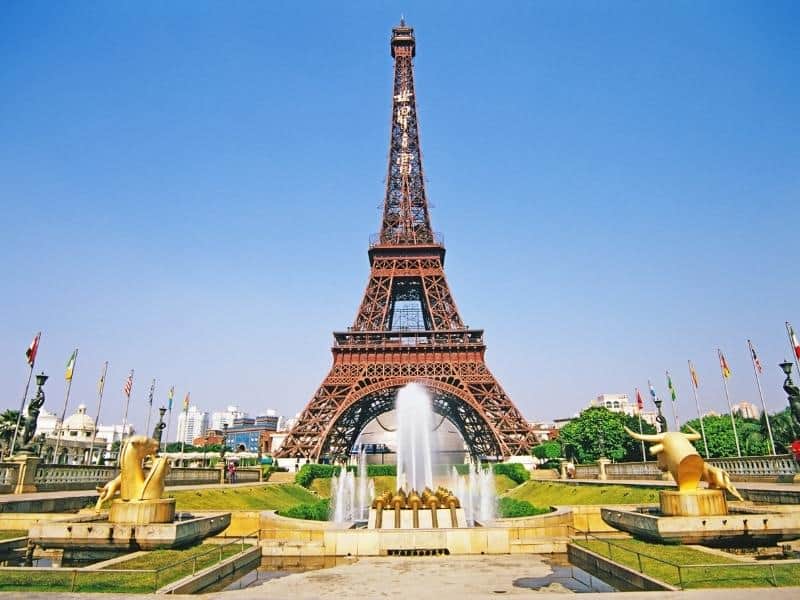
- The Eiffel Tower was constructed between 1887 and 1889 as the entrance arch for the 1889 World’s Fair (Exposition Universelle) in Paris, commemorating the 100th anniversary of the French Revolution.
- Gustave Eiffel’s engineering company built the Eiffel Tower using 18,038 individual iron pieces, held together by approximately 2.5 million rivets, with the iron structure weighing about 10,100 tons.
- Most of the Eiffel Tower’s iron components were prefabricated off-site with extreme precision and then assembled on location, making it one of the earliest large-scale examples of modular construction.
- The tower’s construction required a workforce of 300 workers, and remarkably, only one worker died during the entire construction process – an exceptional safety record for such a massive project in the 1880s.
- Initially intended to be temporary, the Eiffel Tower was supposed to be dismantled after 20 years, but its value as a radio transmission tower saved it from destruction in 1909.
- The tower’s design faced fierce criticism from prominent Parisians during construction, with a petition signed by 300 artists and intellectuals calling it an “iron monstrosity” that would disfigure Paris.
Suggested Read: 50 Fun Facts About Paris: The City of Light Unveiled
Engineering and Architecture

- Standing at 330 meters (1,083 feet) tall including its antenna, the Eiffel Tower was the world’s tallest man-made structure until the Chrysler Building was completed in New York City in 1930.
- The tower’s iron lattice design was revolutionary for its time, using the minimum amount of material while providing maximum structural strength – a principle that influenced modern skyscraper construction.
- The tower’s four legs sit on concrete foundations that extend 15 meters underground, with each leg exerting a pressure of only 4.5 kg per square centimeter – less than a person sitting in a chair.
- The tower sways up to 7 centimeters (2.75 inches) in strong winds and can grow up to 15 centimeters (6 inches) taller in summer due to thermal expansion of the iron structure.
- During extremely cold weather, the tower can shrink by up to 6 inches due to thermal contraction, and ice formation on the structure can add several tons to its weight.
- Lightning strikes the Eiffel Tower approximately 5 times per year, but the structure is equipped with lightning rods and acts as its own lightning conductor, safely directing electrical charges into the ground.
- Radio and television antennas added to the tower’s summit have increased its height several times, with the current antenna system installed in 2010 adding 6 meters to its total height.
Structure and Features
- The tower features three observation levels at heights of 57 meters, 115 meters, and 276 meters, accessible by both elevators and stairs, though visitors can only climb to the second level on foot.
- The tower’s four pillars are named after the cardinal directions (North, South, East, West) and each houses different facilities, including gift shops, exhibition spaces, and the entrance to the elevator systems.
- Gustave Eiffel included a private apartment on the third level of the tower, which he used to entertain distinguished guests like Thomas Edison, and which now houses a recreation of the original furnishings.
- The tower houses several restaurants, including the Michelin-starred Jules Verne restaurant on the second level, where diners can enjoy gourmet French cuisine 115 meters above Paris.
Suggested Read: 25 Facts About The Leaning Tower of Pisa: Tilted Wonder
Maintenance and Operations

- Every seven years, the entire Eiffel Tower is repainted to protect it from rust, requiring 60 tons of paint and taking 18 months to complete with a team of 25 painters.
- At night, the tower is illuminated by 20,000 light bulbs that sparkle for 5 minutes every hour after sunset, consuming approximately 4.6 million kWh of electricity annually.
Historical Events and Wartime
- The Eiffel Tower served as a crucial radio transmission point during World War I, intercepting enemy communications and helping to coordinate the Battle of the Marne in 1914.
- During World War II, French resistance fighters cut the elevator cables, forcing Nazi officers to climb the stairs to reach the top – a symbolic act of defiance that made Hitler’s planned visit to the summit impossible.
- During the 1925 International Exposition of Modern Industrial and Decorative Arts, con artist Victor Lustig “sold” the Eiffel Tower twice to scrap metal dealers, exploiting the tower’s controversial status at the time.
Tourism and Cultural Impact

- The Eiffel Tower receives approximately 7 million visitors annually, making it the most visited paid monument in the world, with over 300 million people having visited since its opening.
- The Eiffel Tower has been featured in over 30 films, from early cinema to modern blockbusters, and has become one of the most recognizable symbols in global popular culture.
- The Eiffel Tower generates approximately €400 million annually for the Paris economy through tourism, entrance fees, restaurant revenue, and souvenir sales, making it one of France’s most valuable cultural assets.
Suggested Read: 35 Intriguing Facts About The Louvre In Paris


